Underwater ecosystems contain numerous secrets, including fragile marine environments and critical infrastructure such as coral reefs, ship hulls, underwater pipelines, dams, tunnels, and bridges. For a long time, inspecting these areas required sending divers into complex and often dangerous conditions.
The Problem of Underwater Inspections
During heavy swells or in emergencies, inspections could be delayed for several days while teams awaited the arrival of divers. It was this problem that prompted two engineers to ask: if robots can transform warehouses, factories, and hospitals, why are people still sent into the most dangerous underwater zones?
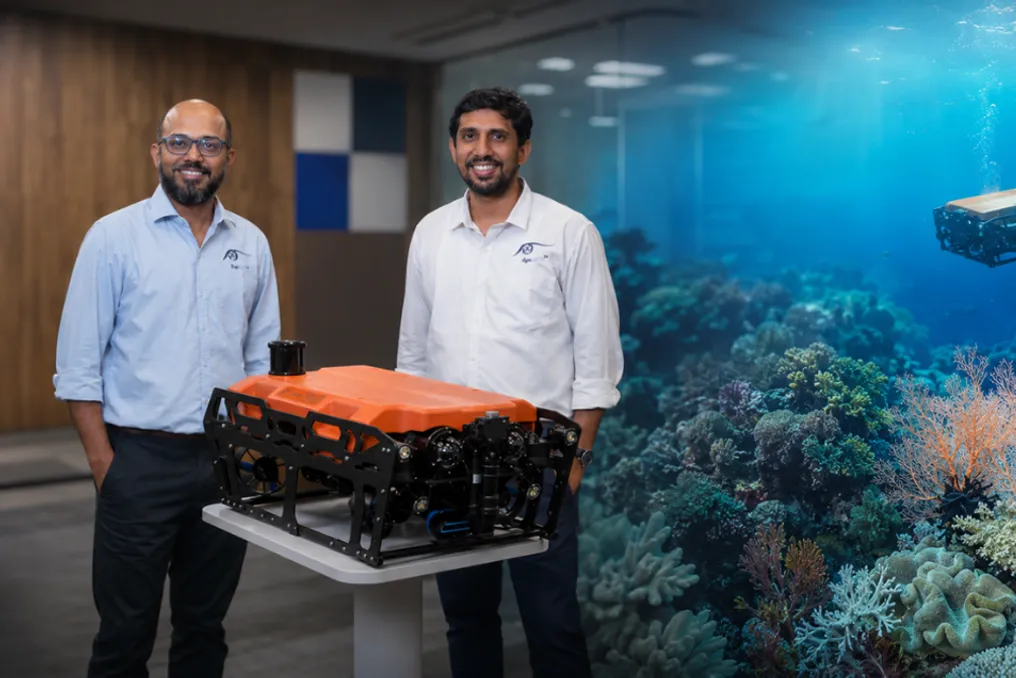
This question led to the creation of EyeROV. The company, founded in 2017 by IIT graduates John T Matai and Kannappa Palaniappan, develops indigenous artificial intelligence-based underwater robots. These systems are designed not only for infrastructure inspection but also to assist scientists in studying marine ecosystems and monitoring coral reefs in the Andaman and Lakshadweep islands.
The Journey to Creating EyeROV
The founders' journey to EyeROV began far from the sea. John and Kannappa were friends since their student days but went different paths. Kannappa studied at the Indian Institute of Technology Madras, while John attended the Indian Institute of Technology Delhi. After earning his master's degree, John joined Samsung Research and Development, but his interest in robotics soon led him to GreyOrange, one of the early Indian robotics startups. His work there showed him that Indian engineers could create globally competitive robotics companies.
Meanwhile, Kannappa encountered a different problem at sea. Working with scientists aboard a vessel, he witnessed the consequences of a ship collision that required urgent underwater hull inspection. However, no diver was immediately available. Even a small delay in the open ocean could turn into a serious operational issue. When the friends reconnected and compared their experiences, they realized that underwater inspection still heavily relied on divers, revealing an obvious gap.
Developing Marine Machines
Today, EyeROV operates from the Maker Village campus in Kerala's Technology Innovation Zone in Kochi, and also has an office in New Delhi. The company has developed a range of marine robotic systems designed for various underwater conditions and tasks. Their compact inspection robot, TUNA, is equipped with HD and 4K cameras and can dive to depths of up to 300 meters.
The larger inspection platform, SAGARA, uses dual 4K cameras with 10x zoom and can move in six directions underwater, allowing it to perform more complex operations. The autonomous surface vessel, Sea Serpent, is designed for coastal surveillance and monitoring. Furthermore, the company has developed TSROV—a robot capable of navigating narrow tunnels and pipelines up to 10 kilometers away, which is useful for infrastructure inspections. Another platform, iBOAT ALPHA, is used for hydrographic mapping and bathymetric surveys. Together, these systems represent an alternative to imported marine robotics technologies, created in India.
Visualizing the Invisible
Underwater inspection is rarely a simple task. Murky rivers, deep reservoirs, and damaged tunnels often reduce visibility to almost zero. This is where the EyeROV AI platform, known as EVAP, comes into play. As soon as the underwater robot enters the water, operators remotely control it via a control station, and video feeds are transmitted to the surface. Then, the AI platform processes these frames to detect defects, create digital models, and form clearer visual reconstructions of underwater structures.
This allows engineers to detect corrosion, cracks, leaks, and structural weaknesses without the need for physical entry into the water. For marine researchers, it also opens up new possibilities. Scientists studying coral reefs in the Andaman and Lakshadweep islands can collect detailed visual data remotely, reducing the need for repeated dives that might disturb sensitive ecosystems. Even in low visibility conditions, enhanced visualization helps researchers monitor the condition of reefs, biodiversity, and environmental conditions more effectively.
Coral Reef Conservation
Coral reefs are among India's most vulnerable marine ecosystems. Rising sea temperatures, pollution, and physical damage continue to put pressure on these habitats. However, monitoring is difficult because many reef systems are located in ecologically sensitive areas where frequent human activity itself can be destructive.
EyeROV's underwater robots offer a less invasive way to observe these ecosystems. The robots capture high-quality video footage and environmental data, minimizing direct human intervention. For scientists, this means a better understanding of reef health, bleaching events, and changes in biodiversity. The company has already supported research on marine biodiversity in both the Andaman and Lakshadweep archipelagos, contributing to ongoing conservation efforts. This is an example of how technology developed for industry can also support environmental protection.
Future Prospects
For coastal communities and industries, safe underwater inspections can reduce delays and increase safety. For scientists, better underwater visibility means higher quality data and a deeper understanding of changing marine ecosystems. For India, it demonstrates the growth of the domestic marine robotics sector, created by Indian engineers. EyeROV's work is changing the approach to underwater inspections, replacing risky human dives in places that may be dangerous, inaccessible, or ecologically sensitive. Thus, these robots help researchers, engineers, and conservationists better understand the world that remains largely hidden beneath the waves.
