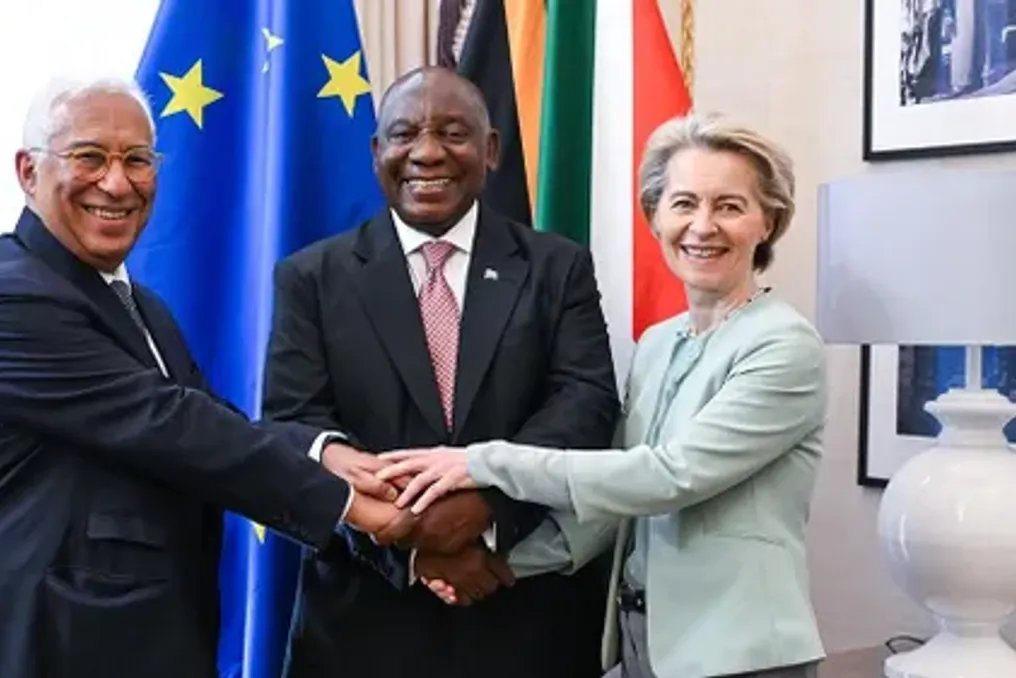
The EU and South Africa began their first intergovernmental dialogue at the level of high-ranking officials on Friday to promote the implementation of the new Clean Trade and Investment Partnership (CTIP).
Goals and Focus of the Negotiations
The main objective of these meetings is to strengthen sustainable and clean supply chains, support local strategic industries, and accelerate investments in green hydrogen and critical raw materials. South Africa is the EU's first partner under CTIP and the largest investor in Sub-Saharan Africa.
Trade volume between the parties reached 45 billion euros (839.7 billion rand) in 2022, with the EU being the leading investor in South Africa, accounting for over 40% of foreign direct investment.
Key Areas of Cooperation
The intergovernmental dialogue will focus on specific business cases and flagship projects within CTIP aimed at realizing mutual trade and investment opportunities. These opportunities include expanding South Africa's electricity grid, renewable energy, sustainable aviation fuel, critical raw materials, and green hydrogen.
Measures to facilitate trade and investment are also being discussed, designed to increase transparency and predictability of the business environment through the exchange of information on recent regulatory processes and providing clarifications for industry. Furthermore, regulatory cooperation in the fields of climate and energy is planned to deepen interaction on standards, approaches, and implementation mechanisms that support the green transition.
Strategic Ambitions and Frameworks
The EU emphasized that the new trade format combines competitiveness and climate action by strengthening mutually beneficial cooperation in the clean economy and working with critical raw materials. Governments play a crucial role in creating a favorable regulatory environment for scaling up these investments.
Ambitions for the future green transition are significant: for instance, South Africa intends to reform its energy sector and build approximately 14,500 km of new power lines over the next decade. CTIP will stimulate investment in clean supply chains and create mutual benefits for the EU and South Africa.
CTIP complements the Economic Partnership Agreement between the EU and the Commonwealth of Southern African States, which provides a solid legal basis for trade in the scope of CTIP, liberalizing trade in environmental goods and providing favorable market access for South African agricultural and industrial products.
History and Tools of CTIP
The first CTIP agreement was signed by the EU and South Africa in November 2025 to promote mutually beneficial trade, investment, and job creation while supporting decarbonization and clean supply chains. In March, the parties held the first business-government dialogue under CTIP, attended by over 150 business representatives.
CTIP is a new policy instrument presented by European Commission President Ursula von der Leyen in 2024. It aims to support the EU's goals for decarbonization and competitiveness as an external tool of the Green Deal. CTIP cooperation tools include measures to improve the business environment for EU companies, mobilizing sustainable finance and green investments through EU development banks and export credit agencies, exchanging information on CTIP-related investments and Global Gateway projects, promoting public procurement in clean sectors, and advancing standards for environmental and social governance and clean technologies.
Statements from Representatives
South Africa's Deputy Minister of Trade, Industry and Competition, Alexandra Abrahamse, stated at the opening of the business-government dialogue that the EU remains one of South Africa's largest trading partners, with total trade increasing by 56% since 2016, and that this mutually beneficial partnership will continue to deepen.
She added that CTIP will expand trade volumes while transforming value chains. This will allow decarbonization to be aligned with industrialization, and investments with local economic development, ensuring that South Africa participates in clean supply chains as an industrial partner, not just as a raw material supplier.