When investing in an irrigation system, it is crucial to pay attention to product quality and suitability, as neglecting this can lead to significant long-term costs. William Smith from Netafim Southern & East Africa recommends prioritizing product durability, operational quality, relevance, and supplier technical support to ensure sustainable productivity and profitability.
Similar stories
Popular
Choosing a Drip Irrigation System
Selecting the correct drip irrigation line is one of the most critical decisions for grape and fruit orchard producers. According to William Smith, Netafim's National Sales Manager in South Africa, successful irrigation begins with a deep understanding of each farm's unique conditions and selecting a line capable of stable operation for many years.
Smith emphasizes that a drip irrigation system is not a universal solution, as every garden and vineyard has different soil characteristics, crop requirements, and field peculiarities that must determine the irrigation design.
Factors When Choosing a System
Before choosing a line, producers must assess several key aspects. These include soil type, crop type, field topography, water quality for irrigation, system hydraulics, installation method, expected system lifespan, and long-term return on investment.
Both surface and subsurface installations have their advantages depending on the production system, and water quality affects filtration requirements and the risk of emitter clogging.
Importance of Dripper Design
The design of the dripper itself plays a significant role in achieving uniform watering. Pressure Compensating (PC) drippers maintain a constant water flow along long rows and uneven terrain, ensuring that every vine or tree receives the necessary amount of moisture.
Smith explains that uniform watering is vital for perennial crops because differences in water and nutrient delivery can directly affect plant growth, fruit quality, and ultimately, yield. Furthermore, drippers with wide flow paths, large internal filtration zones, and self-cleaning mechanisms are more resistant to clogging, which is especially important with low-quality water.
Technical Specifications and Soil
Key technical parameters include dripper flow rate, emitter spacing, wall thickness, operating pressure range, filtration requirements, and internal flow path. These factors determine the efficiency of water delivery to the crop's root zone and influence operating costs, maintenance requirements, and productivity.
The choice of correct flow rate and dripper spacing should be based on agronomic needs. Smith notes that soil type determines how water distributes underground, and the system must create a continuous wetting pattern corresponding to the crop's root zone.
In sandy soils, where water drains quickly, a smaller spacing between emitters at a lower flow rate is usually better. In clay soils, which allow water to spread wider, larger intervals and a higher flow rate are more suitable.
Finding a Reliable Supplier
Choosing the right line also means choosing the right supplier. Smith advises producers to look for proven product performance, published specifications, supplier reputation, and strong technical support. Services such as hydraulic calculations, agronomic consultations, water quality interpretation, soil profile inspection, product training, and after-sales support can significantly enhance the long-term success of irrigation.
He also recommends considering the advantages of local production of drip irrigation lines, as the supplier's ability to produce a product range locally ensures better control over delivery times and greater flexibility in providing required combinations of flow rate and spacing.
Long-Term Investment Planning
Water scarcity, poor water quality, uneven terrain, and changing weather conditions remain serious challenges for grape and orchard producers. Modern drip irrigation technologies help cope with these difficulties through precise delivery of water and nutrients, achieved through advanced dripper and line characteristics.
Smith reminds producers of the need for a long-term approach to decision-making. He concludes that long-term productivity, reliability, and uniformity directly impact yield, maintenance costs, and resource efficiency. For perennial crops, preference should be given to drip irrigation lines and systems that ensure a long service life, stable performance, and savings in water, fertilizer, and energy. Ultimately, a well-designed drip irrigation system is an investment in long-term productivity, sustainability, and profitability.
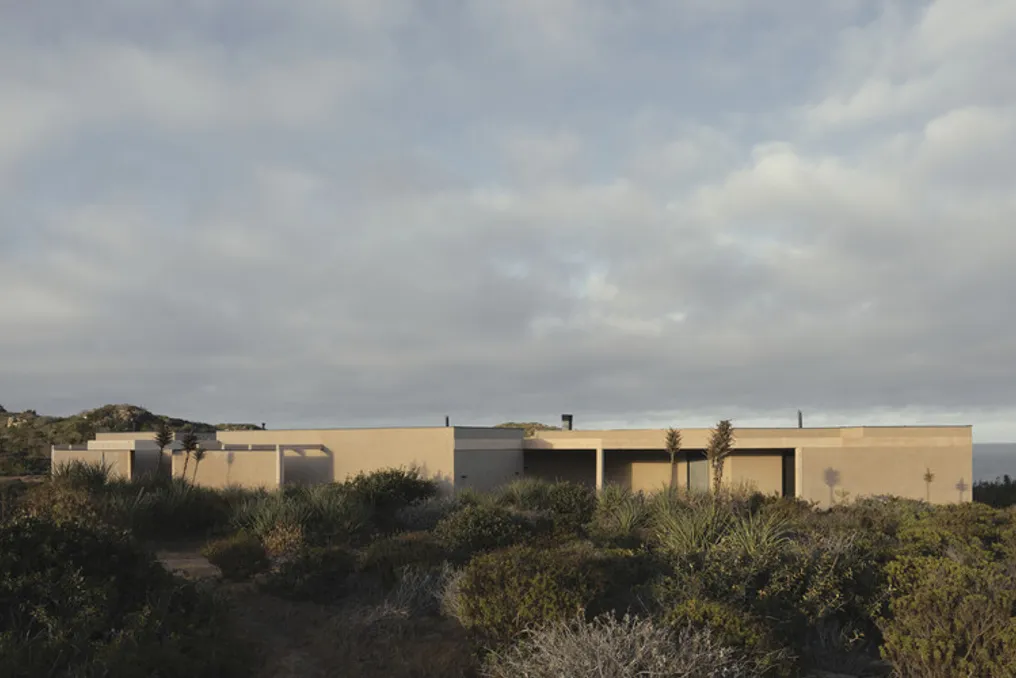
Casa TG was conceived based on the principle of minimal intervention in the territorial environment. This project is located on the coastal strip of Punta Hueso, situated in the Fourth Region of Chile.
Architectural Concept
The property was implemented on a lot characterized by native vegetation and high exposure to climatic conditions. The architectural proposal aims to occupy the space in a way that ensures the preservation of local flora, actively integrating this vegetation into life within the house and making it an essential component of the architectural design.