
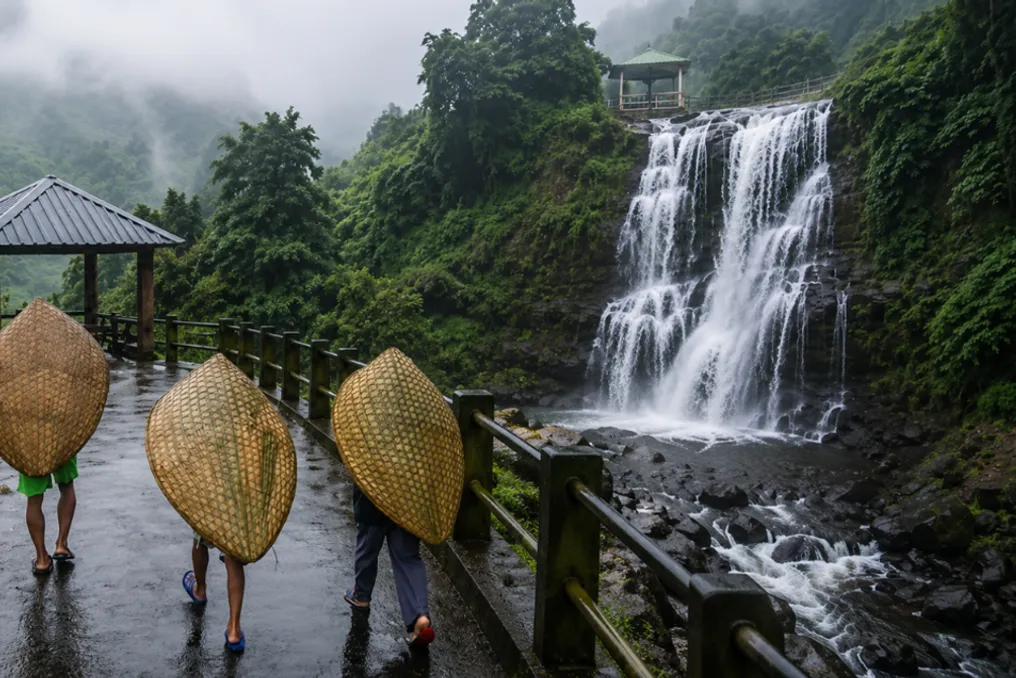
In Mausinram, recognized as the wettest inhabited place on the planet, residents have mastered the art of living in conditions of almost ceaseless rain.
Adapting to Rainy Seasons
When roads become slippery due to moss, and clouds hang so low they obscure the hills, local residents prepare for the inevitable—weeks of continuous downpour. In this location, where an average of 11,872 millimeters of rain falls annually, survival during the monsoon has always been about adaptation, not avoiding the rain.
Innovation: The Protective 'Knup'
One outstanding example of such adaptation is the 'knup.' This item, made from bamboo splints, banana leaves, and local reeds, is a body-length protective shield worn on the back. Shaped like a curved shell, it covers a person from head to below the knees, protecting against heavy downpours while keeping the arms free.
For generations, the residents of Mausinram village have used the 'knup' when gathering firewood, carrying baskets of betel nut, performing farm work, or walking on wet trails.
Construction and Effectiveness
From the outside, people in 'knups' may look like moving roofs passing through the mist. The design is simple but extremely effective. Thin strips of bamboo are bent into ribs and covered with wide banana leaves and other local vegetation to create a waterproof surface. Its inclined shape allows rain to run off quickly, similar to the steep roofs of traditional Khasi houses.
'Knup' is light enough to wear for hours and sturdy enough to withstand several monsoon seasons, solving a simple yet vital problem: how to keep moving when the rain doesn't stop.
Reasons for Record Rainfall
Mausinram is located in the Khasi Hills of Meghalaya state, at an altitude of approximately 1400 meters above sea level, overlooking the plains of Bangladesh. Geography plays a key role in its record rainfall.
Every summer, moist monsoon winds move from the Bay of Bengal across the flat terrain of Bangladesh. Mausinram is one of the first high barriers these winds encounter. When the air is forced to rise along the hills, it cools and condenses, releasing a huge amount of rain in a process known as orographic uplift.
The result is one of the most intense precipitation zones on the planet. Although Cherrapunji nearby long claimed the title of the wettest place in the world, in recent decades, Mausinram has recorded higher average annual rainfall figures.
The scale of this phenomenon is hard to imagine: London receives about 600 millimeters of rain per year, and Seattle receives approximately 950 millimeters. Mausinram can exceed both of these figures in just one monsoon month.
Rain's Influence on Culture
Rain has influenced much more than just meteorological records. It has shaped methods of housing construction, path laying, and even bridge building.
Traditional Khasi houses often feature steep sloping roofs that promote rapid water runoff. Stone paths wind through the forests because exposed soil is easily washed away by constant rain. Furthermore, there are the famous living root bridges of Meghalaya.
For generations, Khasi and Jaintia communities have guided the aerial roots of rubber fig trees across rivers and ravines, gradually weaving them into natural bridges. Unlike wooden structures, which can rot, or metal bridges, which require maintenance, these living bridges thrive in the region's humid climate and become stronger over time. They serve as a prime example of how local communities have transformed deep ecological knowledge into practical infrastructure.
Lessons Learned from Nature
To many visitors, Mausinram is known only for one feature: it is the wettest inhabited place on Earth. However, for the people who call it home, rain is simply part of daily life.
'Knup,' living root bridges, and stone paths were not invented in laboratories or designed by distant engineers. They emerged from generations of observation, experience, and adaptation. In Mausinram, rain does not stop life; on the contrary, it has taught people how to build, travel, and thrive in one of the planet's most challenging climatic conditions.