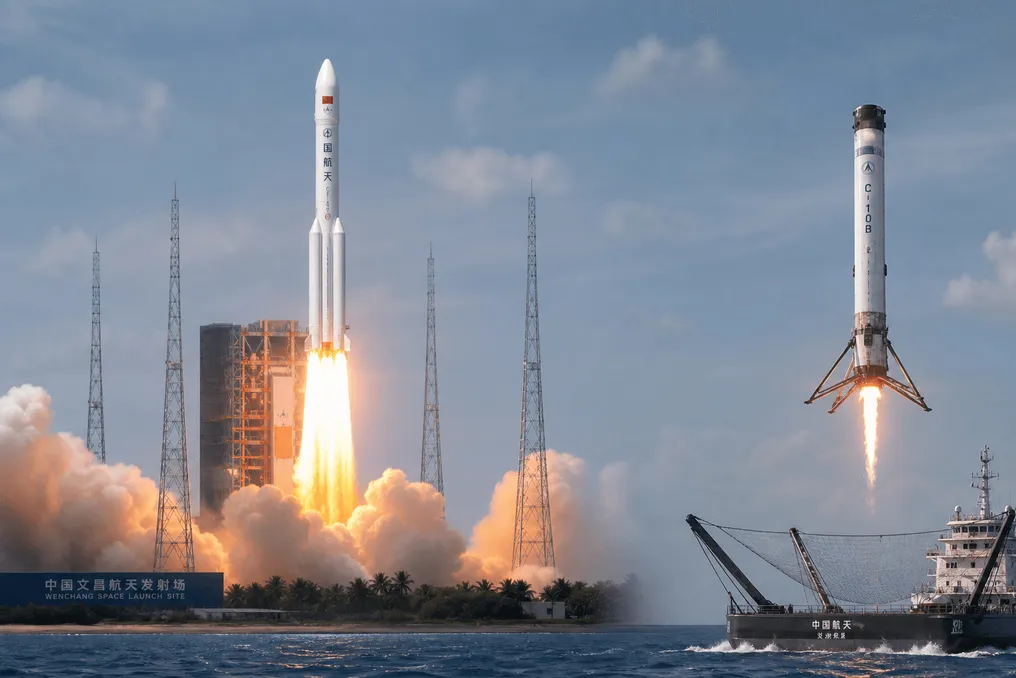
The Long March 10B rocket successfully launched during its maiden flight and demonstrated China's capability to perform the country's first marine recovery of a first-stage booster, thereby joining the club of reusable rockets.
The Long March 10B rocket successfully launched during its maiden flight and demonstrated China's capability to perform the country's first marine recovery of a first-stage booster, thereby joining the club of reusable rockets.
The launch of the Long March 10B CZ-10B Y1 took place on July 10 at 12:14 Beijing time from the Wenchang Commercial Space Launch Site Pad 2. This flight marked the first successful instance of marine recovery of a rocket booster in China.
Approximately eight minutes after liftoff, the first stage of the rocket descended vertically onto the recovery vessel Navigator in the South China Sea, located 431 kilometers southeast of the launch site. During this process, grappling manipulators cleanly engaged the tension cable system.
The Long March 10B is a commercial modification of the CZ-10A. It retains the five-meter main body and seven YF-100K engines, which operate on liquid oxygen and kerosene, providing a thrust of 850 tons at liftoff. Unlike the CZ-10A version designed for crewed flights, the 10B model eliminates redundant life support systems and replaces the upper stage engine with a liquid methane engine to achieve a higher specific impulse and cleaner combustion. In reusable mode, the rocket is capable of delivering 16 tons to low Earth orbit.
Instead of landing legs used by the Falcon 9 rocket, the CZ-10B employs a net capture system. The booster descends using netting fins and retro-thrusters toward the Navigator vessel. This vessel measures 144 meters long and 50 meters wide, equipped with a DP2 dynamic positioning system that allows it to maintain position within 0.5 meters even with 4-meter waves. The vessel's tension cable system uses mobile wagons with six-degrees-of-freedom motion compensation algorithms for precise synchronization with the descending booster. This approach avoids the additional mass associated with landing legs, contributing to increased payload capacity and achieving the target of 10 or more booster reuses with a 72-hour turnaround time.
This success makes China the second country, after the United States, to demonstrate operational high-precision marine rocket recovery. Previously, Chinese attempts using LandSpace Zhuque-3 and CZ-12A in December 2025 resulted in controlled submergence but not recovery. The CZ-10B first stage will subsequently be used as side boosters for the heavy-lift CZ-10 configuration, designed to deliver over 70 tons to LEO, supporting China's crewed lunar landing before 2030 using the Mengzhou spacecraft and the Lanyue lunar module.
The CZ-10B, unofficially named Tianma, is intended for deploying China's satellite internet constellation and lays the foundation for fully reusable launch vehicles. The development team achieved this milestone through iterative improvements to the YF-100K engine using pump-after-swing technology, which ensures deep throttling and precise attitude control. Previously, the CZ-10A underwent a controlled soft splashdown test in February 2026.