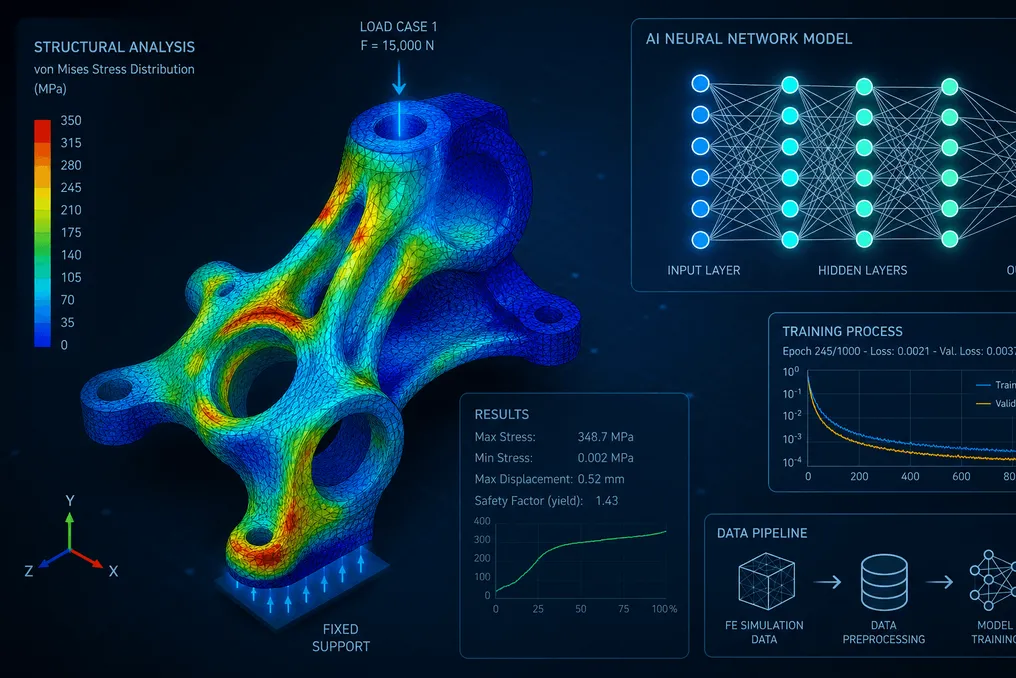
Jiying Technology has released Jiying 2.0-s, a fundamental physics model for solid mechanics that demonstrates zero-shot generalization capabilities.
Jiying Technology has released Jiying 2.0-s, a fundamental physics model for solid mechanics that demonstrates zero-shot generalization capabilities.
This model allows for the generation of physical field results with accuracy close to numerical methods for geometries, materials, and boundary conditions that were never encountered during training. This eliminates the need for retraining when new tasks arise.
The breakthrough resolves a fundamental limitation of traditional surrogate models, which could only interpolate within their training distribution but failed with inputs outside this distribution. Jiying 2.0-s underwent rigorous testing across three independent domains: geometry, boundary conditions, and material parameters, using test datasets not utilized in the training process.
The model maintained high accuracy even when all three axes simultaneously went beyond the training distribution, which corresponds to the scenario most typical of real-world engineering applications. Jiying chose solid mechanics (three-dimensional linear elasticity) as the first physical domain because it represents the most widely applicable engineering need.
Since the analysis of stress, strain, and stiffness is required for almost all load-bearing structural components—from automotive bodies and brackets to semiconductor substrates and medical implants—the model was trained on extensive engineering simulation data combined with complex three-dimensional geometric data. It directly generates highly accurate continuous physical field outputs based on input data regarding geometry and operating conditions.
The company overcame four major technical hurdles for fundamental physics models: multi-scale geometric encoding capable of representing arbitrarily complex three-dimensional shapes; perception of boundaries and interactions, including friction and contact; constitutive generalization through data-driven and physics-constrained approaches, enabling few-shot learning across different materials; and ensuring physical accuracy for stable, long-term, non-dissipative results.
Jiying 2.0-s is the first output from a reproducible methodology pipeline developed by the company for creating new physical fields. The system is named to reflect this: the letter 's' denotes solid mechanics. Future versions will include 'f' for hydrodynamics, 't' for thermodynamics, and so on, aiming for a unified fundamental physics model covering all physical domains within a single architecture.
The company was founded by three candidates of sciences with experience in AI and physical modeling, spanning robotics, semiconductors, and medical devices. Their plan involves achieving full generalization across core physical domains by 2027 and creating a universal fundamental physics model by 2028, positioning physical AI as a foundational layer for digital twins, complex system prediction, and embodied intelligence with reliable physical constraints.