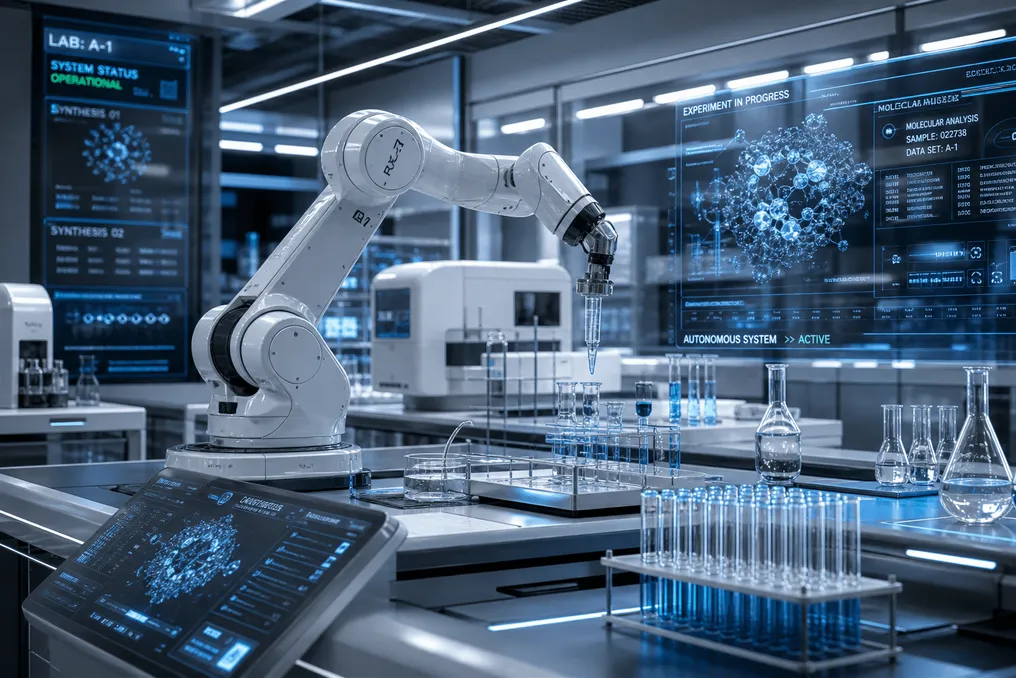
Artificial intelligence laboratories in Beijing are implementing autonomous robotic scientists capable of independently designing experiments, collecting data, and discovering new materials, marking a paradigm shift in scientific research.
Artificial intelligence laboratories in Beijing are implementing autonomous robotic scientists capable of independently designing experiments, collecting data, and discovering new materials, marking a paradigm shift in scientific research.
In the AI for Science laboratories in Beijing, AI and robotic manipulators function as self-sufficient scientists. A journalist from Beijing News visited such an institution and observed a robotic arm preparing conductive liquid, completing each bottle in 20–30 seconds thanks to smooth, standardized movements that eliminate human errors from manual labor.
The autonomous laboratory is built around sealed experimental stations equipped with robotic arms that work with high precision on pipettes, reagents, and samples. The system operates on three levels: firstly, AI independently discovers fundamental scientific laws by conducting experiments; secondly, it creates new materials by generating quality data for training models that produce new knowledge; and thirdly, end-to-end reverse engineering is performed, where results are directly verified in practical applications.
At the Institute of Automation of the Chinese Academy of Sciences, researchers developed the Panshi scientific model. Instead of creating a universal large language model (LLM) like Doubao or Qwen, the team chose a two-stage approach. The first version (1.0) fine-tunes open models on scientific literature and data. The second version (2.0), currently under development, is trained from scratch, integrating text with various scientific modalities, including wave spectra, spectrograms, electromagnetic fields, and molecular structures, into a unified token system. The Panshi model has been adapted across eight scientific disciplines.
The key difference between scientific AI (AI4S) and consumer AI is that scientific AI must interact with the physical world to gain new knowledge. As one head of the research group explained, while systems like DeepSeek and ChatGPT analyze existing internet data, AI4S systems must conduct real experiments to generate additional data that advances human knowledge. This requires integrating AI with laboratory equipment, sensors, and robotic devices in a closed loop encompassing hypothesis, experiment, data collection, and optimization.
Beijing possesses structural advantages in this race. The city is a hub for China's leading research institutions, such as CAS, Tsinghua, and Peking University, and also hosts the country's largest scientific facilities. The Huairou Science Cluster generates enormous volumes of high-quality data for AI training, with the Peking Electron-Positron Collider producing 1 terabyte of data per second. In June 2026, Beijing unveiled its AI for Science implementation plan, which covers six priority areas and aims to establish a globally influential AI-based science innovation center by 2028.