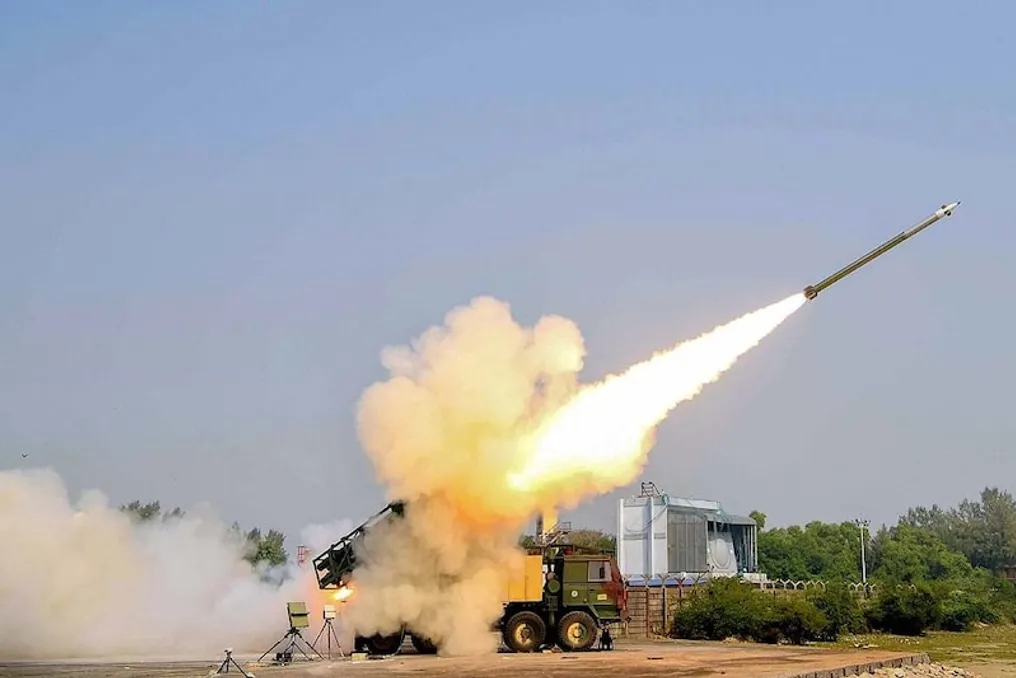
The Pinaka multi-barrel rocket launcher system, which enhances the combat power of the Indian army's artillery, has been modernized and become significantly more formidable. The new Long Range Guided Rocket (LRGR) Mark-3 is capable of striking targets at a distance approximately double that of the old Pinaka Mark-2 rocket, achieving strike accuracy.
Reasons for increased range
The increase in LRGR range compared to Mark-2 is due to several factors: the use of improved fuel, optimized design, and effective application of the navigation package. The older, unguided rockets had limited fuel energy and moved straight without correction, which negatively affected both range and accuracy.
Technical specifications and logistics
LRGR uses high-energy solid fuel, which provides sustained and long thrust. The rocket body is designed longer and possesses better aerodynamics, which reduces air resistance and allows the rocket to fly further. Furthermore, the rocket is launched from the same 214-mm or corresponding tube as the old Pinaka systems, simplifying logistics and eliminating the need for major changes to the launcher itself.
Thanks to the higher energy fuel and better weight balance, the rocket ascends to a greater altitude and covers longer distances. During tests, it achieved a range of up to 120 km and demonstrated accurate hits even at the minimum range of 60 km.
Guidance and control system
The main difference between LRGR and Mark-2 lies in its navigation, aiming, and control package. It is a combination of an Inertial Navigation System (INS) and satellite navigation (GPS or Indian NAVIC). After launch, the rocket independently controls its path and makes mid-flight corrections when encountering wind gusts or minor errors.
Terminal phase corrections are applied for precise target impact, significantly reducing the CEP (Circular Error Probable). If unguided rockets could have an error of hundreds of meters, the guided version can hit high-value battlefield targets such as command posts, ammunition depots, or troop concentrations with high accuracy.
Maneuvering during flight
During long-range flight, various factors can influence the trajectory, including wind, Earth's rotation, and minor mathematical errors, which can cause the rocket to deviate from the target. Therefore, LRGR is equipped with aerodynamic control fins or canards. These movable control surfaces are located on the nose or body of the rocket and change angle based on computer signals.
This allows the rocket to control pitch, yaw, and roll. The flight computer continuously calculates data based on INS/GPS and adjusts the fins. The result is planned maneuvers in flight, trajectory correction, and hitting the target with the highest precision. Canards or foreplanes offer fast response, especially at high speeds, and combined with rear stabilizing fins, they make the rocket stable and maneuverable, maintaining accuracy throughout the entire long flight.
Flexibility and production capabilities
A key advantage of LRGR is that it can be launched from the existing Pinaka system (mounted on a Tatra truck). The army does not need to acquire new launchers or undergo additional training. One launcher can fire Mark-1, Mark-2, ER, and now LRGR-120 rockets, increasing battlefield flexibility and saving costs.
DRDO developed this system for 'shoot and scoot' scenarios, as the launcher can immediately relocate after firing to avoid enemy counterfire. The ability of LRGR to fire 12 rockets in 44 seconds can change the course of battle. The 120 km range LRGR is capable of attacking deep enemy areas without using aircraft or expensive missiles.
DRDO claims that this system will cost less than Israel's fighter system (approximately 40% less), allowing for mass production scaling. Companies such as Munitions India Limited and Solar Group are increasing production. Future variants may include Pinaka Mk-IV (300 km). However, there are also issues that need to be addressed: protection against electronic jamming, production scaling, strengthening targeting capabilities (drones and satellites), and warhead options.