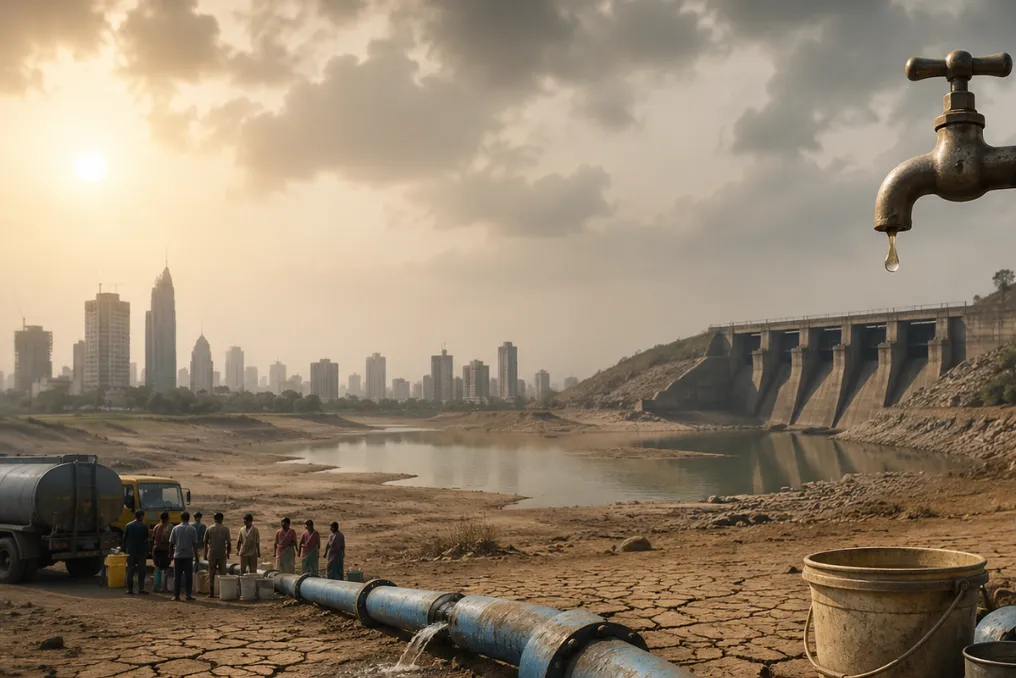
Millions of Indians this summer have learned a special kind of mathematics: how many buckets can be filled before the water pressure from the tap drops, or on which day of the week water actually arrives. This situation has ceased to be an emergency measure and has become routine.
State of Water Reservoirs in India
According to the weekly bulletin of the Central Water Committee dated July 2, the main reservoirs in India are filled to only 26 percent of their designed capacity. The total water level in 166 major reservoirs across the country is just over 47.7 billion cubic meters against a total designed capacity of 183.5 billion cubic meters. On paper, this is only 1.4 percent below the ten-year average for this time of year, but it represents a much sharper decline compared to the level twelve months ago, as current reserves are barely 61 percent of last year's level.
Thirteen states are currently operating below their ten-year norms, and the deficit is unevenly distributed. West Bengal's reservoirs lag by approximately 62 percent from the norm, while Mizoram lags by 54 percent. Karnataka faces a 46 percent deficit, along with other southern states—Kerala, Tamil Nadu, and Telangana—which are 16–46 percent below the norm. These figures are not insignificant; they force state governments to begin rationing even before the peak of summer.
The monsoons were supposed to solve this problem. Although heavy rains have already caused floods in some parts of the country, the geography of precipitation has been heterogeneous. Many catchment areas feeding the most affected reservoirs have not received sufficient rainfall, explaining the persistence of low reserve levels despite the start of the season elsewhere.
Consequences and Plans
The consequences are already visible on the ground. As of July 2, about 41 percent of the country was experiencing some level of drought, according to the India Drought Monitor. The Union Ministry of Agriculture has prepared contingency plans for 12 states that it considers severely affected.
Delhi's Water Issues: Schedule Instead of Tap
Delhi's water supply problem is less about a shortage of sources and more about supplies failing to keep pace with the growing city. In some areas of Delhi, access to running water depends on a schedule rather than the presence of a tap. Residents in several colonies are still waiting for tankers instead of turning on the tap, and in unauthorized settlements around the city, piped water supply has recently begun reaching some streets.
Even where pipes exist, the pressure and water delivery times vary so much that filling a reservoir remains a daily task, not a formality. The agency responsible for replenishing this deficit is the Delhi Water Board, which manages the search, purification, and distribution of the capital's drinking water, including large-scale supplies to NDMC and Cantonment Board. Delhi receives raw water from four sources: the Ganges and Yamuna river basins, the Indus basin via the Bhakra-Beas Management Board, and groundwater pumped through Ranney and Tubewell wells.
These sources collectively produce about 900 million gallons per day, which is close to the system's maximum capacity, supplying approximately 93 percent of the city through the existing network. This figure seems high until it is compared with Delhi's population, which was projected to reach nearly 25 million by 2021 and could approach 32 million by 2030. This growth constantly reduces the amount of water per capita, even if the total supply volume remains roughly constant. Furthermore, Delhi's raw water allocation is fixed by an interstate agreement, specifically the 1994 Yamuna Water Sharing Pact with Himachal Pradesh, Haryana, Uttar Pradesh, and Punjab, which limits the volume of river water the city can draw, regardless of demand.
Decades ago, the construction of three upstream dams—in Renuke, Kishau, and Lakhwar-Vyasi—was proposed to store floodwaters specifically for such deficits, but the construction of two of them never started. Although canal modernization in Munaka, by court order, helped restore water lost due to filtration, and new treatment plants appeared in Bavana, Okhla, and Dwarka, the city is essentially operating near its limit, expanding supplies to new colonies mainly by redistributing existing resources rather than through significant increases.
Mumbai's Water Math: Far Sourcing, Close Losses
Mumbai's water supply problem is not about the distance to the sources, as the city has been seeking them for over 150 years. The problem lies in what happens between the source and the tap. Mumbai currently consumes about 4,000 million liters per day, according to BMC, drawn from seven lakes located along 650 km of power lines and 6,000 km of city mains. Even at this scale, supplies do not cover demand, resulting in a deficit of almost 565 million liters per day. However, the loss rate is more telling than the deficit: non-commercial water, which is pumped and treated but never billed, has exceeded 30 percent, up from 20 percent in 2009. A significant amount of treated water is lost daily due to leaks and illegal connections, which is a more serious depletion than the actual gap between supply and demand.
The city's relationship with distant water sources dates back to 1860, when the Vihar scheme on the Mithi River began, which was then 20 km from the city, supplying about 32 million liters per day to a population of 0.7 million. The deficit by 1885 forced Mumbai to move further upstream to Tulsi Lake, and then to Powai. In 1948, expansion followed to the Vaihtarna River, located 175 km from the city. Each such expansion bought time rather than solving the core problem, and this model has not changed: the BMC Environmental Status Report for 2024–25 forecasts that the gap between supply and demand will increase to 6,424 million liters per day by 2041, and projects are now planned for desalination and advanced tertiary treatment to address it.
Meanwhile, this gap is being filled unofficially. Tankers draw water from wells across the city. Approximately 40 percent of Mumbai's population lives in slums without any piped connection, relying entirely on groundwater, and closed settlements, construction sites, and commercial centers are increasingly doing the same. Rapid urbanization, expanding by almost 4 percent annually, has silted up catchment basins and wetlands that previously replenished groundwater, making the city simultaneously more vulnerable to flooding, saltwater intrusion, and summer shortages. Rainwater harvesting from roofs has been mandatory for larger buildings since 2002, and in 2007, it was extended to buildings over 300 sq. m, but this remains a temporary measure in a system still built around water brought from afar.
Bangalore's Fight for Water
Bangalore's water supply problem is dictated by geography opposing growth, as the city is situated on a plateau through which no major river flows, making it entirely dependent on water pumped up from a great distance. For a long time, the city did not need to source water far away. Until the end of the nineteenth century, the city functioned on a network of lakes, ponds, open wells, and traditional 'Kalyani' systems, including Dharmambudhi, Sampangi, Ulsur, and Sankey ponds. As Bangalore grew, these local sources became insufficient.
The Arkavati water supply system, built in 1896 around the Hesaraghatta reservoir, provided the city with its first filtered piped water supply. Then, in 1933, the Tippagondanahalli reservoir appeared, adding capacity from the same Arkavati river system. However, the reliability of the Arkavati basin did not hold: recurring monsoon failures and reduced inflows meant that by the late 1980s, it could no longer meet the city's needs.
This deficit pushed Bangalore toward the Kaveri River, located about 100 km away and nearly 300 meters lower in elevation, from where water must now be pumped uphill in stages before reaching any tap. The Kaveri scheme has been expanded incrementally to match the city's growth, and today it provides most of Bangalore's water supply via pipelines, while groundwater supplements the rest. It is in this combination that the tension manifests. Water demand in Bangalore continues to grow faster than both primary sources can comfortably handle. Summer exacerbates the problem: groundwater levels drop sharply at the peak of demand, putting pressure on both the Kaveri pipeline and the local aquifers from which residents and developers still draw water. Rainfall unpredictability and climate variability add uncertainty to a system that is already thinly provisioned. Unlike Delhi's fixed allocation problem or Mumbai's leakage issue, Bangalore's problem is more structural: a rapidly growing city is trying to meet rising demand using sources that were not originally designed for such a scale of urbanization, and a landscape that makes every liter of that water expensive to transport.
There is also a structural gap regarding who is connected to the official system at all. Dr. N Manjula, IAS, Chairman of the Bangalore Water Supply and Sewerage Board, notes: 'Another major problem is that many areas, especially on the outskirts of the city, still rely on private wells and tankers instead of receiving official BWSSB connections. During periods of water scarcity, these sources become unreliable, leading to sudden spikes in demand on the public water supply system.'
The solution being discussed is not finding one new source, but changing the relationship with those the city already has. Dr. N Manjula states: 'Our vision is to transform Bangalore from a city primarily dependent on freshwater into a world-renowned, water-secure city where the Kaveri water, treated sewage, groundwater, rainwater harvesting, smart technologies, and citizen participation work together as a single integrated urban water management system. This is the only sustainable path to ensuring Bangalore's water future for the next generation.'
Kolkata: Long Supply Chain
Kolkata's water supply problem is not a lack of a source—the Hooghly River flows directly through the city. The problem lies in the purification system, which is outdated and has undergone several modernizations. The city has been drawing drinking water from the Hooghly since the 1860s, which was purified at a facility known as Indira Gandhi Water Treatment Plant, formerly called Palta. Palta, covering 480 acres, was built between 1864 and 1870 as Kolkata's first water intake point, initially having a modest capacity of 6 million gallons per day. The filtration principle has barely changed since then: water was first settled in reservoirs and then passed through slow sand filters, a process that was expanded incrementally: 24 additional filter beds were added between 1888 and 1893, another set in 1905, and yet another round between 1920 and 1936.
It is remarkable how well the old system has held up. Slow sand filtration does not require daily maintenance; one bed can operate for 100–120 days before requiring cleaning, as a biological layer forms on the surface of the sand, performing most of the work by self-filtering turbidity, color, and microorganisms. Fast gravity filters were later added in 1952 and again in 1968 to speed up part of the process, but the old beds are still in use.
By the early 2000s, Kolkata faced a deficit of nearly 50 million gallons per day, prompting KMC to embark on a new phase of expansion at Palta and Garden Reach. This expansion continues far beyond the initially set deadlines. The Indira Gandhi Water Treatment Plant in Barrackpore now has a generating capacity of 1,180 million liters per day, alongside smaller plants in Vatuganga, Jorabagan, and Jai Hind, plus 839.4 million liters per day from Garden Reach and about 110 million liters per day drawn from deep tubewells. The more serious problem is not the generating capacity, but what happens after the water leaves the plant. KMC currently supplies an average