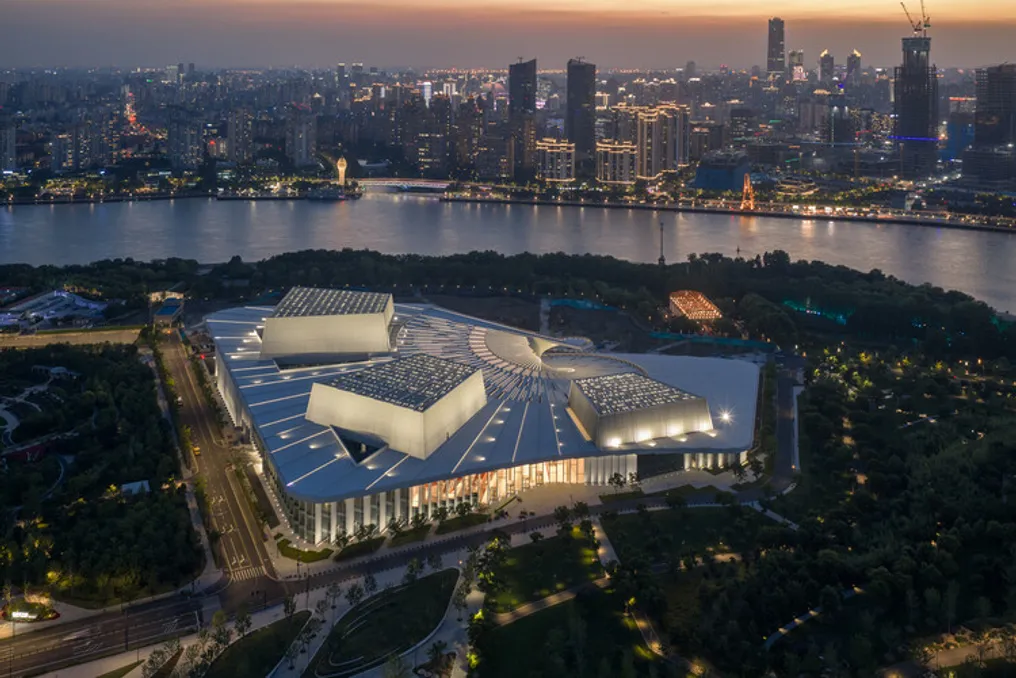
This week, global attention was focused on cultural architecture as landmark buildings of major institutions reached significant stages in construction and design. Among the main events are the completion of work on the Shanghai Opera House, the announcement of new museum projects following international competitions, and the presentation of architectural concepts for major biennials.
Landmark Projects and Discoveries
In China, the spiral Shanghai Grand Opera project by the Snøhetta bureau is approaching its final stage of construction, with a focus on interior finishing. This opera is envisioned as the foundation for a new master plan for Shanghai's development, and its opening is scheduled for October 2026. In another part of the world, France, a new arts center named 'Large' will open in October, situated in a building designed by RCR Arquitectes on Île Seguin—a former industrial site previously owned by Renault.
Furthermore, construction has begun on Dar al Funoon Abu Dhabi in the United Arab Emirates, a new performing arts cultural venue designed by Frank Gehry. As part of broader news, two competitions were announced for new museum spaces, reflecting contemporary institutional values.
Architectural Competitions and Exhibitions
Studio Campo Baeza from Madrid, in collaboration with the Maoda bureau from Quito, won an international competition to design the National Museum of Ecuador (MUNA). The preliminary design references pre-Columbian Andean architecture through a compact vertical volume shaped by light and shadow. Another competition, held in Turin, Italy, attracted MVRDV and Balance Architettura for the restoration and renovation of the Museum of Modern and Contemporary Art (GAM), adapting it to modern exhibition methods.
Architecture is increasingly viewed as a platform for global dialogue. The Sharjah Architecture Triennial, a major event in 2026, presented the list of participants for its next session, which will take place in November under the theme 'Architecture Otherwise: Building Civic Infrastructure for Collective Futures'. Meanwhile, proposals for national pavilions are beginning to arrive for the Venice Architecture Biennale 2027. Austria has offered to temporarily provide its Joseph Hoffmann Pavilion in the Giardini Bosnia and Herzegovina as part of a cooperative concession, raising issues of national representation and architectural exchange.
Urban Development and Infrastructure
Foster + Partners, in collaboration with Samsung C&T, has been selected to develop a residential district in the Apkujeong area of Seoul. This district, one of Seoul's most sought-after coastal plots, will receive a plan that includes eight residential towers situated above a multi-functional podium featuring leisure and commercial zones, as well as a new distinctive public park. The project aims to connect Dosan-daero Avenue in the Gangnam area directly to the Han River bank via a new park area, integrating the development into Seoul's existing urban network. Residential units will feature three facades for lighting and ventilation, along with spacious terraces overlooking the Han River. Public interaction zones are planned in the center of the district to accommodate both long-term and new residents, aligning with the Seoul 2030 urban redevelopment plan.
In Cardiff, Wales, Moxon Architects and Arcadis have received approval to build a 165-meter pedestrian and cycle bridge across the River Taff. The bridge is part of a wider regeneration plan for Channel View Estate. The 6-meter wide crossing will connect two coastal areas—Grangetown and Baytown—with two green spaces, The Marl and Hamadryad Park. It will provide access to up to 360 new homes along the west bank of the river, improving connectivity to the city center and the revitalized Cardiff port area. The bridge features a main 60-meter 'S'-shaped span, providing the necessary clearance for navigation and softening the slope towards the eastern park.
In Bengaluru, South India, the Art and Photography Foundation has announced plans to expand the Museum of Art and Photography (MAP). The expansion will be implemented on adjacent land and curated by Indian architect Rahul Mehrotra, founder of RMA Architects. The new complex will add an expanded conservation laboratory, additional exhibition halls, children's facilities, and the museum's first workshop. MAP houses a collection of over 60,000 works of South Asian visual art. In addition to the Bengaluru expansion, the Foundation announced the creation of a 240-acre sculpture park in the Nilgiri Hills, Tamil Nadu, within the UNESCO Biosphere Reserve. This park is also under Mehrotra's guidance, and the master plan was developed by the Mumbai-based firm Opolis Architects.