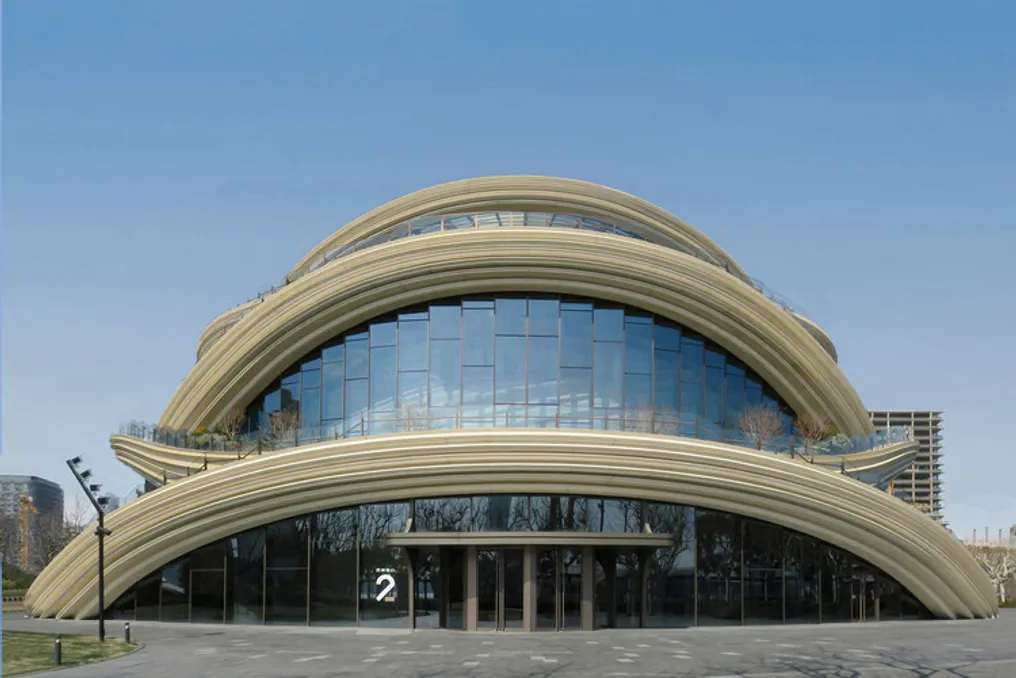
Photographer Paul Clemence created a visual record of the West Bund Orbit, a public exhibition pavilion developed by Heatherwick Studio, located in the West Bund area of Shanghai. His series of photographs investigates the constantly transforming architectural identity of this development.
Location and Project Concept
Situated in the Xuhui District, along the Huangpu River, the building was designed to serve as a cultural landmark within the region's burgeoning financial hub while expanding the network of public spaces characterizing the revitalized waterfront. Clemence's images are not limited to the building as an isolated element; they analyze the interaction between architecture, pedestrian flow, and landscape, showing how the interconnected pathways and layered structure of the project converse with both the waterfront and the surrounding city.
Design and Accessibility
The West Bund Orbit occupies a prominent site next to the West Bund linear park and was conceived to be accessible from all sides, encouraging visitors to traverse the interior and exterior of the structure. This design reflects Heatherwick Studio's intention to create a civic landmark that transcends its exhibition function, stimulating daily engagement with the architecture itself. Additionally, the project is positioned on a lot directly opposite the United Kingdom Pavilion, also known as the Seed Cathedral, which the firm designed for the 2010 Shanghai World Expo.
Distinctive Architectural Elements
The structure is marked by a series of ribbon-like components that wrap around the central exhibition core, forming an integrated system of walkways, bridges, terraces, and stairs. These circulation routes extend to a rooftop garden overlooking the Huangpu River, transforming the building's exterior into a succession of usable public spaces rather than a mere facade. Heatherwick Studio describes the project's inspiration as the traditional Chinese moon bridge, reinterpreting its curved geometry into a modern architectural language that evokes continuous movement. In Clemence's photos, these overlapping ribbons emerge as the main theme, whose dynamic geometry generates distinct spatial relationships depending on the viewing angles along the waterfront.
Internal and External Dialogue
At the heart of the composition is the main exhibition pavilion, around which the rest of the program is organized. Large glazed openings pierce the facade, allowing glimpses of the exhibition spaces and creating visual connections between internal activity and the surrounding public environment. A secondary gallery encircles the main hall, further intensifying this dialogue between inside and outside and contributing to the building's openness toward the adjacent promenade.
Clemence's Photographic Work
The West Bund Orbit adds to Paul Clemence's growing portfolio, which documents significant contemporary architectural projects across various urban and environmental settings. His recent works include pieces such as the International Gateway Centre by Zaha Hadid Architects in Hong Kong, the Pantanal Biopark by Ruy Ohtake in Campo Grande, and the Academy Museum of Motion Pictures in Los Angeles, which was renovated by Gensler and Renzo Piano Building Workshop. In these projects, Clemence's photography focuses on the connection between architecture, landscape, infrastructure, and public life, using the camera to analyze how buildings are experienced within their broader context.