Thirty years after its inception, the UIA World Congress of Architects returned to Barcelona, coinciding with the centenary of Antoni Gaudí's death. This conjunction of history and present lends a special significance to this edition of the congress.
Theme and Scope of the Global Event
Organized by the International Union of Architects (UIA) every three years, this year's event addressed the theme 'Becoming: Architectures for a Planet in Transition.' It gathered architects, academics, and representatives from over 130 countries and regions to discuss crucial global issues, including climate crisis, housing, material circularity, public space, and technological advancements. The way architecture responds to ecological, social, cultural, and technological changes became the focal point of the meeting.
China Pavilion and Curation
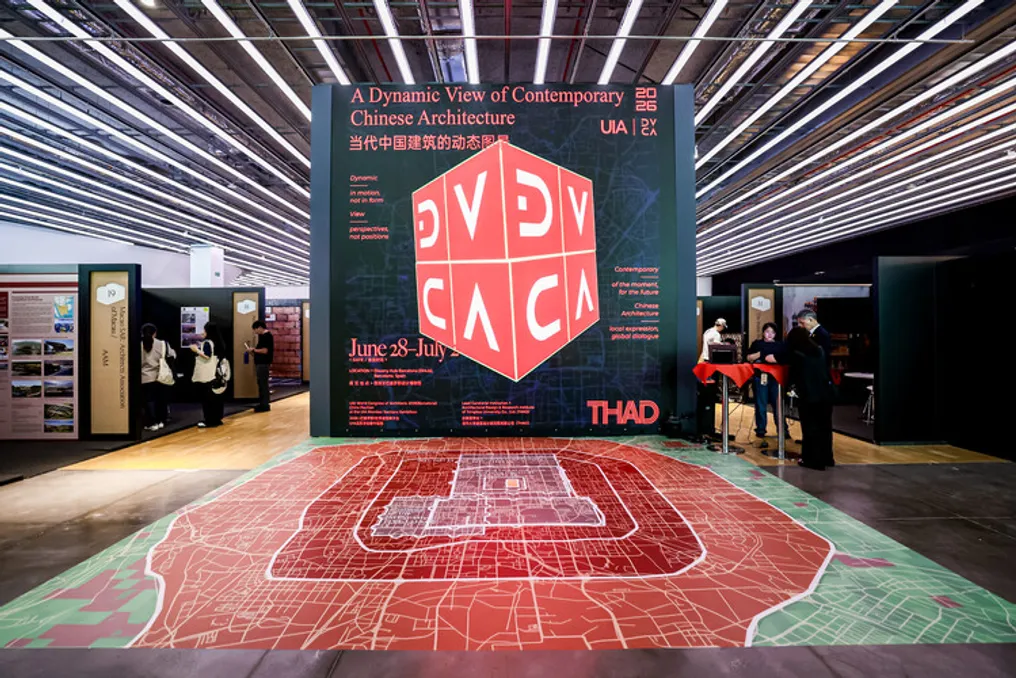
In this international setting, the China Pavilion, presented at the UIA Member Sections Exhibition 2026, had its general curation led by the Institute of Design and Architectural Research of Tsinghua University (THAD). After three years of preparation, and under the title 'DVCA — Dynamic Panorama of Contemporary Chinese Architecture,' the curation involved a committee of over 130 specialists from various fields. The pavilion displayed more than 350 architectural works in a restricted space, utilizing various exhibitions such as proprietary digital interactivity, artificial intelligence experiences, and a cloud virtual gallery, thus presenting to the world the continuous evolution of contemporary Chinese architecture and its engagement in global debates.
Central Issues of Chinese Architecture
The core of the 'dynamic panorama' lies in how to structure a curatorial methodology that balances an international view with an accurate representation of the current state of Chinese architecture, given its complexity and volume. It also questions the profound transformations occurring as the country's construction industry shifts from accelerated growth to high-quality development, now prioritizing everyday themes such as community, health, education, and urban renewal. Furthermore, it discusses how the role of the architect and the integration of new technologies, such as artificial intelligence, will shape the profession in the future.
Interview with Liu Yulong
To explore these concerns, ArchDaily visited the China Pavilion at DHUB (Barcelona Design Museum) to interview Liu Yulong, the pavilion's chief curator, president, and lead architect of the Institute of Design and Architectural Research of Tsinghua University (THAD). The conversation covered everything from the conception of the theme to the logic of selecting the works, passing through the analytical structure based on seven keywords, the pathways for Chinese architecture's dialogue with the outside world, and the evolution of the professional role in the face of industrial changes caused by AI, seeking to understand an architecture in constant construction and transition.
Definition of the DVCA Theme
Liu Yulong explained that the definition of the theme resulted from a continuous process of reflection and deepening over three years. Unlike the traditional curatorial format, which starts from a strict concept, participation in the UIA national pavilion allows for the presentation of productions from different regions and typologies across all of China, forming a global panorama. He sought a theme that captured the current stage and the dynamic transition of Chinese architecture, consolidating the concept 'DVCA — Dynamic Panorama of Contemporary Chinese Architecture' in the last year before the opening.
The Meaning of the Term 'Dynamic'
The adjective 'dynamic' was added later, based on three reflections. Firstly, it dialogues with the congress's general theme, 'Becoming,' which reflects the Western philosophical shift from focusing on 'Being' to 'Becoming,' postulating that everything is in constant genesis and transformation. Secondly, it draws parallels with art and literature, citing Vermeer's work, where the apparent stillness of the painting hides historical transition, and Kazuo Ishiguro's novel, whose fragmented narrative converges into a cohesive whole. Thirdly, there is an observation of an evolution in media: modern cognition depends on a continuous flow of fragmented data, driven by the digital age and artificial intelligence, replacing the static panorama with an image composed of infinite moving fragments. Thus, the 'Dynamic View' serves as a method of observation and a mark of contemporaneity.
Selection of Exhibited Projects
The selection of over 350 projects was a methodological innovation. Given the complexity of contemporary Chinese architecture, the committee decided that multiple perspectives were necessary. A curatorial board was formed with about 130 national and international specialists, including academics, renowned designers, chief architects of major institutes, professors, and global professionals such as Wolf D. Prix (Coop Himmelb(l)au) and Patrik Schumacher (ZHA). The evaluation used a matrix of 11 categories, and the data was tabulated by algorithms to weigh criteria, ensuring that the exhibition was an exercise in shared dialogue and decision-making.