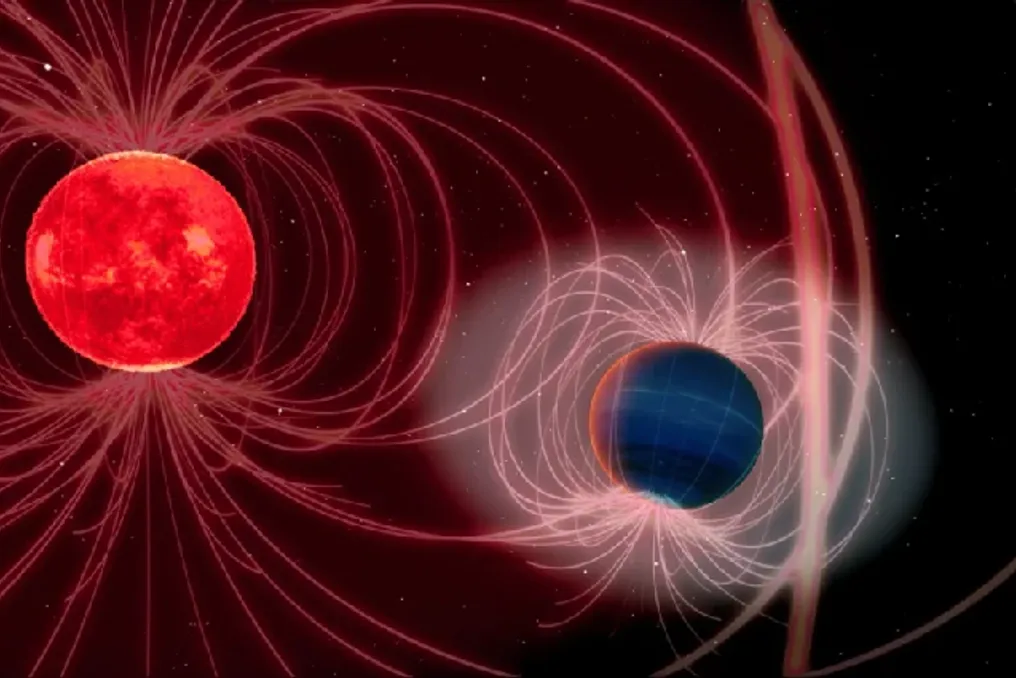
An international group of scientists has discovered convincing evidence of a strong magnetic field around a distant exoplanet, according to Tel Aviv University in Israel on Thursday.
Research Findings
This study, published in the journal Science, provides the most compelling evidence that an exoplanet's magnetic field can directly influence its host star.
Object of Study and Methods
The scientists focused on the planet GJ 436 b, which is a Neptune-sized exoplanet orbiting very close to its host star. By analyzing observation data over a period of 16 years, they recorded periodic changes in the star's ultraviolet radiation that corresponded to the planet's orbit. This indicates an interaction between the planet's magnetic field and the star.
Field Characteristics and Significance of the Discovery
Using computer models, researchers hypothesized that this planet's magnetic field could be 2.3 to 27 times more powerful than Jupiter's magnetic field, which is the strongest among the planets in the Solar System. The scientists noted that this discovery marks a breakthrough, as detecting magnetic fields around exoplanets has been an extremely challenging task.
According to them, this finding could open a new method for studying distant worlds and deepen the understanding of the role that magnetic fields can play in protecting planetary atmospheres and maintaining conditions favorable for life.