Sustainable development has ceased to be merely a corporate social responsibility issue. Wilma Rodrigues, Director of Transformation at Saahas Zero Waste, believes it represents a business opportunity.
Sustainable development has ceased to be merely a corporate social responsibility issue. Wilma Rodrigues, Director of Transformation at Saahas Zero Waste, believes it represents a business opportunity.
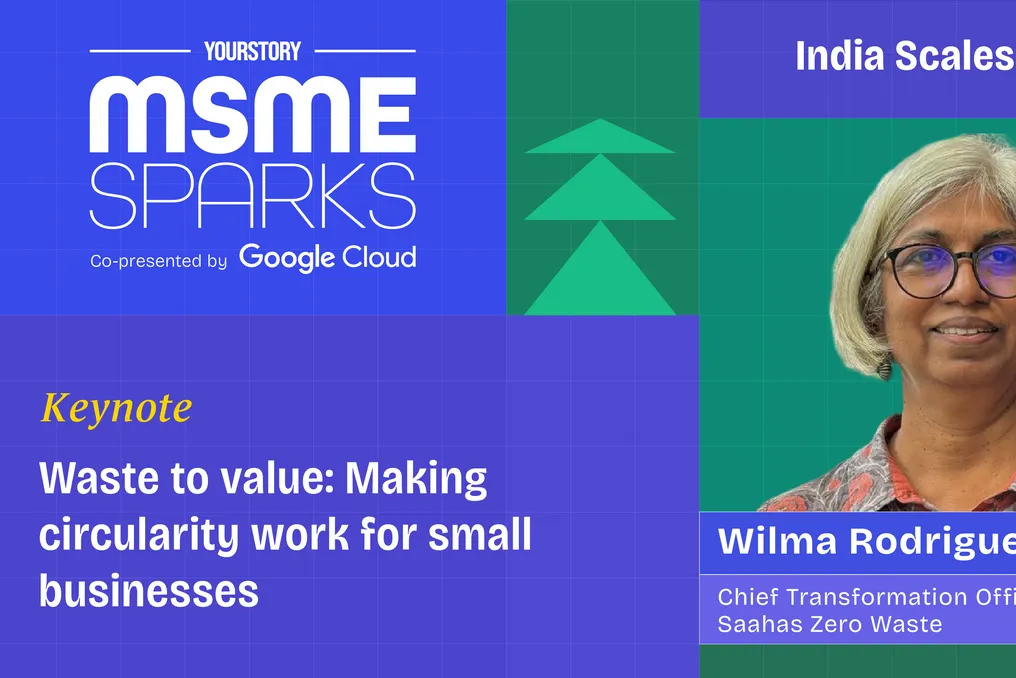
During the five-day MSME Sparks 2026 event, which highlighted India's MSME ecosystem in Bengaluru, Rodrigues delivered the keynote address on the third day. Under the theme 'From Waste to Value: Making Circularity Work for Small Businesses,' she leveraged her 12 years of experience at Saahas Zero Waste to demonstrate that circularity is no longer a secondary focus but a primary necessity for fifty million small and medium enterprises in India.
According to Rodrigues, India generates 62 million tons of waste annually, with up to 80% being either dumped or incinerated instead of being recycled. Only a small fraction is actually subjected to secondary recycling, despite the country's push towards closed-loop systems, which increasingly demand developed economies.
She noted that 'fifty percent of the world's economy comes from nature,' citing raw materials, food, clothing, and housing as examples. Rodrigues emphasized that the exponential growth of the last century was achieved within a linear system, and now SMEs must exercise caution and make the necessary pivot.
Saahas Zero Waste operates across three verticals: a zero-waste program for large generators such as campuses and tech parks; an Extended Producer Responsibility (EPR) vertical covering plastic and e-waste; and a closed-loop retail segment that sells refurbished goods to communities. However, contrary to common perceptions about turning waste into wealth, most of Saahas's revenue does not come from selling recycled materials. Approximately 40% comes from selling materials to recyclers and consumers, while the main share is generated through service fees, as about 70% of the waste the company handles has no inherent economic value.
Rodrigues stated that 'there is limited capital inflow into this sector due to the belief that waste management does not require fees or investment. This mindset is what stalls the sector.' The company reached a peak revenue of about 86 crore rupees in FY24, after which it declined to approximately 60 crore rupees with minor losses over the next two years. Rodrigues attributed this to a slowdown in EPR regulation, noting that Saahas preferred to absorb the financial hit rather than dilute its environmental and social commitments.
With over 400 employees, most of whom are women, the company processes about 100 tons of solid waste daily and diverted 40,000 tons last year through recycling, composting, biogas, and reuse channels, achieving a landfill diversion rate of 96%. Rodrigues stressed that while technology helps close the loop, people are indispensable because they must participate in the system—whether it is collecting segregated waste, aggregating and sorting it, or the recycling itself, which implies adequate remuneration.
She linked Saahas's work to multiple UN Sustainable Development Goals, including those related to poverty, decent work, sustainable cities, and partnerships.
Currently, Saahas has attracted only small amounts of capital—about 8 crore rupees from so-called 'aligned investors' willing to commit to long-term collaboration. In the next five years, the company plans to grow into a business worth 200 crore rupees and is exploring a transition to a stewardship model, which she advised the audience to explore through the Purpose Foundation. Answering audience questions, Rodrigues urged entrepreneurs in second and third-tier cities to enter the waste sector through partnerships, rather than alone, citing the new Solid Waste Management Rules 2026 as a strong positive factor. Regarding the waste issue in Bengaluru, she pointed out that nearly 40% of the city's waste is generated in tech parks and large generators, and strongly urged citizens and businesses to manage waste locally rather than offloading the task onto public spaces. She concluded: 'We must be the change we wish to see. This is the path forward not only for Bengaluru but also for Chennai, NCR... for all of India.'