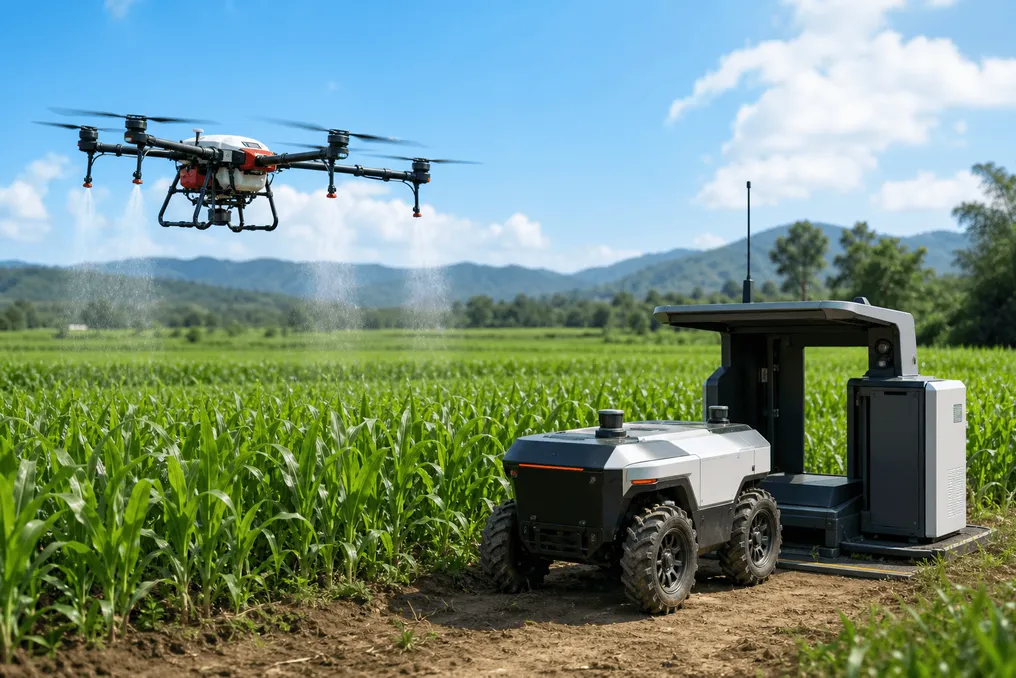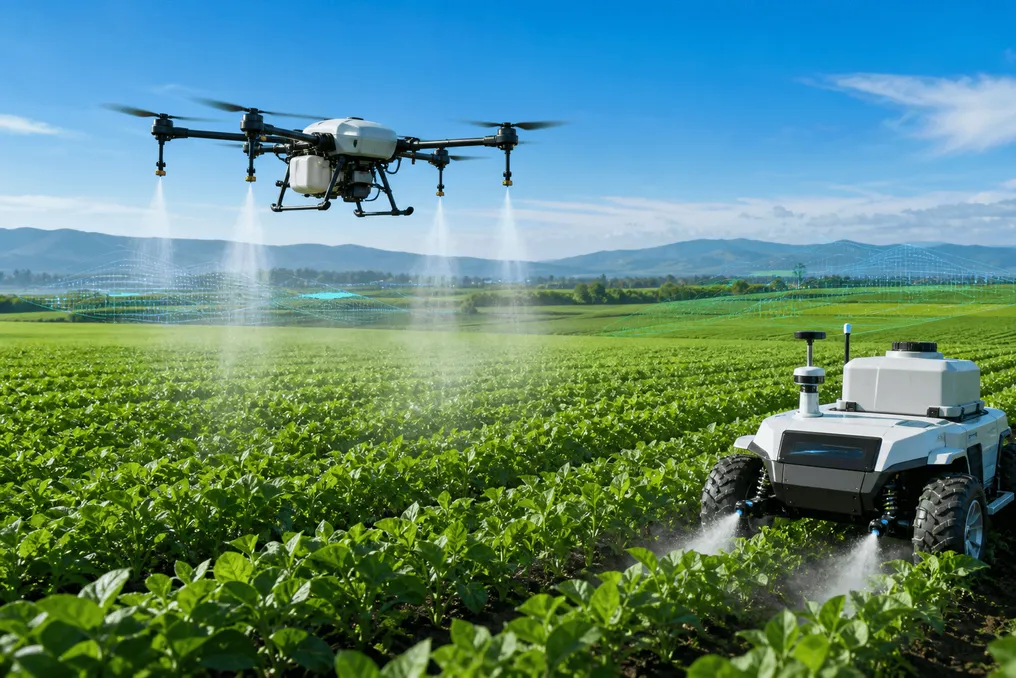
XAG Company has released new agricultural robots that combine aerial drones and ground vehicles, designed for autonomous pesticide application. This step marks a move towards fully automated farming.
Dual System Functionality
The dual-mode system allows farmers to switch between aerial spraying of tall crops and using ground robots for precise application in dense plantations.
Ground Robot Capabilities
The ground robot is equipped with an adaptive navigation system, enabling it to operate on uneven agricultural terrain and in muddy rice fields without the need for manual control. Its spraying system uses computer vision to determine plant density and adjust chemical distribution in real time, thereby minimizing pesticide consumption through targeted application only on plants needing treatment.
Integration with Aerial Drones
Although XAG's aerial drones have been used commercially for several seasons, the new integration with ground robots creates, according to the company, a 'fully autonomous crop protection workflow.' Farmers can pre-program treatment zones and crop types, and the system independently manages routing, obstacle avoidance, and spray calibration.
Economic Impact and Market Trends
The company reports that the combined system reduces pesticide consumption due to more precise application, which decreases both raw material costs and environmental pollution. Field tests in several provinces showed a reduction in pesticide use compared to traditional spraying methods, while yields remained stable or improved due to more uniform coverage. Agricultural automation is accelerating in China amid rural labor shortages, making manual spraying increasingly expensive and difficult to staff. XAG robots solve a direct economic problem for farms of all sizes, although the initial cost of this dual system remains a barrier for smallholdings.