Artificial intelligence models from Chinese companies Zhipu AI and DeepSeek are gaining popularity among American developers because their price-to-performance ratio offers a tenfold advantage over their American counterparts.
Artificial intelligence models from Chinese companies Zhipu AI and DeepSeek are gaining popularity among American developers because their price-to-performance ratio offers a tenfold advantage over their American counterparts.
These Chinese AI models are actively penetrating the US market by offering an attractive value proposition: comparable performance at a cost that is approximately one-tenth of American solutions. As recently reported by CNBC, the number of American companies switching from using OpenAI and Anthropic to DeepSeek, Zhipu AI, and Qwen for their AI infrastructure needs is growing.
Data from the platform OpenRouter, which aggregates numerous AI models for developers, shows that token consumption by Chinese models has consistently exceeded 20% of the weekly share since February 2026, peaking at up to 30%. This figure represents a sharp increase compared to the average of the previous 12 months, which was around 7%, indicating a structural shift in developer preferences.
The cost difference is substantial. When comparing the pricing of DeepSeek V4 with GPT-5.5, the Chinese model costs about 5% of the American competitor for input tokens and around 7% for output tokens. The Zhipu GLM-5.2 model has an input price of approximately 28% of GPT-5.5, while the output cost is about 15%. In contrast, GLM-5.2 is 30% cheaper than Anthropic Sonnet 5 for input, and 56% cheaper for output. For high-load and cost-sensitive applications, such differences can translate into millions of dollars in annual savings.
Performance has also significantly improved. DeepSeek V4 ProMax demonstrated competitive results in LiveCodeBench, Terminal Bench, and BrowseComp tests, surpassing Claude Opus 4.6 on some metrics. The Zhipu GLM-5.1 Thinking model showed higher scores in SWE Pro than Claude Opus 4.6 and GPT-5.4. Furthermore, GLM-5.2 trails Claude Opus 4.8 by only about 1% in the FrontierSWE benchmark, while costing five times less.
In addition to the cost factor, Chinese AI models benefit from openness. DeepSeek, Zhipu AI (GLM), and Qwen offer open-weight models, allowing enterprises to use self-hosted options and maintain data sovereignty, which closed American models cannot provide. As AI adoption deepens, companies are increasingly demanding controlled AI architectures covering public cloud, private deployment, and hybrid schemes.
The founder of an American AI company shared on X that he completely switched traffic from Anthropic to DeepSeek V4 in early June, saving millions of dollars and noting performance improvements across many use cases. This trend is spreading throughout the US developer ecosystem, weakening the pricing power previously held by leading American AI labs, and signaling a shift from a 'who is strongest' market to a 'who offers the cheapest unit of intelligence' market.
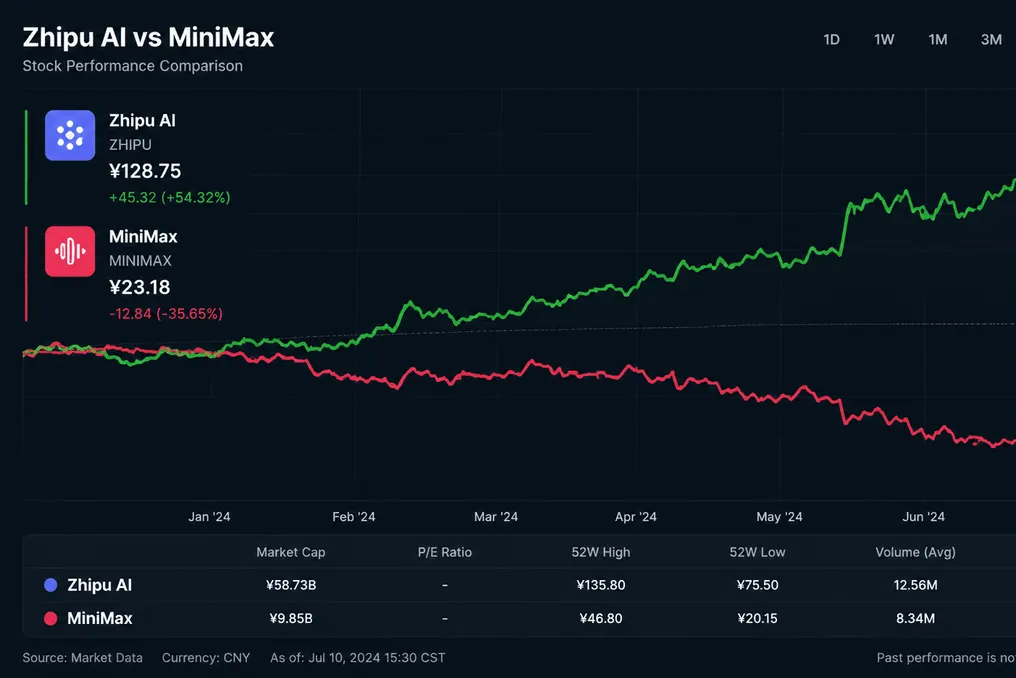
Upon the expiration of the share lockup period, two leading Chinese artificial intelligence companies experienced drastically different outcomes: Zhipu AI's shares rose by 13%, while MiniMax's shares fell by 18%, reflecting fundamentally distinct business models and varying levels of market confidence in these companies.
On July 8th and 9th, respectively, both companies faced initial lockup expiration events that resulted in diametrically opposed outcomes. Zhipu AI's shares increased by 13.35%, approaching a market capitalization of $126 billion. Meanwhile, MiniMax's shares sharply declined by nearly 18%, closing at HK$297.4, which was below its Initial Public Offering (IPO) price.
This divergence is not only due to different unlock proportions. Zhipu AI faced the unlocking of only 5.76% of shares held by 11 key investors, primarily state-backed funds with long-term mandates. In contrast, MiniMax saw the unlocking of 44.85% of its shares, expanding the tradable volume from 3% to nearly 50%. This allowed early venture investors, including Hillhouse, Sequoia, IDG, Alibaba, and miHoYo, to exit the company.
These price fluctuations are underpinned by fundamentally different business trajectories. Zhipu AI benefited from shifting its market focus towards Agent-type applications and AI coding, where its GLM series ranks among the best domestic models. Revenue from the company's corporate API and MaaS platform demonstrates strong demand, reaching a gross margin of 41% in 2025, indicating pricing power confirmed by recent price increases without loss of sales volume.
MiniMax, which was valued twice as high as Zhipu at the time of its IPO, based on its multimodal offerings and AI companion services, witnessed a shift in its market narrative. After reaching a peak market capitalization of HK$400 billion, its shares declined for over three months amid the cooling of the multimodal concept following the halt of OpenAI Sora and difficulties in monetizing video models. MiniMax's gross margin stands at 25%, suggesting weaker pricing power; its flagship M3 model was launched with a subsequent constant price reduction of 50% within just one week.
The company faces additional hurdles due to new regulations for AI companions taking effect on July 15th, which restrict the functions of AI emotional interaction, specifically banning virtual companions for minors. Although MiniMax Talkie/Xingye products constitute the bulk of revenue, income from Hailuo AI and the open platform is growing rapidly.
Nevertheless, MiniMax possesses advantages, including foreign revenue accounting for 73% of total revenue in 2025, serving 236 million users in over 200 countries. The company's revenue doubled compared to the previous year, while marketing expenses decreased by 40%, indicating improved unit economics. For both companies, these lockup events mark a transition from pricing controlled by a small number of shares to valuation determined by the broader market, a trend expected to continue with future unlock tranches.
DeepSeek and Zhipu AI have joined OpenAI and Anthropic in developing specialized chips for inference. This move signals a fundamental shift in the industry, as leading artificial intelligence laboratories aim to create their own silicon products to reduce costs and decrease reliance on Graphics Processing Units (GPUs).
According to a Reuters report on July 7, DeepSeek is working on its own AI chip specifically designed for large model inference. The project, which began about a year ago, is gradually expanding its chip design team and collaborating with chip manufacturers, foundries, and memory suppliers.
On the same day, The Information reported that Zhipu AI is considering developing its own AI chips amid growing demand for its GLM series models.
This trend is not limited to China. On June 24, OpenAI unveiled its first proprietary inference chip, codenamed Jalapeño, developed in collaboration with Broadcom. Samples of this chip are already being tested in the lab, with deployment planned for the end of the year. Previously, in April, it was reported that Anthropic was considering creating its own chips, and in June, it hired a key engineer from OpenAI's chip project.
A pattern is emerging: leading companies involved in AI models in both China and the US, regardless of whether they use open or closed strategies, are simultaneously entering the capital-intensive business of chip manufacturing. The economic viability is clear: training advanced models requires significant expenditure, but inference costs accumulate continuously with every user interaction, agent operation, or token generation.
DeepSeek and Zhipu AI are focusing on inference chips to optimize the performance of their MoE architectures, KV cache management, and low-precision computing.
For Chinese AI companies, developing their own chips is also a response to strategic vulnerability. US export controls restrict access to advanced NVIDIA GPUs, making domestic alternatives and proprietary silicon solutions a matter of operational control, not just cost savings.
However, chip development involves enormous risks. Industry estimates suggest that designing an advanced AI chip costs around $500 million, and there are no guarantees of success. The spectrum of self-development includes Google's full-stack TPU approach or partnerships between architecture developers and established firms like Broadcom, as demonstrated by OpenAI's Jalapeño.
There is an accelerating separation of hardware for training and inference. Google split its eighth-generation TPU into 8t for large-scale training and 8i for low-latency inference. Huawei has done something similar, dividing the Ascend 950 series. The moves by DeepSeek and Zhipu AI reflect a broader industry understanding: at the forefront of development, the optimal path requires control over the entire stack—from silicon to the model itself.