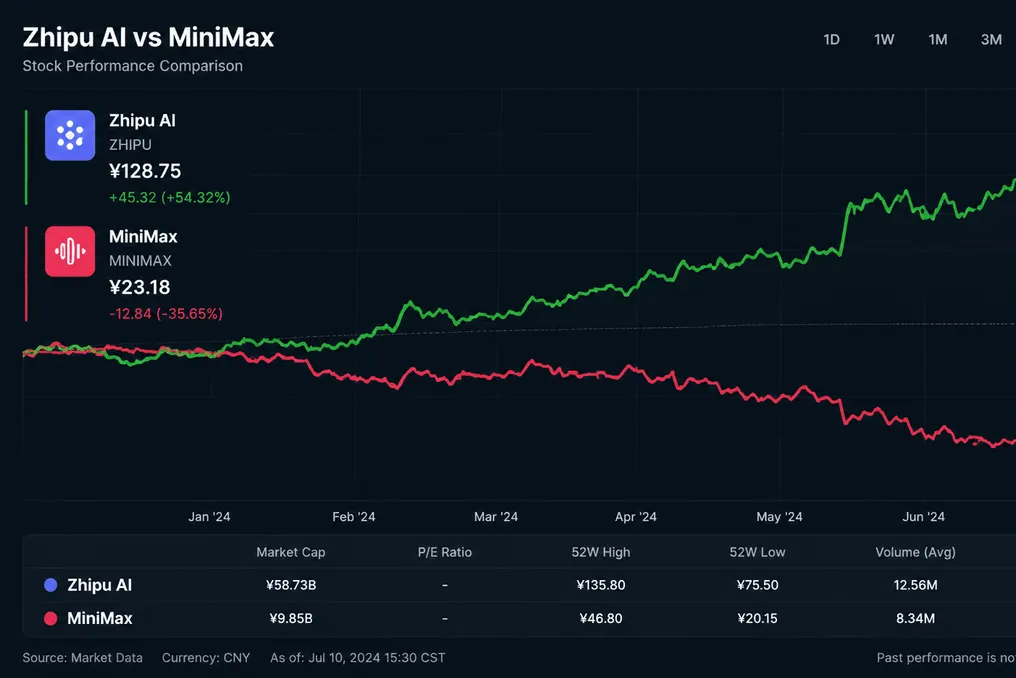
Upon the expiration of the share lockup period, two leading Chinese artificial intelligence companies experienced drastically different outcomes: Zhipu AI's shares rose by 13%, while MiniMax's shares fell by 18%, reflecting fundamentally distinct business models and varying levels of market confidence in these companies.
Popular
Initial Events of Lockup Expiration
On July 8th and 9th, respectively, both companies faced initial lockup expiration events that resulted in diametrically opposed outcomes. Zhipu AI's shares increased by 13.35%, approaching a market capitalization of $126 billion. Meanwhile, MiniMax's shares sharply declined by nearly 18%, closing at HK$297.4, which was below its Initial Public Offering (IPO) price.
Differences in Unlock Structure
This divergence is not only due to different unlock proportions. Zhipu AI faced the unlocking of only 5.76% of shares held by 11 key investors, primarily state-backed funds with long-term mandates. In contrast, MiniMax saw the unlocking of 44.85% of its shares, expanding the tradable volume from 3% to nearly 50%. This allowed early venture investors, including Hillhouse, Sequoia, IDG, Alibaba, and miHoYo, to exit the company.
Different Business Strategies
These price fluctuations are underpinned by fundamentally different business trajectories. Zhipu AI benefited from shifting its market focus towards Agent-type applications and AI coding, where its GLM series ranks among the best domestic models. Revenue from the company's corporate API and MaaS platform demonstrates strong demand, reaching a gross margin of 41% in 2025, indicating pricing power confirmed by recent price increases without loss of sales volume.
Challenges for MiniMax
MiniMax, which was valued twice as high as Zhipu at the time of its IPO, based on its multimodal offerings and AI companion services, witnessed a shift in its market narrative. After reaching a peak market capitalization of HK$400 billion, its shares declined for over three months amid the cooling of the multimodal concept following the halt of OpenAI Sora and difficulties in monetizing video models. MiniMax's gross margin stands at 25%, suggesting weaker pricing power; its flagship M3 model was launched with a subsequent constant price reduction of 50% within just one week.
Regulatory and Market Factors
The company faces additional hurdles due to new regulations for AI companions taking effect on July 15th, which restrict the functions of AI emotional interaction, specifically banning virtual companions for minors. Although MiniMax Talkie/Xingye products constitute the bulk of revenue, income from Hailuo AI and the open platform is growing rapidly.
Advantages and Future
Nevertheless, MiniMax possesses advantages, including foreign revenue accounting for 73% of total revenue in 2025, serving 236 million users in over 200 countries. The company's revenue doubled compared to the previous year, while marketing expenses decreased by 40%, indicating improved unit economics. For both companies, these lockup events mark a transition from pricing controlled by a small number of shares to valuation determined by the broader market, a trend expected to continue with future unlock tranches.