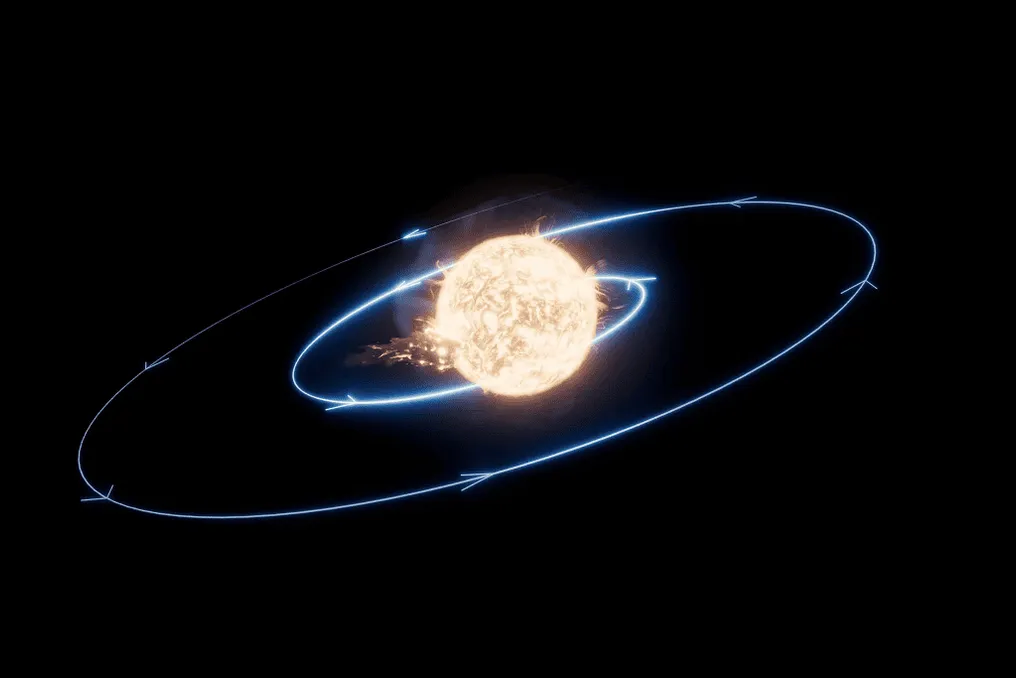
Scientists have discovered a star located approximately 1,300 light-years from Earth that may have destroyed one of its planets and is on a collision course with a second celestial body.
Research Findings
The conclusions are presented in two new studies published in The Astrophysical Journal and The Astrophysical Journal Letters. Researchers assert that the star, named TOI-5882, exhibits chemical signatures consistent with the absorption of a planet in the relatively recent past. Furthermore, a large object known as a brown dwarf orbiting very close to the star is also likely to be swallowed in the future, possibly sooner than previously thought.
A Fate Similar to the Solar System
According to astronomers, so-called planetary engulfment is a natural process of stellar evolution. When a star ages and enters the red giant phase, it expands and is capable of absorbing nearby planets, which are then destroyed and incorporated into the star's composition. A similar fate awaits part of the Solar System. In a few billion years, when the Sun reaches this stage, it will have to absorb Mercury, Venus, and possibly even Earth.
Although this process is still far off for the Sun, scientists can find examples in other stars because the destruction of a planet leaves detectable chemical traces in the light emitted by the star.
Lithium as Evidence of a Destroyed Planet
It was this type of evidence that drew researchers' attention to TOI-5882. By analyzing the light emitted by the star, scientists found unusually high levels of lithium—a chemical element much more common on planets than on stars. According to the first study published in The Astrophysical Journal, the presence of this element indicates that the star has likely absorbed a planet.
Claudia Aguilera-Gomez, a researcher from the Institute of Astrophysics at the Pontifical Catholic University of Chile and one of the study's authors, stated in The New York Times that such discoveries allow for the simultaneous study of stellar and exoplanetary evolution. She noted: 'Engulfment events can tell us something about the star, as well as the exoplanet, and that is the most incredible thing. They connect these two parts of astronomy that usually remain separate.'
Brown Dwarf May Have Caused the Collision
The star TOI-5882 has a mass approximately 30% greater than the Sun's mass and has already attracted the attention of astronomers due to the presence of a massive brown dwarf in its orbit. This object, named TOI-5882-b, has a mass about 22 times that of Jupiter and orbits the star in just one week. Its proximity is so great that researchers consider its future absorption by the star inevitable.
According to Brooke Cottten, an astronomy graduate student at the University of Michigan (USA) and lead author of the first study, the massive gravitational influence of the brown dwarf may explain how the first planet was destroyed. Since TOI-5882 has not yet entered the red giant phase, it is not expanded, making simple absorption due to natural growth unlikely. The hypothesis put forward by the researchers is that the gravity exerted by the brown dwarf altered the orbit of a neighboring planet, directing it straight toward the star.
Planet Could Have Vanished Up to Two Billion Years Ago
Scientists believe that the destroyed planet could have been a rocky super-Earth or a world with a mass comparable to Neptune. In the researchers' opinion, it was likely ejected onto the star at some point within the last two billion years. Although its destruction happened quickly—perhaps over days or weeks—the chemical traces left by this event can remain detectable for billions of years.
Brooke Cottten explained: 'Engulfment events happen very quickly; therefore, we cannot observe them in real time.'
Brown Dwarf Will Also Be Swallowed
If the first planet was merely a 'snack,' the brown dwarf could be the star's next target. Previous studies suggested that TOI-5882-b would be swallowed in about 110 million years. However, the second study, published last week in The Astrophysical Journal Letters, indicates that this process could occur significantly sooner. This study was led by Ritwik Narayan, a astrophysics graduate student at the Massachusetts Institute of Technology (MIT).
Using models simulating tidal interactions between stars and orbital objects, the team concluded that the brown dwarf could spiral toward the star two to six times faster than previously estimated. Narayan stated: 'It may be in position to begin being swallowed in the next 25-30 million years.'
Further Study of the System
Scientists plan to continue studying TOI-5882 in search of new signs of planetary destruction. For Cottten, every new observation helps reconstruct the history of this planetary system. 'For me, it's like being a detective. We just keep collecting clues.'