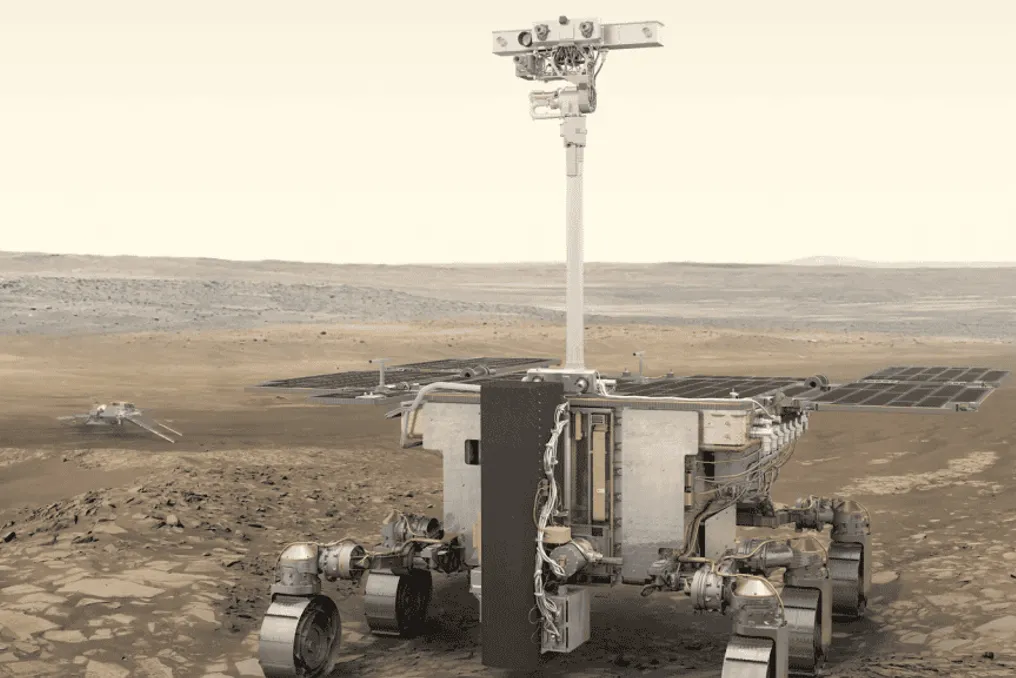
Researchers have identified vast reserves of clay in the Oxia Planum area of Mars. This location was selected by the European Space Agency (ESA) for the landing of the Rosalind Franklin rover, part of the ExoMars mission.
Potential for ancient life on Mars
These minerals have the potential to hold records of an era when Mars had large volumes of water, turning the region into a primary focus in the search for signs of ancestral life on the planet. The discoveries were detailed in a scientific article published in the journal Science Direct.
ExoMars Mission and the Rosalind Franklin Rover
The ESA continues to advance the development of the ExoMars mission, with the launch of the Rosalind Franklin rover to Mars scheduled for 2028. The vehicle is expected to land in Oxia Planum, a depression on the Martian surface where scientists conjecture there was a lot of water in the past.
According to the space agency, the rover will use its instruments to examine the geological context of the area and determine if the clays have preserved evidence of life forms that might have existed billions of years ago. Elliot Sefton-Nash, deputy scientist of the ExoMars project, stated in an ESA press release: “We will use the onboard instruments to confirm on the ground the findings made from orbit, understand the ancient environment in which they formed, and check if they preserve evidence of Martian life. Heat and nutrients in an ancient Martian seabed could have provided habitats for primitive life.”
Water history of the Red Planet
The investigation into life on Mars is intrinsically linked to the planet's history. Researchers suggest that the surface water of Mars disappeared about three billion years ago. Previously, Mars likely had a denser atmosphere, with rivers transporting water that flowed into lakes scattered across the surface.
Due to this history, many scientists consider it plausible that the planet sustained some form of life in remote times. Although this theory is not yet proven, last year, scientists located what is now considered the most robust physical evidence of possible life on Mars: a biosignature.
Extent of the clay deposits
The new study demonstrated that the clay deposits found in Oxia Planum are not limited to the rover's landing site. The research indicates that these deposits extend over approximately 300 kilometers, covering an area known as Mawrth Vallis.
To identify these minerals, scientists analyzed data captured by orbiters around Mars, using the OMEGA instrument from the Mars Express probe, also from the ESA, and the Mars Reconnaissance Orbiter, belonging to NASA. The analysis revealed mineral layers in both Oxia Planum and Mawrth Vallis, along with indicators of changes in the chemical composition of water over time. These findings corroborate results from previous research pointing to the presence of water in Mars' ancient history.
Implications of a large-scale process
Inés Torres Auré, lead author of the study and affiliated with the University of Lyon (France), commented that the mission will allow for a deeper understanding of how these deposits formed. She stated in the same release: “By landing in Oxia Planum, we will reveal a large-scale process that shaped the ancient clays across Mars.”
Jorge Vago, a scientist involved in the ExoMars project, emphasized that the size of the deposits suggests this event was not isolated. He explained: “Since the area is very extensive, we are not talking about a localized occurrence, but rather a regional or global process that would have required immense amounts of water. We are focusing on the oldest deposits in the sequence, which makes the potential implications for the primitive geology and climate of Mars very relevant to the Rosalind Franklin mission in its search for life.”
Although no mission has confirmed extraterrestrial life, researchers emphasize that, in the context of terrestrial life, water is a vital component. Therefore, areas showing signs of ancient aquatic environments remain places of great promise for future investigations.
Subsurface exploration with Rosalind Franklin
The Rosalind Franklin rover will be launched as part of the ESA's ExoMars program and will operate in collaboration with the Trace Gas Orbiter, which already orbits Mars. A distinctive feature of the vehicle is a drill capable of penetrating the Martian subsurface, allowing for the analysis of materials below the surface, where biosignatures may have remained preserved for billions of years, protected from radiation and the harsh conditions of the Martian environment. The ESA believes that the combined action of the orbiter and the rover will significantly increase the chances of detecting signs of ancient life on the Red Planet.