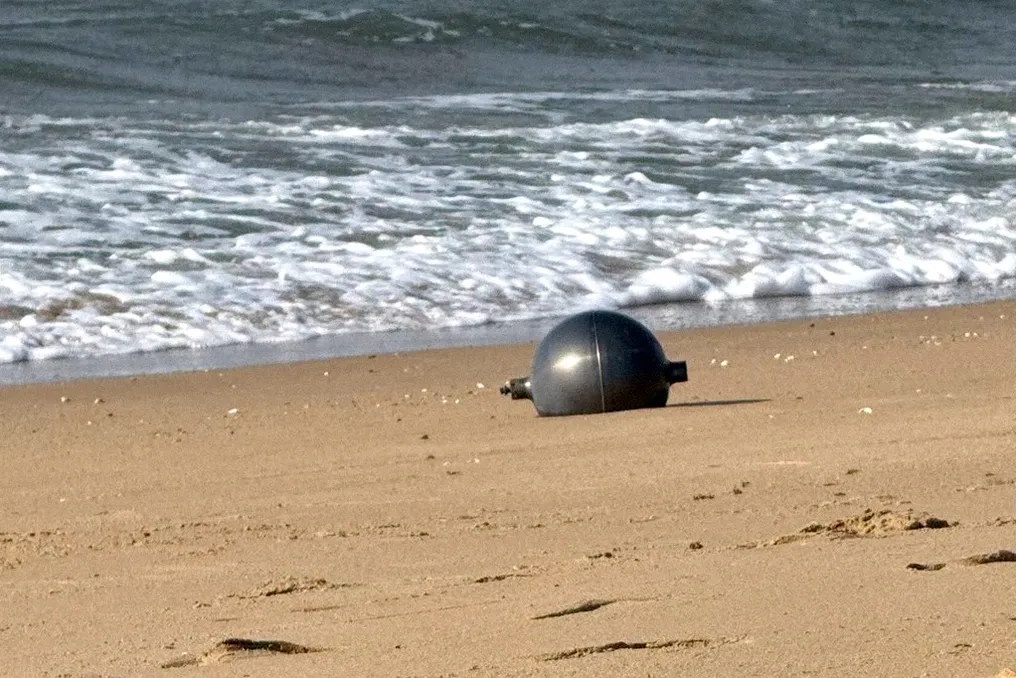
A small coastal town in Australia experienced a notable mystery when six large metallic spheres were discovered on the sand of Forrest Beach, in the state of Queensland. The appearance of these objects led residents to speculate about various possibilities, including extraterrestrial visits, resulting in the partial isolation of the beach for analysis.
Investigation and Discovery
The first artifacts appeared on July 3rd, followed by more spheres scattered across the beach. Each object was about twice the size of a basketball, featuring a metallic coloration and two small protrusions on opposite sides. Due to uncertainty about the nature of the items, authorities adopted a cautious stance, establishing a 50-meter exclusion zone around the objects while specialized teams, wearing protective gear, collected them for inspection, fearing the presence of hazardous substances such as rocket fuels.
About 1,300 inhabitants of the town watched the events with great interest. Lisa Scobie, owner of a nearby restaurant, told the New York Times that despite the tranquility of the area, there were many jokes about the possibility of them being aliens.
Confirmation by Space Agency
On Monday (the 6th), the Australian Space Agency (ASA) announced on Facebook the identification of the probable source of the objects. According to the agency, the spheres appear to be pressurized containers belonging to a space launch vehicle. Their characteristics and location are consistent with debris from a foreign rocket that recently returned to the atmosphere after a period in orbit.
The ASA communicated that it is in contact with international bodies to obtain official confirmation regarding the rocket's origin and the country responsible for the launch. Emergency teams determined that the recovered objects are safe, but the agency warned about the possibility of new fragments appearing in the region, advising anyone who finds a similar object to keep their distance and contact the authorities, without attempting to handle or remove it.
Nature of the Space Components
Experts indicate that this type of component, despite its unusual appearance, is relatively well-known in the aerospace industry. Alice Gorman, a space archaeologist from Flinders University, explained to the ABC that the spheres are a classic example of 'space balls,' which function as pressurized containers in rocket fuel systems. These reservoirs store gases or fuels under high pressure before or during specific phases of the mission.
Gorman detailed that such tanks are generally constructed from titanium alloys or other metals resistant to extremely high temperatures, allowing them to survive the strong friction generated during atmospheric reentry, unlike other parts of the rocket. After the fuel is consumed, these spheres become hollow, capable of floating and being carried by ocean currents and waves to beaches, as happened at Forrest Beach. According to her, the survival of these elements does not necessarily imply failures during launch, but rather expected behavior for such equipment.
The Problem of Space Debris
The objects found in Australia fit into the growing context of space debris, defined as any man-made item remaining in space without fulfilling its function. This category ranges from discarded rocket stages to deactivated satellites and small pieces resulting from collisions. With the increase in launches, this 'orbital graveyard' is growing rapidly; in 2019, there were approximately one thousand active satellites, and by March 2026, this number exceeded 14,500, with nearly ten thousand belonging to SpaceX's Starlink constellation.
Most of this debris does not reach the ground because, as its orbit decreases, it reenters the atmosphere at very high speed, and the heat from friction usually causes it to burn up and disintegrate. However, more robust pieces can survive reentry, and the pressurized containers found in Australia are examples of components that best resist extreme heat.
Previous Cases and Legislation
This is not the first incident of space debris in Australia. In 2022, a large fragment of the SpaceX Dragon capsule was located in the southeast of the country. The following year, a vast metallic dome found on a beach in Western Australia was identified as part of an Indian rocket from the national space program. A notable event occurred in 1979 when NASA's Skylab space station reentered the atmosphere, scattering debris over Western Australia, including some of its fuel tanks.
According to international legislation, these objects remain the property of the launching country, even after falling into another territory. Alice Gorman mentioned that the Australian government will need to negotiate with the responsible nation to determine whether the components should be returned.
Local Reactions
Meanwhile, Forrest Beach capitalized on the sudden notoriety. A local supermarket used social media to joke about the need for 'panic buying' after the supposed fall of a UFO. Lisa Scobie's restaurant also launched a themed dish of fish, squid, and fries, promoted with an image of an alien on the beach, which, according to her, was a great success.