OpenAI announced the launch of ChatGPT Work this Thursday, July 9th. This new artificial intelligence agent was designed to operate autonomously, aiming to reduce users' repetitive workload.
OpenAI announced the launch of ChatGPT Work this Thursday, July 9th. This new artificial intelligence agent was designed to operate autonomously, aiming to reduce users' repetitive workload.
ChatGPT Work operates by connecting various files and applications to generate complete materials. The user only needs to define a general objective, such as 'prepare a sales meeting' or 'analyze the budget,' and the agent takes care of collecting all necessary context to produce documents, presentations, and spreadsheets without direct intervention.
To achieve this high degree of automation, the tool offers native integration with widely used platforms, including Microsoft Teams, Slack, Gmail, and Google Drive. To mitigate risks associated with an autonomous agent handling sensitive information, OpenAI implemented administrative control, allowing IT departments to define which files and applications the AI can access. The company emphasizes that the system underwent rigorous testing, blocking all attempts to extract protected data.
The technology powering this agent is the new GPT-5.6 model family. This model was only made available to the public after a limited preview period for organizations previously approved by United States authorities. The release was paused at the request of the Donald Trump administration, which required additional time to reevaluate security measures given the tool's potential. After technical cooperation between the startup and regulatory bodies, the model was finally launched.
GPT-5.6 was segmented into three distinct versions to meet varied market needs: Sol, which is the main and most sophisticated model; Terra, an intermediate option balancing cost and performance; and Luna, the lighter version focused on offering good value for money.
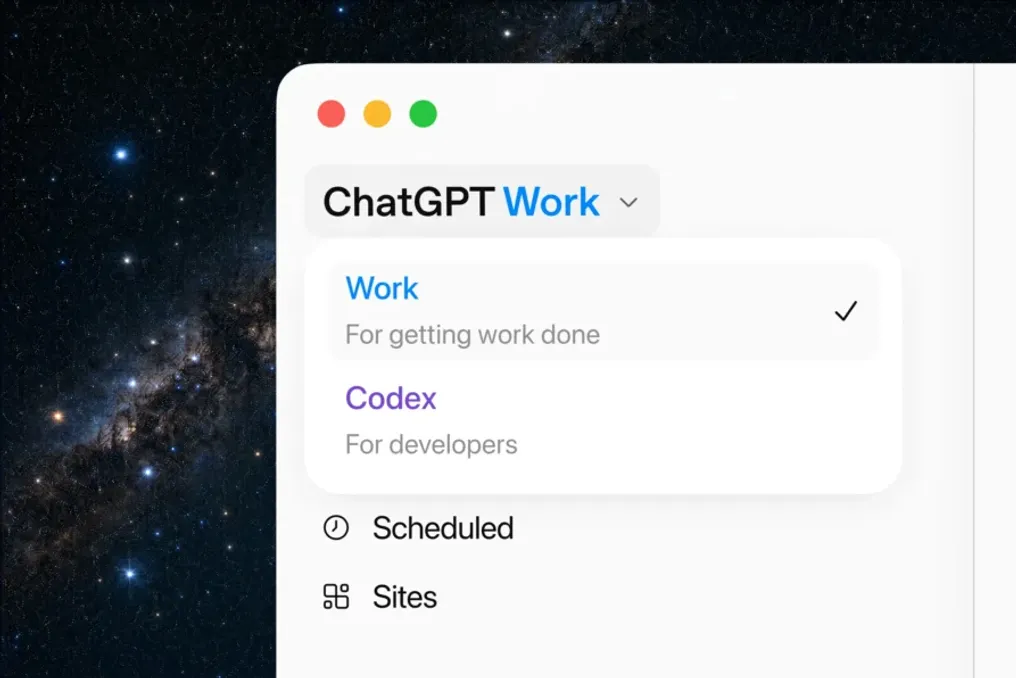
Alongside these innovations, a new application for Windows and Mac systems is being introduced. This application unifies ChatGPT, Work, and Codex into a single interface. Presented during the launch broadcast, the 'Computer Usage' feature allows the AI to perform background actions on the device, such as typing, clicking, and moving files autonomously. The application also incorporates an integrated browser and the Sites functionality, which transforms idea sketches into interactive pages.
Regarding availability, the timeline varies depending on the user's plan. The new desktop application can be downloaded globally by all users, including the free version. ChatGPT Work, accessible via web and mobile devices, is initially being released to Pro, Enterprise, and Edu subscribers, with expectations of reaching Plus and Business plans soon.
On Thursday, the 9th, OpenAI unveiled ChatGPT Work. This is a version of the artificial intelligence (AI) developed by the company, specifically aimed at the work environment.
ChatGPT Work has the ability to perform various tasks directly in different applications and files used by users.
OpenAI confirmed that its new family of artificial intelligence, consisting of the Sol, Terra, and Luna models, will be available to the general public starting this Thursday, July 9th. Although the models were introduced two weeks ago, their access was initially limited to specific clients due to direct requests from the United States government.
The release of GPT-5.6 occurs after the Donald Trump administration removed the restrictions imposed on AI tools. This measure follows the permission granted to Anthropic, which restored the availability of Claude Fable 5 for all users. Both the new versions of Claude and ChatGPT had been restricted under justifications related to national security.
Initially, when GPT-5.6 was revealed, the company led by Sam Altman indicated that it would comply with the limitations, although it disagreed with a definitive solution. OpenAI had anticipated public availability in a few weeks, which has now materialized. According to the portal Axios, these restrictions were considered crucial by the US government due to the great potential of the technologies involved. Both Anthropic and OpenAI had already warned about the need for caution in using AI in cyberattacks.
After the launch of Claude Mythos Preview, a consortium of partner companies and the US government, through a project called Project Glasswing, gained restricted access to the new AI model, which was classified as excessively powerful for public use. Despite having been launched with restrictions, the Trump administration forced the removal of these barriers, allowing the product to be commercialized again the previous week.
In addition to the general availability of GPT-5.6, the company also introduced GPT-Live, a voice generation model aimed at making ChatGPT more natural. The new models include distinct specifications:
OpenAI informed that this family of AIs is close to the current GPT-5.5, which serves as the basis for the new GPT-Live. This voice model promises more human interactions, greater responsiveness, and clearer explanations, potentially even incorporating visual elements to assist the user in resolving doubts.