OpenAI unveiled the GPT-5.6 family on Thursday (9th), presenting three models with different cost and capability profiles. The launch was accompanied by a live demonstration and statements from CEO Sam Altman to CNBC.
The three introduced models are: Sol, the most robust, focused on complex tasks; Terra, designed for daily and balanced use; and Luna, characterized as the fastest and most accessible.
Sam Altman told CNBC that companies are focused on the return on investment in AI, and this is OpenAI's main focus. Specifically, GPT-5.6 Sol demonstrated 54% greater token efficiency in agentic coding tasks and was rated as 'as good as or better than' competing models.
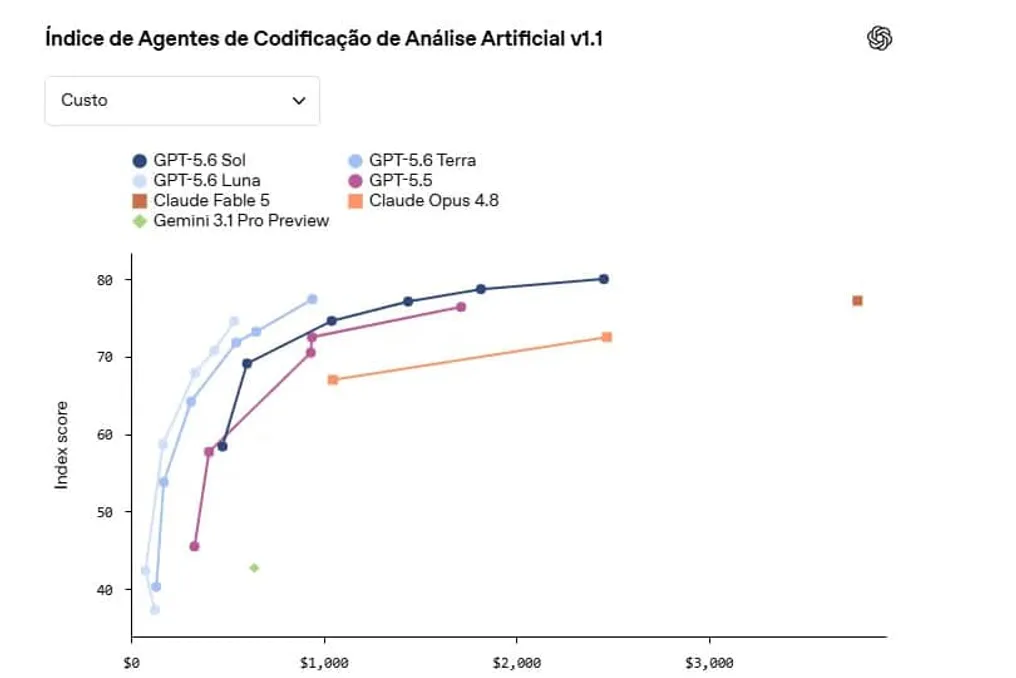
In tests conducted on the Agents’ Last Exam benchmark, which evaluates long-duration professional workflows across 55 areas, the Sol model scored 53.6 points, surpassing Claude Fable 5 by 13.1 points. Even using the medium reasoning mode, Sol outperformed Fable 5 by 11.4 points, costing approximately a quarter of the estimated value.
Additionally, in the Artificial Analysis coding index, Sol achieved 80 points with maximum reasoning, surpassing Fable 5 by 2.8 points, while using less than half the output tokens, in less than half the time, and at a cost about one third lower. The Terra and Luna models also demonstrated superiority over Fable 5 in coding, with costs reduced by about 1/16.
GPT-5.6 incorporates a new mode called 'ultra,' which, by default, orchestrates four agents simultaneously for demands requiring high processing capacity. This mode prioritizes more potent results and shorter execution times in intricate tasks, trading off higher token consumption.
In cybersecurity and science fields, Sol registered significant advancements. In cybersecurity, it reached 73.5% on ExploitBench (compared to 47.9% for GPT-5.5) with a similar token budget, and almost doubled the previous model's success rate on ExploitGym. In bioscience, Sol showed improvements in GeneBench Pro, LifeSciBench, and MedChemBench tests compared to GPT-5.5.
GPT-5.6 is already available since Thursday on ChatGPT, Codex, and via the API. The prices per million tokens are set as follows: Sol costs $5 for input and $30 for output; Terra costs $2.50 for input and $15 for output; and Luna costs $1 for input and $6 for output. Users with Plus, Pro, Business, and Enterprise subscriptions can access the Sol model through ChatGPT, and it is also available to developers via the OpenAI API.
OpenAI assures that the new models underwent the company's longest safety evaluation period. This included about 700,000 hours of automated red teaming tests using A100e GPUs. Furthermore, the cybersecurity filters implemented in Sol can block approximately ten times more potentially harmful activities compared to previous versions.