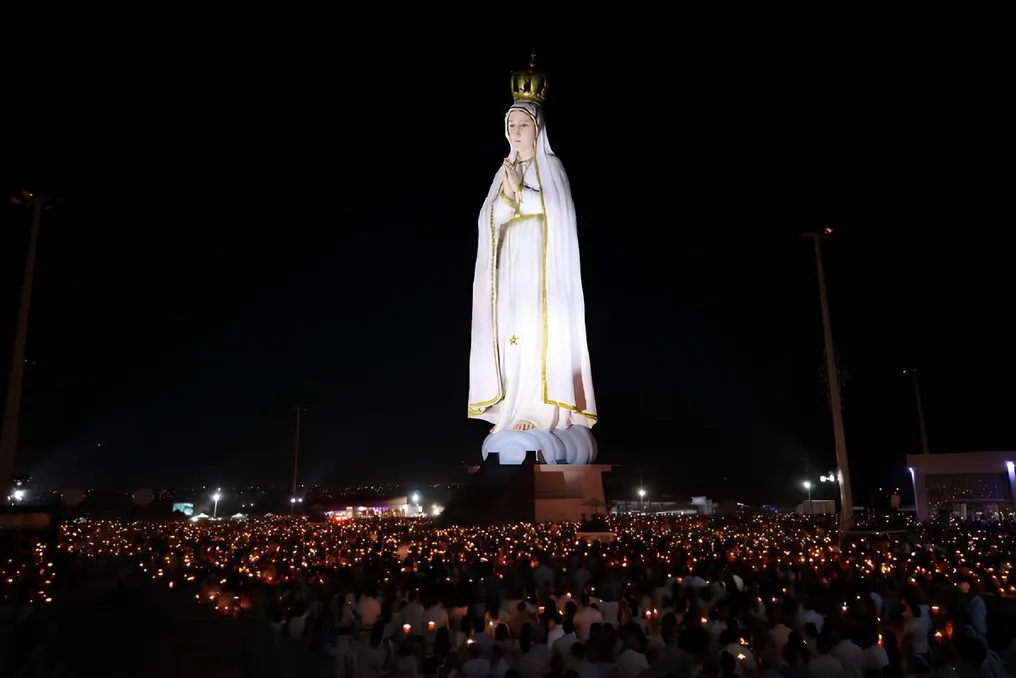
The state of Ceará has established the Faith Tourist Route, an itinerary covering 13 cities and focusing on religious tourism. This initiative was formalized by Law 15.445 of 2026, which received sanction from President Luiz Inácio Lula da Silva last week.
The route includes places of great devotion, such as the Statue of Father Cícero in Juazeiro do Norte and the image of Our Lady of Fátima in Crato. Since it is formalized by law, this route can access federal government funds intended for improving infrastructure, management, and promotion of tourist spots. Furthermore, the Ministry of Tourism may assist municipalities in preparing to receive a larger flow of visitors.
Currently, religious tourism in the Cariri area generates more than R$ 2.5 million, according to state data. The creation of the Faith Tourist Route is expected to significantly strengthen this economic activity.
In Juazeiro do Norte, the municipality is a tourist hub centered on the figure of the blessed, featuring the 27-meter Statue of Father Cícero and the Living Museum of Father Cícero. In 2025, the pilgrimage honoring the 91st anniversary of the priest's death attracted approximately 300,000 devotees. Crato gained notoriety after the installation of the Statue of Our Lady of Fátima in 2025, which is the largest dedicated to the Virgin of Fátima in the world, standing 54 meters tall. Santana do Cariri attracts tourists through the Tourist and Religious Complex of Blessed Benigna Cardoso, who honors the local saint canonized by Pope Francis in 2022. Nova Olinda is the concentration point for the Pilgrimage of Little Benigna towards Santana do Cariri, while Campos Sales stands out for the Viewpoint of Our Lady of Penha, which offers a view of the Araripe Plateau.
Canindé receives thousands of pilgrims annually due to the Statue of Saint Francis of the Wounds, which measures 31 meters. Quixadá features the modern Sanctuary of Queen of the Sertão, located atop the Urucu Range, providing a wide view of the regional hills. Russas is marked by the Parish Church of Our Lady of the Rosary, built in 1707, which is considered a state historical heritage site and one of the oldest Catholic churches in Ceará.
Baturité has the Jesuit Monastery, founded in 1922, a notable point in the Baturité Massif, a geological formation located more than 800 meters above sea level, characterized by mild and humid climate. Redenção offers the High of Santa Rita, with the Chapel of Santa Rita accessible by a staircase of 720 steps, and the Parish Church of the Immaculate Conception, erected in 1868 and a symbol of local romantic architecture. Caucaia houses the Tourist Complex of Santa Edwiges, which receives pilgrims and is distinguished by the statue of the blessed measuring 23 meters. Finally, Fortaleza, the state capital, concentrates centenary landmarks, including the Metropolitan Cathedral, the Sanctuary of Fátima, and the Church of Our Lady of Conception of Prainha.