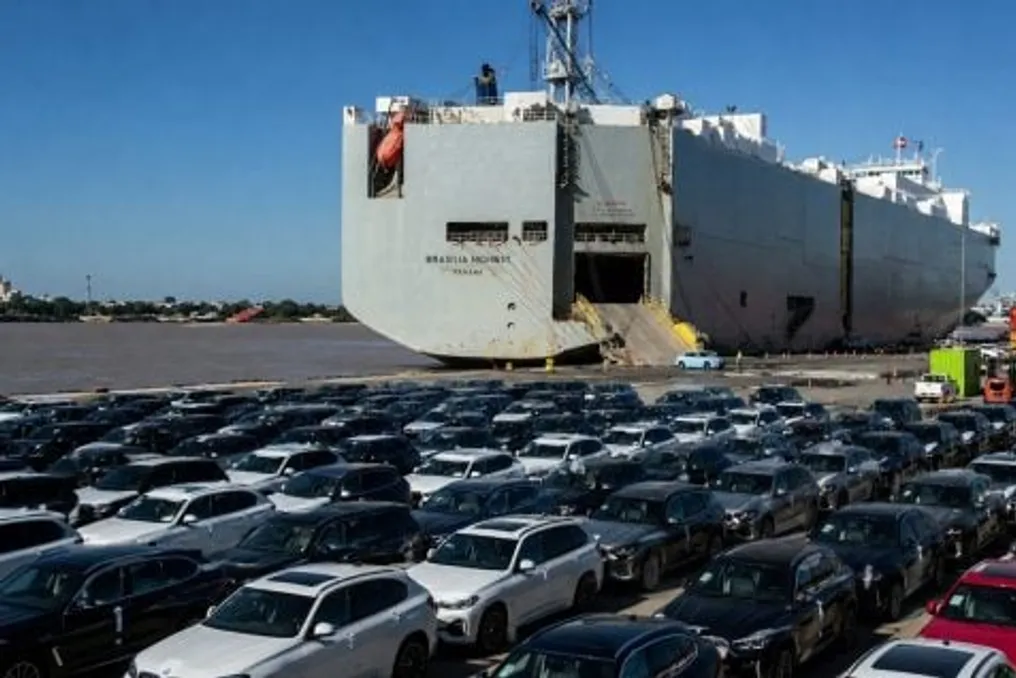
The vessel Brasilia Highway docked on Tuesday afternoon, the 7th, at the Port of Itajaí, located in Santa Catarina (SC), transporting 769 luxury vehicles from the BMW brand. With this new arrival, the terminal reached a total of 16,265 automobiles handled in 2026 through the roll-on/roll-off (Ro-Ro) system, used for transporting wheeled cargo.
This ship specializes in this type of operation and does not require cranes. The cars are removed directly from the hold by staff, who drive them down the ramp, moving between the deck and the terminal area. This same procedure applies to trucks, buses, and machinery, which handle their own loading and unloading. Due to reduced handling and lower risk of damage, this method is preferred for importing assembled vehicles.
The call of the Brasilia Highway joins several other operations carried out throughout the year. Among the ships that visited the pier in 2026, notable are the Victoria Highway, which made at least three stops, transporting 628, 674, and 767 vehicles; the Dover Highway, with 457 and 739 units in two trips; and the Good Wood, which moved 430 cars.
This progress is part of the broader recovery of the port complex. In 2025, the port registered the movement of 4.76 million tons, and in the first quarter of 2026 alone, 1.67 million tons were moved, representing an increase of approximately 40% compared to the previous year.
The resumption of activities was made possible by the dredging of the access channel, completed in 2025, which restored the necessary depth to receive large vessels. Under the management of JBS Terminais since October 2024, the terminal serves importers and exporters from 21 states and the Federal District, with investment plans of R$ 844 million scheduled between 2025 and 2030. The receipt of imported cars reinforces the complex's focus on high value-added cargo.
Artur Antunes Pereira, superintendent of the Port of Itajaí, commented that the current pace demonstrates the consolidation of the public terminal. He stated: 'After the resumption of operations, the Port of Itajaí is advancing to a new stage: consolidation. We are recovering high value-added cargo, increasing movement, and demonstrating in practice that the public port has become competitive, efficient, and strategic again for Brazilian logistics.'