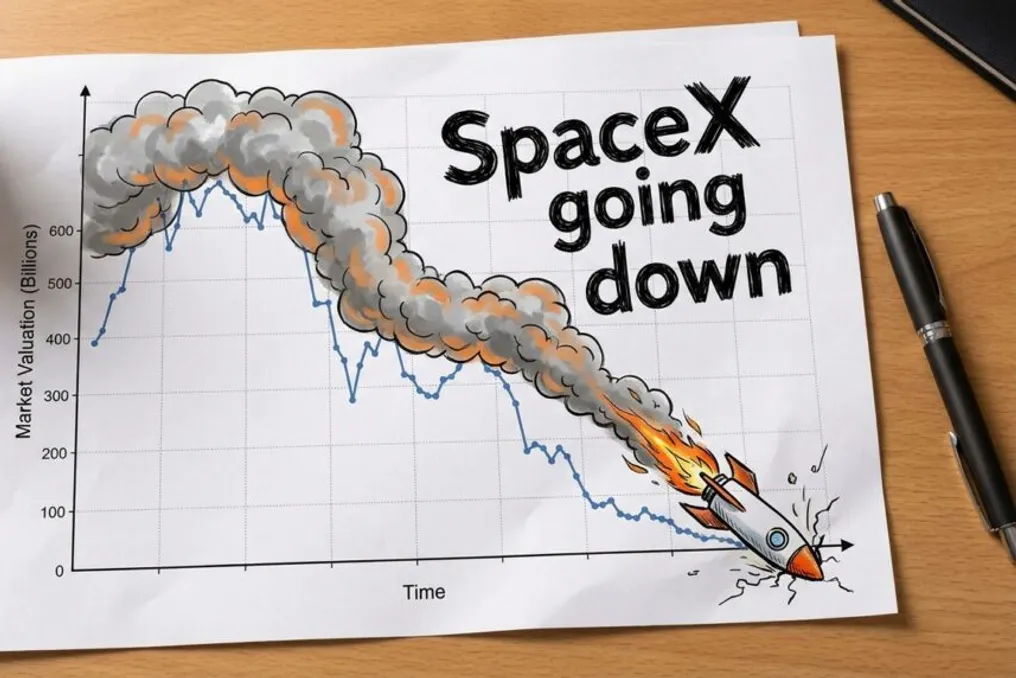
SpaceX shares closed at $148 (2,423 rubles) on Tuesday, falling below the market debut price of $150 (2,456 rubles) for the second consecutive time. This resulted in the loss of almost all revenue generated since the company's listing on June 12, which was the largest IPO in history.
Stock Performance and Losses
Before trading began, the shares were valued at $135 (2,210 rubles), and they opened at $150 on the first day of trading. After the IPO, the shares reached a peak of $225.64 (3,694 rubles) in subsequent weeks, but then declined by approximately 35%, leading to SpaceX's market capitalization being reported at about $1.9 trillion (31 trillion rubles). The decline occurred even after the company was included in the Nasdaq-100 index, which usually stimulates institutional buying.
Financial reports show that in 2025, SpaceX recorded a net loss of $4.9 billion (80.2 billion rubles), and in the first quarter of 2026, the company spent another $4.3 billion (70.4 billion rubles). These losses are due to significant expenditures on the xAI artificial intelligence division and the Starship development program.
Investments in Blue Origin
This decline came as Blue Origin, SpaceX's closest competitor, raised $10 billion (164 billion rubles) in its first round of external financing. This increased the company's valuation to approximately $130 billion (2.13 trillion rubles). Coatue Management is expected to lead this round with a commitment of $4 billion (65.5 billion rubles), while Bezos himself will add $2 billion (32.7 billion rubles) from his own funds.
Blue Origin has secured multi-billion dollar contracts from NASA and the US Armed Forces for projects such as the New Glenn heavy-lift rocket and the Blue Moon lunar lander for the Artemis program. Despite lagging behind SpaceX in launch frequency and commercial revenue, and losing the New Glenn rocket due to an explosion during a ground test in Florida in May, the attracted funds give SpaceX's main competitor a long-term 'war chest.'
Licensing Issues in South Africa
Another part of the article mentions that Elon Musk was born in Pretoria. The satellite internet service Starlink, created by the company he leads, still lacks a license to operate in South Africa. This is because ICASA requires telecommunications licensees to have at least 30% ownership from historically disadvantaged groups. SpaceX offered to meet this threshold through Equity Investment Programs, including a commitment of 500 million rubles to connect 5,000 rural schools, but ICASA confirmed in June that the official license application had not been received.
South Africans use Starlink by registering antennas in neighboring countries such as Mozambique and Namibia. ICASA warned that this workaround could result in service termination and equipment confiscation. ICASA also stated that updating its regulatory framework could take between 12 and 18 months, which rarely meets stock market expectations.