The Russian House in Tashkent held another summer water event for students, which included SUP surfing, beautiful landscapes, new acquaintances, and wild nature.
The Russian House in Tashkent held another summer water event for students, which included SUP surfing, beautiful landscapes, new acquaintances, and wild nature.
The water activity has become a good tradition among students in SUP parks. For two years, this event has been held in cooperation with the SUP surfing club 'SUP GO UZ' and the 'Rossotrudnichestvo' representation in Uzbekistan.
On July 8, more than 40 young people gathered—students from higher educational institutions of Uzbekistan, as well as students from Russian universities studying under the quota of the Russian government. The event was organized along the Anhar Canal in the area of the Japanese Garden.
Participants were given SUP boards, life jackets, paddles, and symbolic caps on site. Before the start, experienced instructors explained how to stand correctly on the board, observe safety rules, and control the board to enjoy the swim.
The swimming took place over a distance of 2.5 kilometers. The route started from the 'Morzhclub' sports club, passed along the Minor Mosque, crossed a bridge, and ended near the Japanese Garden, after which the return journey followed. The first part of the route proved difficult: students swam against the current and encountered small whirlpools. The return journey was significantly easier and more interesting, as participants enjoyed the city views and wild nature along the canal, using the force of the current.
Among the participants were both those who had previously engaged in SUP surfing and newcomers. Trainers monitored the students throughout the process, providing assistance when necessary. During the swim, students were also able to get to know each other, take photos, and support those who were trying SUP boards for the first time.
Upon returning to Kyrgyzstan, many expressed gratitude to the organizers and shared their impressions. A representative of the Russian House in Tashkent noted: 'You understand that your work will not be useless in such sincere moments.'
The qualification stage of the 'Best Book Lover' contest took place at the Southern Operational Command within the Southern Military-Western Special Military District. This contest was organized to ensure the execution of the head of state's decree from January 15, 2026, 'On measures for developing a culture of book-loving and increasing public interest in reading books,' and the corresponding order of the Minister of Defense.
Military personnel serving on mandatory duty, as well as officers and sergeants serving under contract up to the age of 30, participated in the contest. Participants exchanged knowledge and ideas in the fields of education and thinking.
Participants were tested based on two criteria. The first criterion was 'Quick Question-Answer,' where each participant answered four randomly selected questions quickly and accurately. This stage was evaluated on a 100-point scale.
The second criterion, 'Expert in Literary Works,' required participants to read excerpts and episodes from various literary works. They demonstrated their knowledge by naming the work, explaining its content, essence, idea, and educational significance. This stage was also graded on a 100-point scale.
Following the competition, participants who achieved prize places gained the right to participate in the contest to be held at the Ministry of Defense level. At the conclusion of the event, winners, prize-winners, and actively participating military personnel were recognized with honorary certificates and commemorative gifts from the Southern Operational Command.
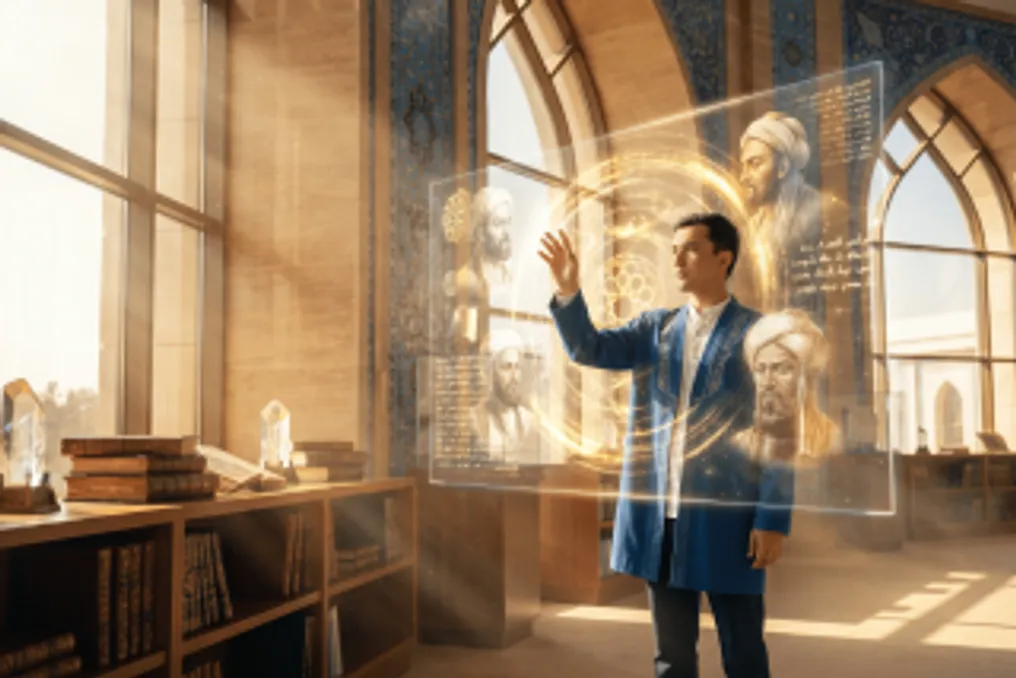
Although ancient Greece was considered the center of world philosophy, great Greek thinkers drew inspiration from philosophical sources created in the ancient East, particularly in the territory of Turan.
The roots of intellectual development in this territory go back to deep antiquity. Even before the appearance of Greek philosophers in this region, a worldview based on the struggle between good and evil had formed through the sacred book 'Avesta' of Zarathustra. This became one of the first philosophical reflections on the place of man in the world and his moral responsibility. There were also natural philosophical views among our ancient ancestors who revered the four main elements of nature—earth, water, air, and fire, which was a pure scientific endeavor to understand the origin of existence. These ideas spread not only in our region but also to neighboring countries, including Ancient Egypt and Babylon, and later reached Greece. Research shows that even representatives of the Milesian school, considered the first philosophical school of Greece (Thales, Anaximander, Anaximenes), may have adopted their ideas, especially the concept that the material substance is the basis of the world, from the East.
Turan always served as a crossroads of great cultures and intellectual currents. After the campaigns of Alexander the Great, Greek philosophy and culture penetrated here and interacted with local views. In the pre-Roman era, under the rule of the Kushan Empire, Buddhist teachings from India influenced the region, and its philosophy of reality, consciousness, and liberation from suffering affected the worldview of residents of cities such as Samarkand, Bukhara, and Termez. However, the ideas of the 'Avesta' did not completely disappear from popular memory. By the 3rd century AD, Manichaeism arose in this area, promoting ideas of equality. Later, it became the spiritual support for the Mazdaist movement, which demanded social justice. All this testifies to the constant intellectual quest of our ancestors and their attempts to find solutions to the problems of society and existence.
With the arrival of Islam in our region, a new, higher stage in the history of thought began. The scientific and cultural rise in Turan during the 9th–12th centuries can be called the First Renaissance without exaggeration. During this period, the 'Bayt al-Hikma' (House of Wisdom), founded in Baghdad, became a major center for translating ancient Greek, Indian, and Persian scientific heritage into Arabic. However, Central Asian scholars played a leading role in this process, such as Muhammad al-Khwarizmi, Ahmad al-Farrani, and Abbas ibn Sa'id Jawarizmi. They did not just translate Greek heritage; they critically analyzed it and enriched it with new knowledge, laying the foundation for entirely new scientific achievements. Muhammad al-Khwarizmi laid the foundations of algebra and introduced the concept of 'algorithm' into science, presenting humanity not only with a new method of calculation but also with a philosophical principle of ordered, logically consistent problem-solving. Ahmad al-Farrani's works on astronomy served as the main textbook in Europe for centuries. The pinnacle of philosophy during this period is undoubtedly represented by the names of great figures such as Abu Nasr al-Farabi and Abu Ali ibn Sina. Al-Farabi, celebrated as the 'Second Teacher' after Aristotle, deeply studied the views of ancient Greek philosophers, especially Plato and Aristotle, and reconciled them with Eastern thought. His work 'The City of Blessed Men' presents a perfect political-philosophical doctrine on governing society based on justice, knowledge, and enlightenment. This work was his own response and development of Plato's 'Republic'. Sheikh ur-Rais ibn Sina is a universal genius who embodied all the knowledge of his era. His philosophical system includes doctrines on being, cognition, logic, and the soul. Ibn Sina's experiment of the 'Thinking Man' laid the foundation for the human ability to understand oneself independently of external sensations, which occurred almost six centuries before the famous conclusion of the Western philosopher René Descartes: 'I think, therefore I am'. Through this experiment, he attempted to prove the existence of pure thought. Another outstanding figure of this period was Abu Rayhan al-Biruni. In his research, he demonstrated an unprecedented degree of objectivity and scientific conscience. Al-Biruni's work 'India' is a model of the first comparative cultural studies, examining the culture, customs, and religious views of other peoples without any prejudice and with high respect. His scientific method remains an example for modern researchers. Furthermore, Sufi or mystical teachings developed widely during this era. These teachings put forward the idea that reality can be grasped not only by reason and logic but also by inner intuitive knowledge, i.e., through revelation. In Yusuf Khos Hajib's work 'Qutadgu Bilig' ('Knowledge Leading to Happiness'), philosophical concepts such as state governance, justice, reason, and contentment are deeply analyzed through artistic images.
In the 14th–15th centuries, during the reign of Amir Timur and his descendants, Turan once again became a center of scientific and cultural flourishing, which can rightly be called the Second Eastern Renaissance. The great Amir Timur deeply understood the importance of science for the prosperity of his state and gathered the best scientists, architects, and masters of his time in Samarkand. The most prominent representative of this period was Mirzo Ulugbek. His observatory, built in Samarkand, was not just a place for observing celestial bodies but a symbol of the tradition of precise scientific knowledge based on experience and observation. Ulugbek's activities showed how great the support for science from a ruler could be, paving the way for great discoveries. During this period, philosophical thought developed mainly through Sufi teachings and poetry. Thinkers such as Sadiddin Tahtasuni and Mir Sayyid Sharif Jurjani elevated logic and rhetoric to a high level. In the works of Abdurakhman Jami and Alisher Navoi, eternal philosophical themes—man, his spiritual perfection, love, and justice—were exalted with the highest artistic mastery. Navoi's poem 'Khamsa' is an encyclopedia of humanism, promoting the ideals of the perfect human and a just society.
In the late 19th and early 20th centuries, when Turkestan was experiencing deep socio-political and economic decline, the Jadids emerged. Enlightenment figures such as Mahmudkhodja Behbudi, Abdurauf Firat, Abdullah Avloni, and Munawvarkori Abdurashidkhonov believed that the only path to national awakening and liberation from stagnation lay through enlightenment. Their activity was aimed at creating a new national philosophy. The philosophy of the Jadids included reforming education, opening schools using new methods, promoting progressive ideas through the press and theater, as well as issues of women's equality and understanding national identity. In Firat's works, such as 'Oila' or 'Rahbari Nazhot', ideas about strengthening the family as the basis of society and educating the younger generation in modern knowledge and national spirit were deeply analyzed. They criticized outdated orders and called for development and renewal. Unfortunately, their noble aspirations ended tragically due to the repressive policies of the Soviet regime, and many of the nation's most outstanding figures perished.
During the Soviet period, Uzbek philosophy faced a deep ideological crisis. It was turned into a servant of the ruling communist regime and the doctrines of Marxism-Leninism. Any national and independent thought was condemned as 'bourgeois nationalism'. The translation of literature first from Arabic to Latin script, and then to Cyrillic, completely separated the people from their long-standing rich scientific and literary heritage. Nevertheless, thanks to the efforts of scholars such as Academician Ibrahim Muminov, Vahid Zokhidov, and Muzaffar Khayrullaev, certain studies on the history of philosophy, particularly on the heritage of Central Asian thinkers, were conducted despite ideological pressure. Ibrahim Muminov tried to justify the place of Amir Timur in history while facing serious obstacles. Studies of that time were mainly conducted in the fields of philosophy of history, logic, and ethics, but all of them were viewed through the prism of the dominant ideology.
After Uzbekistan gained independence, crucial tasks were set before national philosophy: to cleanse it of ideological shackles, re-examine the rich historical heritage, and develop the philosophical foundations of national development. The period of recent years has received a particularly large impetus for this. The idea of creating the fundamental Third Renaissance in the country represents a new national philosophical program. The main directions of contemporary Uzbek philosophy include: firstly, a critical reassessment of the historical and philosophical heritage. Today, the legacy of geniuses such as Khwarizmi, Farabi, Ibn Sina, Biruni, Ulugbek, and Navoiy is studied not merely as a historical monument but as a source of ideas relevant to modern Uzbekistan. Secondly, rethinking the idea of national sovereignty in light of modern global challenges. The principles of building an open, democratic, and legal state, as well as human values, are philosophically substantiated in this context. Thirdly, analyzing the problem of preserving national identity in the context of globalization. While the influence of information flows and 'mass culture' increases, ensuring a balance between adherence to national values and openness to universal achievements is one of the most pressing tasks of contemporary philosophy. In conclusion, the philosophical thought of the Uzbek people has undergone a long, rich, and complex journey over millennia. It has made a huge contribution to the development of world thought, surviving several cycles of rise and fall. Today, the deep study of this invaluable heritage, its connection to the demands of modern development, and the outlook for the future is the foundation of the spiritual revival of New Uzbekistan and the solid basis of the Third Renaissance.
The celebration of the Day of Press and Mass Media Workers took place at the Berdak Theater in Karakalpakstan on June 27.
The Chairman of the Jogorku Kengesh of the Republic of Karakalpakstan, Amambai Orinbayev, congratulated those present on the professional holiday. It was noted that in recent years, under the leadership of the President, large-scale measures are being taken to ensure freedom of information and support the media. The work of industry employees in conveying changes in the socio-political and economic life of the country to the public is highly valued, especially within the concept of 'For Human Dignity'. In honor of the holiday, several workers were awarded distinctions, including the 'Shuhrat' medal from 'Jaslar TV' channel and 'Nukus FM' radio.