Ensuring residents of Karashadary region have access to quality drinking water has become one of the priority areas for developing social infrastructure in recent years. Large projects, implemented with the participation of international financial institutions, are bringing the water supply system to a completely new level.
Rural Development Program
In accordance with the President's decree No. PQ-141 of March 28, 2024, work has begun on the construction and reconstruction of drinking water supply systems in 25 settlements of the Kitob, Shahrisabz, Yakkabog, Kamashi, and Guzor districts of Karashadary region, as part of the second stage of the 'Comprehensive Rural Development' project, implemented with the participation of the Islamic Development Bank.
The total cost of these projects is 94.7 billion soums, with construction and installation works planned for 60.1 billion soums by 2026. To date, 269.3 kilometers of new water pipelines have been laid, and modern engineering solutions have been introduced to ensure reliable system operation through the construction of several water management facilities.
Results by District
Indicators in the covered territories are also noteworthy. In the Kitob district, 40.6 kilometers have been laid in six settlements; in the Shahrisabz district, 60.1 kilometers in four settlements; in the Yakkabog district, 31.7 kilometers; in Kamashi, 45.4 kilometers; and in the Guzor district, 93.5 kilometers of new drinking water networks. These figures reflect an improvement in the daily life, health, and quality of life of thousands of families.
Situation in Guzor
Special attention is paid to the work being carried out in the Guzor district. This district has a population of 227 thousand people, of whom currently only 77.9 thousand, or 34.3 percent, use centralized drinking water supply. The rest of the population is forced to obtain water using special trucks, which created not only additional expenses but also a number of problems related to sanitation and living standards.
As part of the current project, 121.3 kilometers of new drinking water networks are being laid in the settlements of Humdon, Khalqobod, Yangiobod, Muminobod, Boston, and Chanoq, with 19.5 billion soums allocated, and construction and installation works are proceeding at an accelerated pace. Additionally, $18.1 million has been allocated for the construction of nine water pipelines in the center of the district, a modern wastewater treatment plant, and six sewage pumping stations.
Planned Effect of the Projects
After the completion of these projects, 38.9 thousand people will gain access to centralized drinking water supply for the first time, increasing coverage from 34.3% to 51.5%. It is also planned to increase the coverage of wastewater disposal services from the current zero level to 17%.
According to Allaiyor Toxtaev, chief engineer of the Guzor district water supply enterprise, the situation in the district has changed dramatically over the past six years. He noted that in 2020, the share of the population supplied with centralized drinking water was only 3%, while today it has reached 34%. After the full launch of the new projects, this indicator will exceed 51%. Currently, water is supplied to 12 settlements, and soon this number will reach 18. The specialist added that eight reservoirs with a total capacity of 16 thousand cubic meters serve the district.
Ikhtiyor Umarov, head of the information department of the joint-stock company 'Karashadaryo Suv Ta'minoti', reported that about 60% of the construction work has been completed. He specified that 121 kilometers of water pipeline network are being laid under the project, and construction work is planned to be fully completed in September of this year.
Personal Experiences of Residents
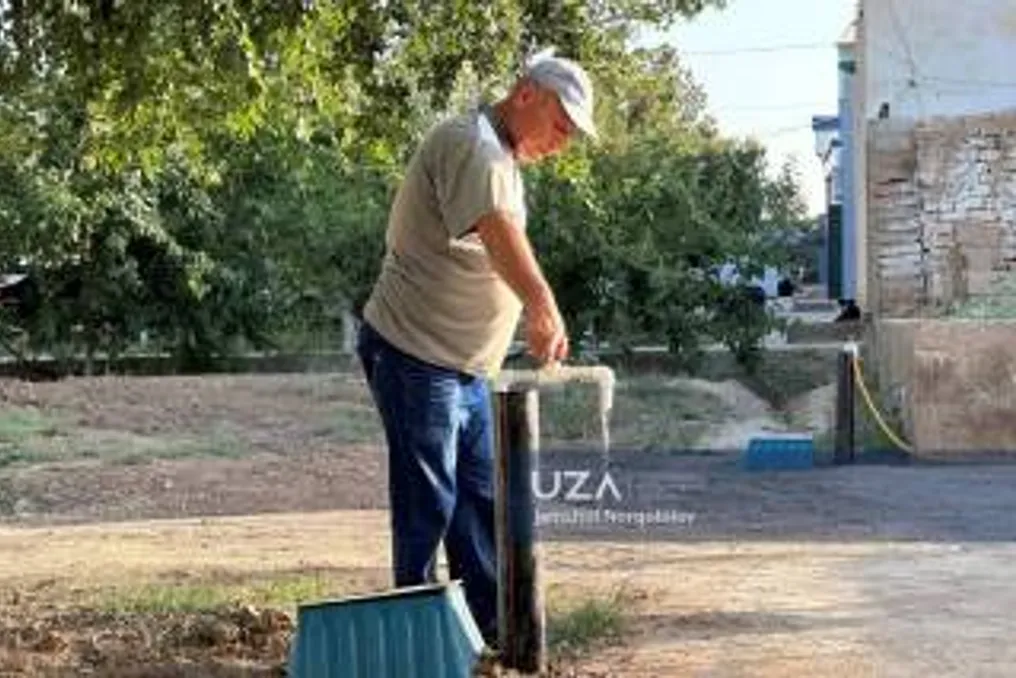
However, the true value of these indicators is revealed in how they affect people's lives. Mastura Haiitova, head of Chanoq settlement, said that water pipelines have been laid in all 673 houses in the village, and meters and taps have been installed. She emphasized that previously residents spent 250–300 thousand soums on one water truck, whereas now water comes directly to the door of each house, which has eased life.
Resident Dilrobo Berdieva gave examples of changes in daily life. She noted that after living in the house for 35 years, the water, which used to be bought expensively and stored for months, now comes to the house, which is not only a convenience but also a significant saving.
Dilrobo Yuldosheva, head of Humdon settlement, expects that soon all about 1200 houses in the village will be provided with drinking water. She noted that previously people had to bring water themselves, but now construction is underway on all streets, and people's mood has improved because they feel these changes in their lives.
The main thing is that the success of these projects is measured not by built pipes or money spent, but by real changes in people's lives. Houses that previously spent hundreds of thousands of soums on water delivery now benefit from stable utility services. Sanitary conditions are improving, time and money are being saved, and most importantly, people's faith in the future is strengthening.
These projects, implemented in Karashadary, are not limited to infrastructure construction. They are a practical embodiment of the principle of 'Human Value' through improving the quality of life of the rural population and reducing regional disparities.