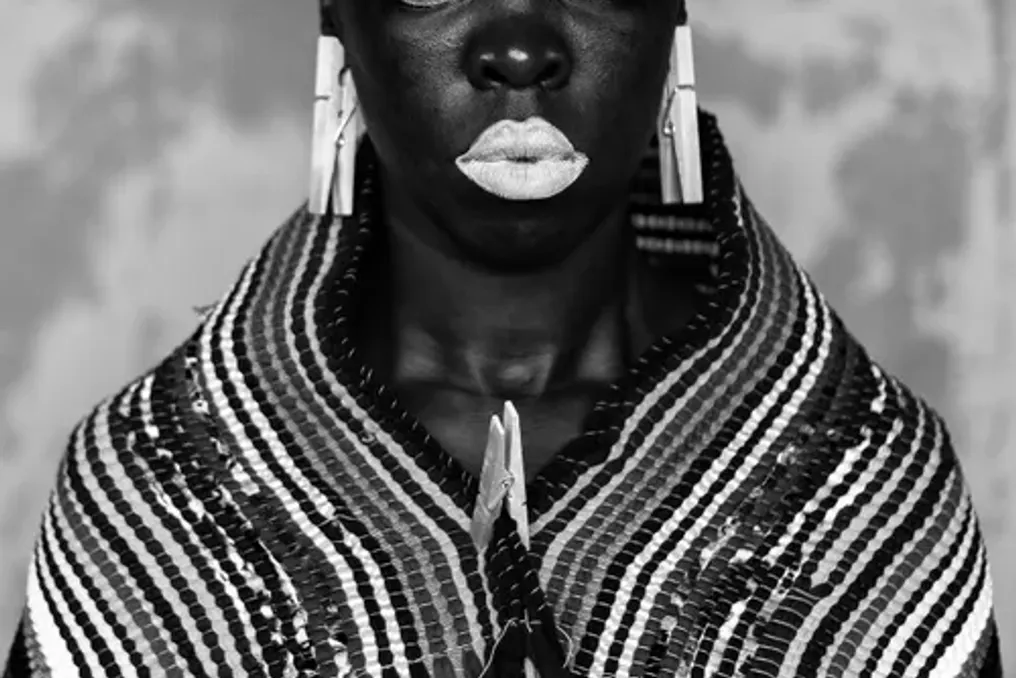
After years of exhibitions in leading global museums and galleries, internationally recognized South African visual activist and artist Zanele Muholi presents a major solo exhibition in her homeland, marking two decades of her visual activism.
The exhibition 'Alongside You' will take place at Southern Guild in Cape Town on July 18th and will be Muholi's first major solo exposition in South Africa in many years. The exhibition covers more than two decades of creativity, uniting photographs, sculptures, and films that celebrate the lives of Black LGBTQ+ individuals, exploring themes such as identity, memory, resilience, and sense of belonging.
This showing marks an important return for Muholi, whose work has received international recognition, including being awarded the Hasselblad Prize in 2026. The artist noted: 'Returning home this year feels profound.'
The exhibition coincides with several personal and national dates. It marks the 20th anniversary of the start of the Faces and Phases portrait series, which documents the Black LGBTQ+ community and was created in response to the violence, discrimination, and invisibility faced by members of this community. Furthermore, this year commemorates the twentieth anniversary of the death of Muholi's nephew Nkantiso and friends during the HIV/AIDS epidemic, the twentieth anniversary of South Africa's Civil Union Act, the 70th anniversary of the Women's March of 1956, the 50th anniversary of the Soweto Uprising in 1976, and 30 years of democracy.
Works named after the isiZulu phrase meaning 'with you,' 'alongside you,' or 'unity' explore themes of identity, memory, visibility, resilience, and collective care. Among the presented pieces are the Faces and Phases series, Only Half the Picture, Being, Mo(u)rning, ZaVa, LiZa, as well as the internationally renowned self-portrait series Somnyama Ngonyama (Hail the Dark Lioness). The exhibition also includes newly created bronze sculptures dedicated to lineage, vulnerability, protection, and strength.
At the heart of the exhibition is Faces and Phases—an ongoing archive that began in South Africa in 2006 and subsequently expanded internationally, including portraits taken in cities such as London, Porto, Panama City, Los Angeles, Salvador, São Paulo, and Venice. Muholi stated that the goal of this work is to preserve the stories that form part of South Africa's collective history. She emphasized: 'Art is a form of education. Through these images we learn to see, remember, and care for ourselves and others. Every portrait, every sculpture carries a story belonging to our collective history. This is how we build dignity and understanding for future generations.'
The exhibition will run until September 10th at Southern Guild, Silo 5, V&A Waterfront, offering South Africans a rare opportunity to see one of the country's most influential contemporary artists on home soil.
According to data from the Chinese Center for Disease Control and Prevention, published by China Daily, 79 thousand confirmed cases of COVID-19 were registered in the PRC in June of this year.
Among these cases, 130 severe cases and one death were noted. These figures exceed the data from May, which amounted to about 21,861 cases, and April, when 23,477 cases were recorded, indicating a worsening situation.
It is emphasized that all identified cases are linked to the 'Omicron' variant, and no signs of new strains have been detected.
Following a substantive discussion at the Winter Wool Festival in the Karoo, co-founder of Food For Mzansi, Ivor Price, shared his thoughts on what agriculture, journalism, and the Karoo landscape itself can teach South Africa about responsibility, trust, and the voices that often go unheard.
The Karoo is a place where noise does not reach. This region has never been interested in spectacle; it demands patience and rewards consistency. It tolerates no shortcuts, slogans, or performative outrage, only asking whether a person has the character to endure another season. The author believes this is precisely what South Africa needs right now.
The panel discussion touched upon familiar themes: politics, media, trust, disinformation, and the future of organized agriculture. Despite heated debates, honest reflections, and complex questions, the author concluded that the wrong things were being discussed. He emphasized that modern media often overlooks the people who quietly support communities.
For many years, the author traveled across the country, telling the stories of farmers who rarely make headlines. These include young livestock farmers in the Eastern Cape, women growing vegetables in rural KwaZulu-Natal, emerging commercial farmers in Limpopo, and wool producers in the Karoo. These families measure success not by social media followers, but by rainfall levels, calving percentages, and the ability to provide a life on the farm for the next generation.
Food For Mzansi was founded to challenge this trend. The organization has worked for years to change the perception of the South African farmer, who is too often viewed through narrow political prisms, as if agriculture belongs to only one language, one race, or one version of history. However, the truth is much richer: the future of South African agriculture is multilingual, multi-racial, and deeply entrepreneurial.
Some of these farmers operate small plots, others large, but all deserve a place in a national dialogue that cannot be built on fear. Fear is easy to create, as news feeds are daily filled with angry messages specifically designed to provoke an emotional rather than a rational response. Algorithms have found that anger spreads faster than hope.
During the discussion, the growing influence of social media on public opinion was noted, but the author argues that South Africa is not Twitter or Facebook. Real South Africa is found in places cameras rarely visit: in wool processing sheds where generations work side-by-side, in classrooms where agricultural sciences open doors closed by poverty, and in informal markets, family farms, and cattle auctions. These people are interested in food production, job creation, and building businesses, not ideological disputes.
Farmers understand the concept of stewardship: the land underfoot belongs to no one permanently; it is borrowed from the future. Whatever the outcome, it either enriches or depletes that land. The same applies to democracy, journalism, and leadership. Responsibility is not about winning today's debate, but about leaving behind stronger institutions for future generations.
The author asserts that journalists should primarily be accountable to the public, not to governments, political parties, or lobbying groups. This public is not the one living online, but those who rise before dawn to milk cows, shear sheep, inspect gardens, harvest maize, and pack fruit, while maintaining faith in a better tomorrow. It is these people who explain the importance of agricultural journalism, as agriculture has always been about more than just food—it has been about dignity and belonging.
Driving through the Karoo, surrounded by landscapes that have weathered governments, ideologies, and generations of politicians, the author recalled that journalism often forgets: nations are held together not by rage, but by trust. And trust, like good soil, is built slowly, fiercely protected, and carefully passed on to the next generation. Perhaps this is the true task for all of us—to become a nation worthy of believing in its own stories.
American actress Raven-Symoné was spotted in Cape Town during the filming of the highly anticipated movie 'The Cheetah Girls: Next Gen' in South Africa. The actress, singer, and producer was relaxing at a local restaurant with Nigerian-American documentary award winner, television producer, and activist Nneka Onuor.
Nneka Onuor shared a video on Instagram featuring both of them enjoying the winter sun, with Symoné drinking a smoothie and observing the relaxed atmosphere. Onuor captioned the post, noting: 'I love spending time with my person from the beginning in South Africa @ravensymone… some friends feel like home.'
Symoné looked just as relaxed in the Mother City, and fans were happy to see the Disney star enjoying her time in Mzansi. The actress recently confirmed via Instagram that production on 'The Cheetah Girls: Next Gen' has officially begun. Sharing a behind-the-scenes shot, she wrote: 'POV: heading to the set of The Cheetah Girls: Next Gen.' She then added another exciting message: 'This is happening, and it is CHEETAHLISHIOUS.'
The upcoming Disney film introduces viewers to four new friends whose unbreakable sisterly bond and shared passion for music form the basis of the plot. Raven-Symoné will return in her beloved role of Galleria and will also serve as an executive producer on the project.
Fans of the franchise can also expect the return of several familiar actors. Adrienne Bailon will reprise her role as Chanel and join the production as a co-producer, while Sabrina Bryan will appear in a special role as Dorinda. Bailon and Bryan participated in all three original 'Cheetah Girls' films, including 'The Cheetah Girls: One World.' Lynn Whitfield will also return as Galleria's mother, Dorothea, and Lori Alter will once again play Chanel's mother, Juanita. Since filming is taking place in South Africa and many actors from the original cast are returning, 'The Cheetah Girls: Next Gen' is already generating excitement among Disney fans awaiting the next chapter of their favorite franchise.