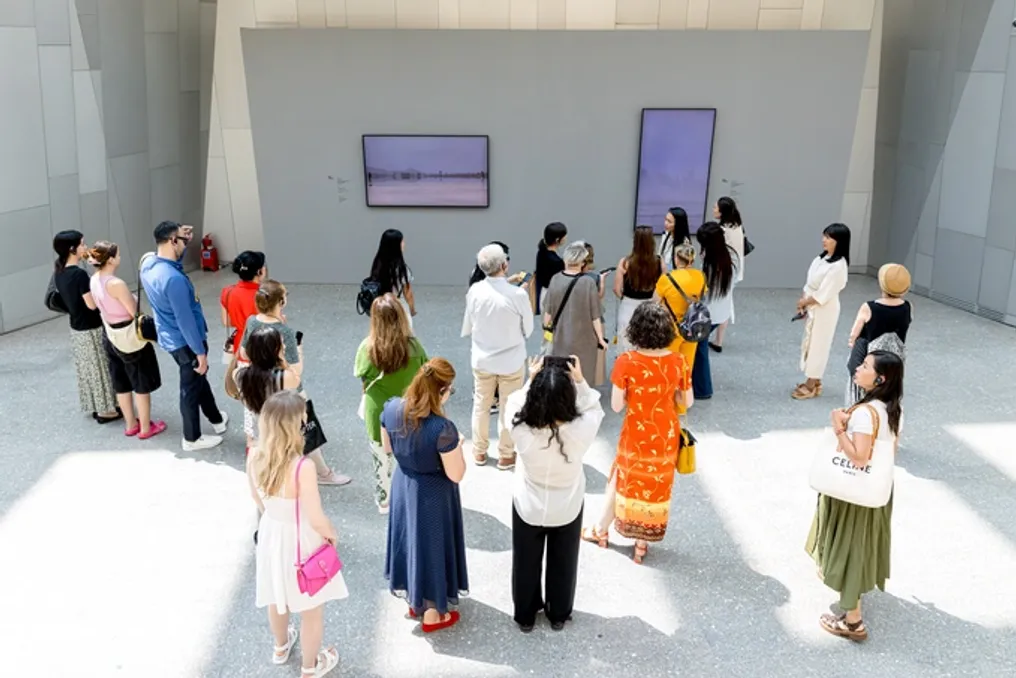
A retrospective of Bill Viola (1951–2024) has opened at the Almaty Museum of Modern Art (ALMA), a significant event because the works of this video art pioneer have not previously been exhibited in Central Asia. The closest event to the region was his solo exhibition at the Pushkin Museum of Fine Arts in Moscow in 2021, which was the first of its kind in Russia.
Popular
The Artist's International Career
For decades, the exhibition activities of one of the most influential video artists of the late 20th and early 21st centuries spanned leading global art institutions. These included MoMA in New York (USA), the National Gallery and Tate Modern in London (UK), the Guggenheim Museum in Bilbao (Spain), and the Grand Palais in Paris (France).
Arrival in Kazakhstan
Kazakhstan managed to include its venue in the list of Almaty Museum of Arts, which began operations in September of the previous year. Initially, Almaty residents and city visitors were able to see Viola's original installation 'Stations' (1994), acquired by the museum founders, Nurlan and Madina Smagulov, for one of the four 'Artist Halls'. Nine months later, the ALMA team presented the public with the first international exhibition project—the retrospective 'Space of Time', dedicated to the memory of Bill Viola, who passed away in 2024.
The Museum Founders' Vision
Nurlan Smagulov, one of the museum's founders, noted that the main goal was to host an international exhibition of high level in Almaty, emphasizing that Bill Viola is a global figure. He shared that the idea of needing to encounter world video art in Almaty arose after visiting his exhibition in Liège (Belgium) in 2017. Smagulov expressed hope for guests from China, Azerbaijan, Russia, and Uzbekistan to personally see Viola's works. He also stressed that the opportunity to connect with the artist's work reflects the museum's core concept—integrating Kazakhstan into the global artistic context, which is important for inspiring local and Central Asian artists.
Organization and Exhibition
The exhibition was organized by the Almaty museum with financial support from Halyk Bank and in partnership with Bill Viola Studio, curated by Kira Perov, the artist's wife and collaborator. The exhibition includes 18 works, ranging from large immersive to more intimate video installations created by the master between 1977 and 2013. These pieces are displayed in the 'Uly Dala' hall, which features high ceilings of 12 meters.
Creating an Immersive Space
The joint technical team of ALMA and Bill Viola Studio set up a mystical labyrinth of corridors and 'installation rooms' on an area exceeding 1000 square meters over 40 days, these spaces are termed liminal or transitional. Exhibition coordinator Dayana Vafina explained that such zones are necessary so that visitors can slow down and contemplate what they see in their journey through time. Vafina added that interacting with each piece requires concentration and openness, as the exhibition develops sequentially through this 'space of time.'
Technical Aspects and Sound
The installation process proved complex, requiring the use of various equipment for video playback, including LCD screens, CRT monitors, and projection panels. Specialists from the 235 media laboratory in Germany manufactured and installed parts of sculptural objects, such as 'Heaven and Earth' (1992) and 'Incrementation' (1996). The technical diversity demonstrates the evolution of media technologies over nearly forty years, showing how Viola's video installations became increasingly grandiose, and the screen transformed from a flat surface into a voluminous, sometimes frightening space.
The Significance of Sound and Absence of Text
Sound design plays a key role: many installations contain their own sound elements—the noise of water, whispers, or nature sounds. This sonic palette becomes part of the exhibition's architecture, lending it an atmosphere reminiscent of a dream world. A distinctive feature of Viola's exhibitions is the deliberate absence of explanatory captions, which aligns with the position of the artist and his studio. Viola, who deeply studied religions and spiritual practices, believed that description limits understanding, and for him, conveying experience at the level of sensation was more important.
Viola's Creative Philosophy
In the artist's view, experience is a form of knowledge, and he offers the viewer the opportunity to make their own discoveries. The main themes addressed by Viola include life and death, self-awareness, rebirth, the nature of time, and human emotions. The artist insisted on the authenticity of the transmitted material, asserting that it does not replace true experience with spectacular spectacle. For instance, to create the installation 'Fire Woman' (2005), a pool was built in the hangar into which a woman fell, surrounded by a real wall of fire.
Self-Portrait and Legacy of Classics
In his early works, Viola often depicted members of his family. The installation 'Incrementation' (1996) is considered a kind of self-portrait: a black-and-white image of the artist is displayed on the wall, next to a red counter tracking each of his breaths. By the time of the exhibition's opening, the counter had exceeded 4 million, comparable to the approximate number of breaths a person takes in 85 years of life. Although Viola died at 73, his digital version continues to 'breathe'. In his search for meaning, Viola referred to art history, seeing in it a continuation of classical painting traditions, which he called the 'great hidden tradition'. In an interview with curator John J. Hanhardt, he noted that the movement of consciousness is the true subject of old masters' paintings, and painting could resemble Zen.
The Influence of Water and Conclusion of the Exhibition
The audiovisual installation 'The Greeting' (1995) is a striking example of adherence to Mannerist traditions, particularly the painting by Jacopo Pontormo. Using slow-motion technique, Viola makes the moment tangible and eternal. Water also plays an important role in his works, helping to visualize the space behind the screen. For Viola, water is not just a technique but a primary element, symbolizing purification, birth, and transition. This exhibition can be experienced at the Almaty Museum of Arts until January 17, 2027.