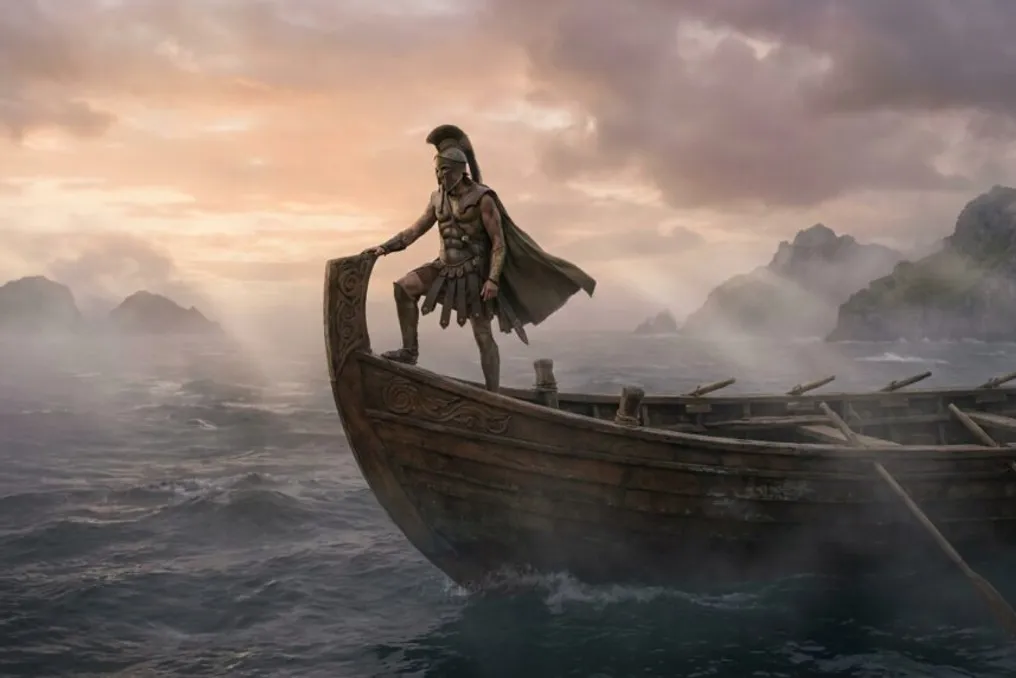
Christopher Nolan's film 'Odyssey,' scheduled for premiere on July 17, has already sparked heated discussions among critics who attended the world premiere at Leicester Square on Monday. These reviews have been highly enthusiastic.
This three-hour adaptation of Homer's epic poem took place in London. The cast includes Matt Damon as Odysseus, Anne Hathaway, Tom Holland, Zendaya, Lupita Nyong'o, Robert Pattinson, and Charlize Theron, who is from South Africa. The film was shot entirely on large-format IMAX cameras, and its estimated budget is $250 million (approximately 4.58 billion rands). According to The Guardian, it needs to gross at least $500 million (about 9.15 billion rands) to break even.
Universal Studios declined standard influencer screenings, so initial opinions were primarily formed among the press invited to the gala event. Steven Weintraub from Collider called the movie 'INCREDIBLE,' noting that 'everything—from the flawless acting to how Nolan uses the supernatural—is just perfect,' and strongly advised viewers to watch it in IMAX 70mm for a 'breathtaking experience.'
Eric Davis, writing on X, characterized the work as an 'absolute triumph and the pinnacle of cinematic achievement by one of the greatest directors of our time,' adding that 'the scale is unlike anything he has done before.' Davis specifically highlighted Robert Pattinson, who plays the villain Antinous, stating: 'Robert Pattinson simply stole the show for me.' He noted that Pattinson fully immerses himself in the character's villainous nature, making it one of the most striking roles of his career.
Aaron Couch from The Hollywood Reporter pointed out an unexpected element—a 'developed horror scene' from a director not known for this genre, emphasizing that 'Odyssey' is something new in Nolan's filmography in the last 25 years. Anne Thompson from IndieWire went further, naming the film a contender for Best Picture and suggesting that Damon 'could win Best Actor.' However, not everyone was unanimous. The lead critic at IndieWire, David Ehrlich, described the picture as 'surprisingly natural' and 'less desperate' compared to Nolan's previous film 'Oppenheimer,' which won the Oscar in 2023 and grossed nearly $1 billion (about 18.3 billion rands) at the box office, but also found it 'too cumbersome to be an S-tier Nolan, although the final act rewards the journey.'
Presenting the film on Monday evening, Nolan told the audience at Leicester Square that the premiere there was a 'moment of full circle,' as he grew up watching films in that same cinema, and had 'dreamed of one day making a film that would fill this screen.' He then offered a lighthearted warning to the attending critics: 'You are the first in the world to see this film, so please be kind.' Full reviews remain under embargo until closer to the July 17 release date. Judging by the initial reactions, Nolan did not need to worry.
Musical works by South African artists, including Amapiano styles and local hip-hop, are being covertly collected by global artificial intelligence (AI) companies. These tech firms are allegedly scanning local music catalogs to train AI models without obtaining permissions, citing authorship, or providing compensation.
The inclusion of music from artists such as Kabza De Small, Nasty C, and DJ Maphorisa into machine learning systems allows these companies to create commercial software capable of generating synthetic music. This raises concerns that South African culture is being monetized without fair compensation for the creators.
The data collection process occurs when AI bots browse the internet to download large volumes of metadata and music. A data audit conducted by cybersecurity firm Cybrsec Clinique showed that Kabza De Small appeared in documented AI training sets 360 times, followed by DJ Maphorisa (270), Spirit of Praise (212), Nasty C (193), and Thomas Chauke (183).
This practice extends to independent labels, electronic musicians, and historical catalogs, including the works of the late Hugh Masekela. According to CISAC, unlicensed generative AI could divert up to 25% of creators' royalties globally, as AI-generated tracks increasingly compete with human music without paying royalties to the artists whose work influenced them.
The issue became central at the sixth Africa Rising Music Conference (ARMC), held at Constitution Hill, where participants from Africa and around the world discussed creators' rights in the age of automation. One significant outcome was the expansion of the Berlin AI Think Tank in Johannesburg through a partnership between Paradise Worldwide, AIxchange, the Association of Electronic Music (AFEM), the Fraunhofer Institute for Digital Media Technologies (FIDMT), SAMPRA, CAPASSO, and SAMRO.
At the core of this initiative is the Creative Weight Attribution (CWA) system, currently patenting, developed by AIxchange and FIDMT. It measures the degree of influence an artist's work has on an AI model, which could potentially pave the way for automated licensing and fair remuneration.
Meanwhile, Gallo Records General Manager Rob Cowling warned that unauthorized AI scanning threatens both contemporary artists and Africa's musical heritage. He stated that Gallo is creating a protected environment around its content to guard against AI scanning and will challenge any companies using their content for AI purposes.
South Africa's legal framework is struggling to keep pace with AI development. Copyright is still governed by the Copyright Act of 1978, creating uncertainty regarding ownership rights of AI-generated works and who ultimately holds the copyright—developers or users. Karla Denehi, a partner at Webber Wentzel and member of the firm's AI legal advisory working group, notes that enterprises using AI-generated content without proof of ownership risk infringement, liability, and reputational damage.
Entertainment legal professionals are closely watching the expected copyright amendment bill, fearing that AI developers might invoke 'fair use' or 'fair dealing' provisions to justify scanning copyrighted works. Rights holders insist that commercial AI training must require licenses because the final product directly competes with original music.
SAMRO supports initiatives like the Berlin AI Think Tank while simultaneously working with legislators to develop norms ensuring fair compensation for creators when their works are used to train AI. SAMRO emphasizes that 'legislative guidelines will be crucial to ensuring proper protection and guarantees in the interest of those who use these services.'
Beyond copyright disputes related to AI companies using artists' works, there is another issue: how generative AI is transforming the music production process itself. The sensation TikTok Credo V. Daniels found himself at the center of this discussion after a widely criticized live performance on eNCA, which revealed a stark contrast between his vocals and polished studio recordings.
Daniels later admitted to using AI-supported tools in his creative process, claiming they supported rather than replaced his artistic vision. His explanation drew criticism from industry figures, including artist manager Justo Klo, who urged him to take greater responsibility for the music creation process.
The conflict intensified after allegations that Daniels' song 'Ngafa' copied elements from Hozier's song 'Cherry Wine'. Although these claims remain disputed, Apple Music eventually removed his debut album 'Still Where We Were' from the platform.
The South African music industry is now facing a dual challenge from AI: protecting artists' works from unauthorized commercial data harvesting and maintaining trust and authenticity in the age of AI-generated music.
Johannesburg's public libraries are vital community resources amid rising costs. Driven by a growing petition to resume Saturday hours, the role of libraries in modern urban life is being highlighted.
In an era where almost everything has a price, Johannesburg's public libraries remain one of the few places where knowledge, community, and opportunities are available free of charge. The increasing support for the petition to restore Saturday operating hours raises a broader question about the function of libraries in a modern metropolis.
The modern library has long gone beyond being just a place to borrow books. Today, it is a space where a high school student can print an assignment due to lacking a printer at home, where a parent introduces a child to reading without needing to spend hundreds of rand in a bookstore, where a job seeker updates their CV using free Wi-Fi, where pensioners attend book clubs, and where youth find one of the few places where they don't have to buy anything.
Therefore, the growing petition demanding the return of Saturday library hours in Johannesburg resonates with many citizens. The organization Friends of the Johannesburg Public Libraries NPC, in collaboration with Joburg Crisis Alliance and Johannesburg Heritage Foundation, has launched a public campaign addressed to the Johannesburg City Council, demanding the resumption of Saturday services. Proponents argue that weekday-only access excludes many people who rely most heavily on the libraries.
According to Zarah Natalie, head of Friends of the Johannesburg Public Libraries NPC, this discussion is about much more than just opening library doors. She emphasized that 'libraries are more than resource centers. They are one of the few free, non-commercial spaces available to everyone.'
For many Johannesburg families, Saturday is a time when life slows down, allowing them to catch up. It is a moment when parents can take children to educational activities, students can study without school distractions, and full-time working individuals can utilize services unavailable during their work hours.
Natalie notes that the loss of Saturday access has disproportionately affected working-class families. She explained that due to financial constraints, many cannot afford to buy books, computers, or internet access, relying instead on public libraries. Consequently, they lose the opportunity to engage in personal leisure reading, socialize with others, and participate in community programs in a safe and supportive environment.
For many households, the library is not just a place to borrow books, but an accessible source of internet, educational materials, and a welcoming public space. Urban planners often speak of the importance of the 'third place'—a space that is neither home nor work, where people can gather, learn, or simply spend time. While coffee shops can offer something similar, this requires funds for coffee, and shopping malls are geared towards spending.
Libraries are unique because they require nothing in return except passing through the front door. Natalie asserts that closing libraries on Saturdays deprives Johannesburg of one of its few truly inclusive public spaces. She warned that if the doors remain closed, many young people will lose free, safe, and quiet places for learning and studying, as well as access to educational materials and free reading programs.
The campaign warns that the long-term consequences of Saturday closures extend beyond just missing a library visit. Parents working during the week often count on weekends to take children to story-telling sessions and borrow books for continued reading at home. Natalie stated that closing libraries on Saturdays excludes many young people from accessing books they could take home for reading and study in their free time.
In her view, early childhood literacy education is under particular threat. She specifically highlighted the importance of toddlers attending reading programs in libraries, as well as the ability to take age-appropriate books so parents can help develop reading skills at home. Natalie believes this impact can be felt into adulthood: people with low literacy or difficulty comprehending what they read will face limited opportunities in the workplace.
According to Natalie, the closure was caused by changes in library staff schedules. She reported that this was a decision by the mayor to change employee working hours from 40 hours per week over six days to 40 hours per week over five days. This shift resulted in Johannesburg libraries closing on Saturdays. Previously, libraries operated on a rotating schedule that allowed staff to alternate days off, keeping branches open on Saturdays. Natalie insists that this would not have happened if the previous successful arrangement had been maintained, and therefore, the Council and the Mayoral Committee led by the Mayor should be held responsible.
She added that the campaign has engaged with the city's library department but has not yet submitted the petition to the municipality as she continues to gather public support.
Responding to whether this is related to a lack of political will or resources, Natalie believes both factors are to blame. She posits that libraries are not viewed as an essential service, which reflects a lack of political will. Furthermore, there are budgetary constraints, as she believes vacant positions cannot be filled, and there is insufficient staff to cover shifts.
Despite acknowledging that reopening libraries on Saturdays will be difficult without adequate staffing, she insists that libraries must be considered integral public infrastructure.
While some might assume the closure primarily affects students, Natalie argues that every neighborhood in Johannesburg has felt the impact. Library services are necessary for working adults, students, elderly residents, people with disabilities, unemployed individuals, and families from underserved areas. She cited examples of other municipalities in South Africa that continue to operate libraries on Saturdays through various staffing models, proving that weekend access is possible.
If budget constraints only allow for the opening of a small number of libraries, the organization believes priority should be given to branches in the areas of Jacobs, Orange Farm, Florida, Sandton, and the Johannesburg Central Library due to their wide reach and accessibility.
The campaign to restore Saturday library hours ultimately concerns more than just changing a schedule. It questions what kind of city Johannesburg wants to be: a city where access to books, internet, learning spaces, and community depends on operating hours, or a city where everyone, regardless of age, income, or postal code, can spend a Saturday reading with children, preparing for exams, acquiring a new skill, or simply enjoying one of the few public spaces that demands nothing in return.
The Thomas Street Residence, a project developed by the Embrace Architects office, constitutes a sophisticated single-family residence located in the city of Melbourne, Australia.
The design of this residence was meticulously conceived, incorporating elements such as balanced proportion, strategic use of natural light, curved geometric shapes, and the selection of materials that ensure durability over time.