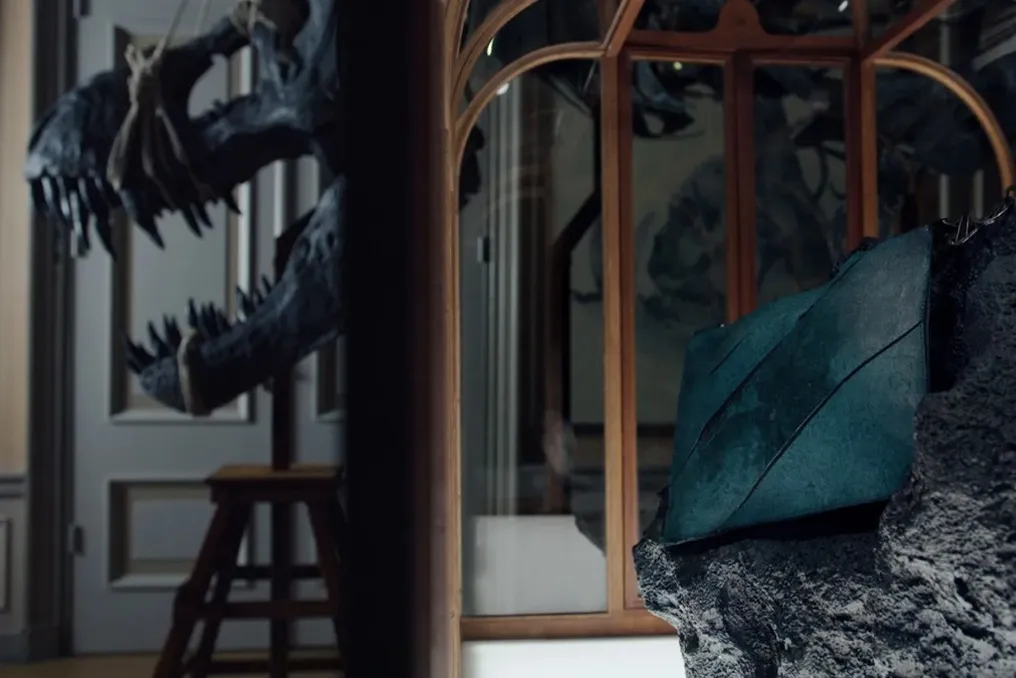
A bag that promised to revolutionize the leather market, created in a laboratory using collagen from a T. rex fossil, failed to sell at auction despite its promise of innovation.
A bag that promised to revolutionize the leather market, created in a laboratory using collagen from a T. rex fossil, failed to sell at auction despite its promise of innovation.
The T. rex, an iconic figure from Jurassic Park movies, has been extinct for 66 million years. In April of this year, the fashion market presented an intriguing item: a bag called 'tyrannosaurus leather.' Although it might have seemed like a fake or an AI-generated image, the news was true; the material was a cellular reconstruction of the dinosaur's skin, not a direct use of fossils.
The techwear brand Efin Levé developed the piece through an extensive scientific process. The team began work with fragments of collagen protein preserved in a T. rex femur fossil discovered in Montana, USA. It is important to note that the process did not use the dinosaur's DNA, as this molecule does not survive for tens of millions of years.
Researchers employed computational biology methods and artificial intelligence modeling to fill in the gaps in the collagen, establishing an estimate of the original genetic sequence of the protein. To aid in this reconstruction, known protein structures from other animals were used as references, notably those from chickens, considered closer relatives to dinosaurs.
This reconstructed sequence was synthesized in a laboratory environment and introduced into host cells, which then produced the collagen, resulting in the material known as 'T. rex leather.' This product is manufactured from these cells, eliminating the need for plastic (as in synthetic leather) and removing the need for animal slaughter, while promising durability and composition similar to traditional leather.
However, the main controversy does not lie in the quality of the material, but rather in scientific uncertainties. Although the bag was produced based on collagen fragments from the fossil, some experts question the certainty that these proteins are genuinely from the dinosaur, given that it is highly unlikely they survived for more than 60 million years. One hypothesis suggests that the structures found may belong to organisms, such as bacteria, that colonized the bones over time.
Additionally, other scientists argue that, due to the small size of the preserved collagen fragment, a large part of the material called 'tyrannosaurus leather' actually derives from proteins of other animals used to recreate the genetic sequence.
Despite the scientific reservations, the piece was promoted as the 'world's first product made from T. rex leather' and classified as a 'unique luxury bag.' The initial expectation was to raise hundreds of thousands of dollars, with the bag valued between US$ 350,000 and US$ 580,000 (approximately R$ 1.8 million to R$ 3 million). An auction was held in Paris specifically for the sale of the item in June. However, buyer response fell far short of expectations; the highest bid registered was only US$ 170,000, and the bag ended up without a buyer.