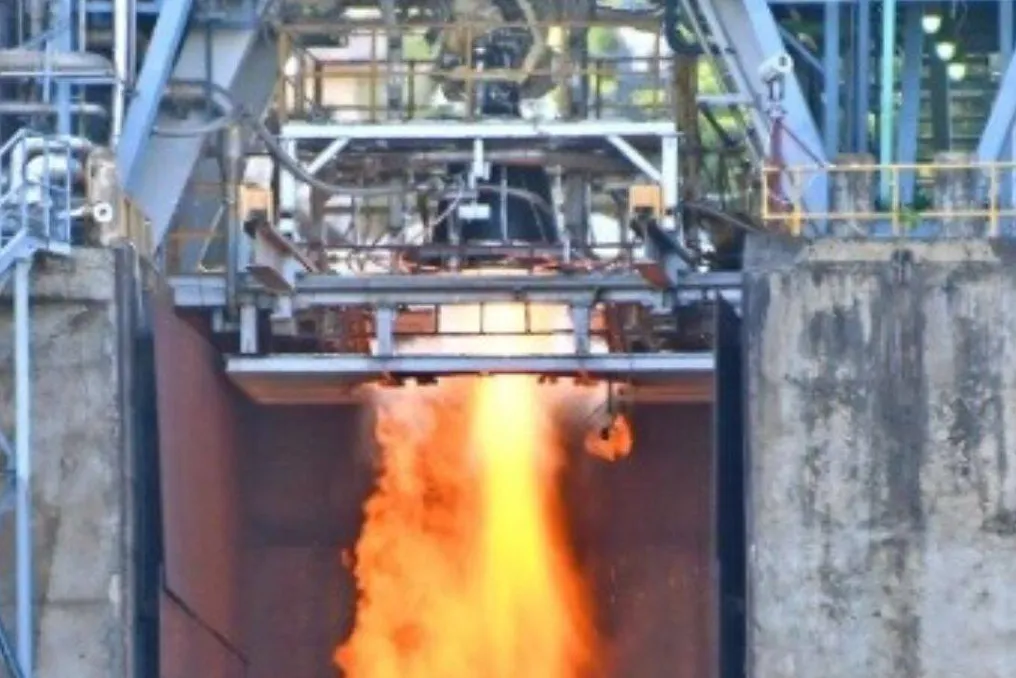
The Indian Space Research Organisation (ISRO) has completed a hot fire test of the indigenous cryogenic engine CE20, which will power the upper stage of the next LVM3 launch, designated as LVM3-M7.
Although ISRO has not yet specified the exact date for the LVM3-M7 mission launch, the latest test was conducted on July 6th at the ISRO Propulsion Complex in Mahindragiri. This test marked the first instance where the space agency utilized the newly developed Nozzle Protection System (NPS) during a flight acceptance test. ISRO reported that both the engine itself and the new system demonstrated satisfactory performance, allowing work to commence on repairing the engine and integrating it with the C32 cryogenic stage, which is being prepared for the mission.
During the tests, the engine operated at a thrust of 19.5 tonnes for 45 seconds, after which the power was increased to the maximum nominal thrust of 22 tonnes for an additional 25 seconds. According to ISRO data, the results confirmed that both the engine systems and the NPS are functioning correctly.
The CE20 engine is used to power the cryogenic upper stage of the LVM-3—India's heaviest operational launch vehicle. This engine was developed domestically and is capable of operating within a thrust range of 19 to 22 tonnes. It has already participated successfully in eight consecutive LVM-3 missions, including Chandrayaan-2 and Chandrayaan-3, as well as three commercial launches. Furthermore, the engine has undergone human reliability qualification necessary for participation in the Gaganyaan program, India's first crewed flight mission.
ISRO explained that the new Nozzle Protection System was developed to enable testing of the CE20 engine, equipped with a full area ratio nozzle, under sea-level conditions. Previously, such tests required the use of complex high-altitude test stands to simulate near-vacuum conditions where upper-stage cryogenic engines operate. The new system simplifies these procedures, reduces the resource requirement for engine testing, and allows for longer duration tests. The agency had previously developed and tested the NPS on a qualification engine across multiple test campaigns before using it in the flight acceptance test.
The successful demonstration of this technology is expected to optimize future CE20 engine acceptance tests and support upcoming LVM3 launches, including missions under the Gaganyaan program.