Previously, launching an online business required hiring a developer, waiting weeks for a website to be built, and spending funds that many small and medium enterprises (SMEs) could not afford. Today, a business owner can describe their idea in simple language and receive a functional website by the end of the day.
The Significance of India's SME Sector
This shift is hugely significant because India's SME sector accounts for over 31% of the country's GDP, contributes nearly 49% of exports, and supports more than 320 million jobs. For such a large segment of the economy, the question of who can have a digital presence and under what terms carries serious economic implications.
Nevertheless, most Indian SMEs still rely on social media pages or listings on third-party marketplaces instead of owning their own web presence. The reasons are clear: a professional website traditionally meant engaging developers, working with unfamiliar platforms, configuring plugins, and waiting weeks for a functional result. For a small business owner already facing financial and time constraints, this was often an impractical expense. In such cases, a social media page seemed free, instant, and sufficient.
However, 'good enough' has its limitations. A business existing only on Instagram or a marketplace does not control its presence. It cannot dictate how its work is presented or how customers interact with it. One algorithm update or policy change can cause visibility to vanish overnight.
The Evolution of Website Builders
Tools available to small businesses have been constantly improving. Platforms like Wix, Squarespace, Shopify, and WordPress gradually lowered the barrier to entry: templates replaced custom code, drag-and-drop editors eliminated the need for developers, and monthly subscriptions replaced high upfront costs. These platforms have truly helped millions of small businesses go online and continue to provide support.
The newest generation of AI-based tools goes further. Instead of requiring the business owner to choose a template, configure a layout, or manually connect a payment gateway, they generate a complete, working website based on a simple text description. According to a 2026 Vi Business study, 57% of Indian SMEs consider AI an important driver for business growth, and about a quarter have already integrated AI into their operations. Infrastructure appears precisely when small businesses are ready for these changes.
When Website Creation Became a Business Solution
An example of this category's development is Hostinger's AI Builder. The business owner describes their activity in simple language or in one of more than 80 languages, including Hindi, Bengali, Tamil, and Telugu, and the tool creates a complete website, including code, file structure, and backend, based on this description. There is no need to set up templates, install plugins, or consult a developer. Plan costs start from 609 rupees per month.
The possibilities opened up afterward expand rapidly. Within the first 30 days, most users who created a website for the first time move beyond the basic resource: payment integrations are activated, Razorpay and UPI support allows Indian companies to accept payments immediately, and backend features like user login and data storage are added through simple prompts. The range of what SMEs can create reflects how much the definition of a website has changed. Booking and appointment systems, product catalogs with checkout, customer portals, inventory trackers—tools that previously required a developer and a significant budget are now available to the user from day one.
It is important to understand what AI website builders are suitable for. Businesses that require highly customized applications, complex integrations, or enterprise-level solutions will likely still need developers or specialized agencies. AI-generated content, especially for legal documents, SEO, and accessibility, needs human verification before it can be fully relied upon. However, for many SMEs whose main need is a reliable and functioning digital presence, these tools have radically changed capabilities.
Creation in Native Language
For entrepreneurs in second and third-tier cities, the barrier to going online was never purely technical; it was also linguistic. Studies consistently point to regional languages and voice channels as the primary ways many Indian SMEs interact with digital tools, reflecting the reality: a significant portion of business owners think, work, and communicate in Hindi, Tamil, Telugu, or Bengali, not English.
Hostinger's AI Builder supports prompts in over 80 languages, and the entire interface, pricing information, and supporting content are available in Hindi on hostinger.com/in-hi, which was developed after a series of usability tests with Hindi speakers. An entrepreneur in Kanpur or Coimbatore can describe their website in the language they work in, and the AI handles the rest. Furthermore, Hostinger manages a dedicated data center in Mumbai, ensuring high performance of local servers and data storage within the country for Indian customers.
Expanding the Role of AI
Launching a website is only part of the task. For an SME owner without their own marketing or operations team, what happens after launch is equally important. Hostinger's AI agent, named Kodee, performs over 500 administrative tasks on request, including backups, DNS configuration, store management, and billing support. According to the company, by early 2026, it managed 86% of all support requests on the platform.
Five specialized AI agents are also available directly from the dashboard: an SEO consultant, copywriter, marketing planner, legal counsel, and business consultant. Tasks such as keyword research, writing blog posts, email campaigns, privacy policies, and developing pricing strategies, which previously required hiring a freelancer or consultant, can now be solved with a simple prompt. For a solo business owner, this means a significant reduction in the workload that needs to be outsourced.
From Stability to Growth: The Technofet Example
For Technofet, a firm specializing in digital services and maintaining websites for multiple clients, the transition to Hostinger was less about new features and more about recovering lost time. Before migrating, the team regularly faced malware infections and security issues across several client websites simultaneously. Cleaning infections, fixing compromised files, and dealing with fallout consumed hours that should have been spent working with clients. After switching to Hostinger, security problems ceased. The result was clear: 10 to 15 hours were saved weekly, redirecting effort from troubleshooting to development. For a small team, this reallocation of resources is highly significant.
A Two-Person Typography Workshop
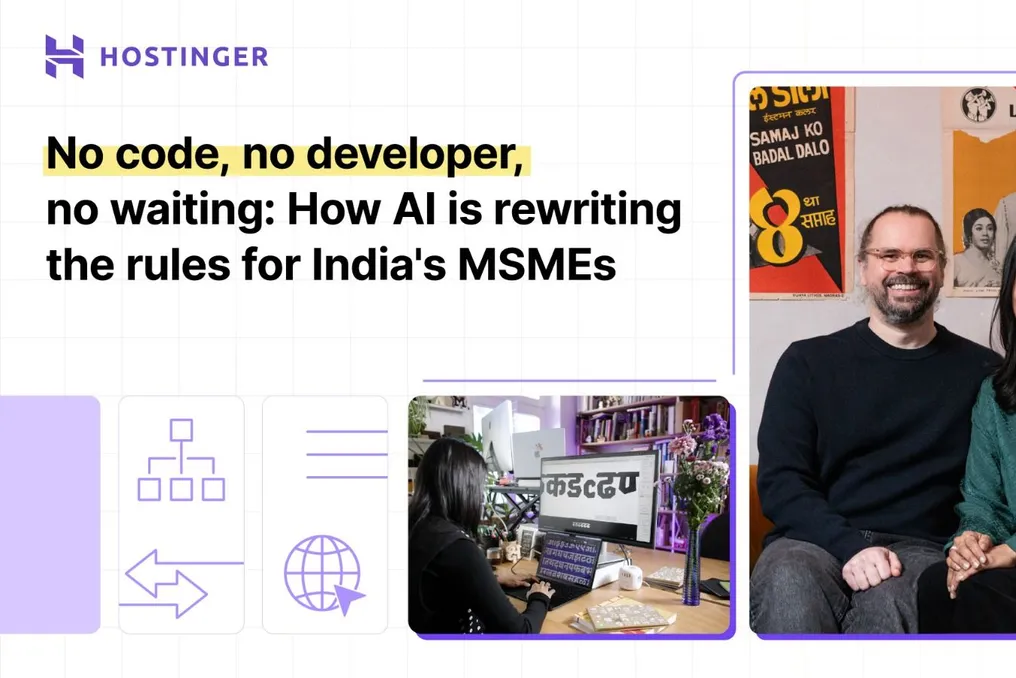
Mota Italic, a typography workshop founded by Rob Keller and Kimya Gandhi, operates as a two-person studio for almost two decades. During this time, they have created a library of 17 font families and 609 individual fonts, and completed 43 custom projects, managing all of this, including numerous websites, through a single Hostinger panel.
Before the switch, the website was a constant source of stress due to downtime, manual fixes, and unexpected failures. This situation changed afterward. Keller noted: 'Now I don't have to worry about the website. It just works.' For Gandhi, who had long postponed creating her own personal website because she considered the process too technical, the availability of visual tools completely changed her attitude toward the process. She said: 'I am glad it doesn't look like something you have to sit down and write code.'
The Inevitable Shift
Indian SMEs no longer face the same challenges they did ten years ago. Going online is no longer a complex undertaking. The question now is how quickly a business can turn an idea into a digital presence that it owns, controls, and can grow upon, without resorting to a developer, a large budget, or a technical team.
The tools are ready. The language barrier is shrinking. The cost barrier has largely disappeared. All that remains is the decision to act.