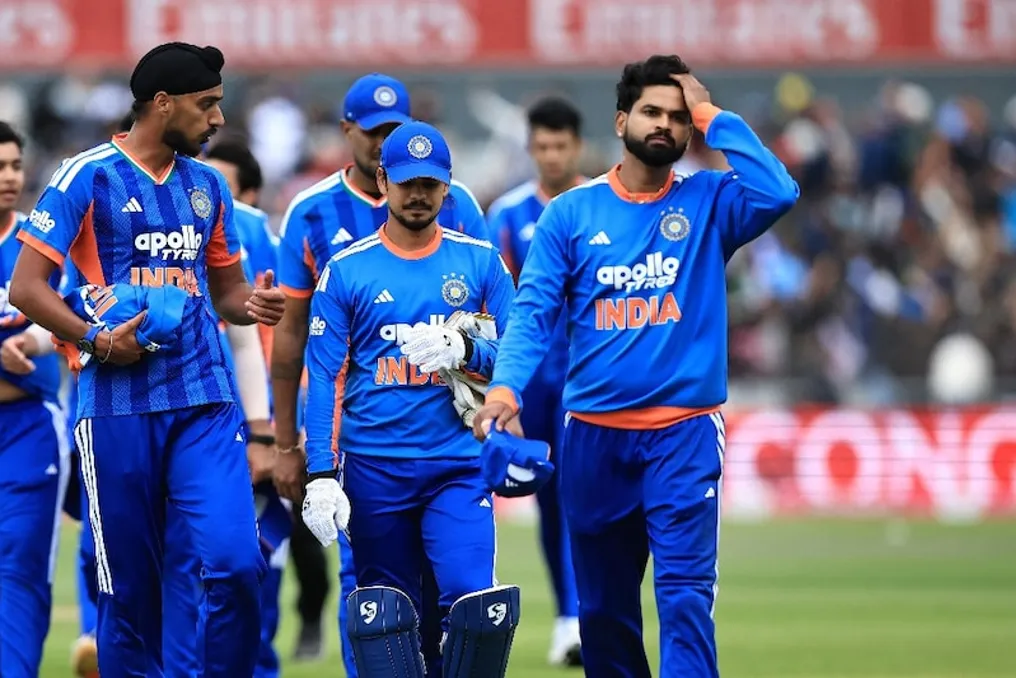

The Indian team, which won the T20 World Cup title just four months ago, is showing a sharp decline in performance. After a series of losses to the Irish team (0-2), the team's problems became evident during their visit to England.
Unsuccessful Matches in England
At Trent Bridge stadium in Nottingham, the team suffered a humiliating defeat against the English national team with a score of 125 points. This result called into question the plan for the Indian team's 'reboot'.
Captain Shreyas Iyer described the batsmen's performance in Nottingham as 'extremely poor and unacceptable'. Meanwhile, head coach Gautam Gambhir had previously stated that the current changes were part of the 'reboot' process. However, observers are questioning whether this is truly a period of transformation or if the Indian T20 team is losing its former identity.
Changes in Squad and Strategy
Many changes were made to the Indian team's squad after the 2026 T20 World Cup. Shreyas Iyer took over the captaincy from Suryakumar Yadav, and experienced players like Hardik Pandya and Jasprit Bumrah are no longer in the squad. Gautam Gambhir aims to form a new team, but constant defeats cannot be attributed solely to squad changes. The Indian team wishes to continue playing in an aggressive style that brought them victory in the World Cup, but the current squad lacks both the experience and the ability to handle complex situations.
Problems in Captain's Play
Shreyas Iyer's start as a T20 captain has been difficult. As a batsman, he shows insufficient consistency: his scores in the last five matches were 3, 10, 68, 37, and 5 runs. Furthermore, some of his decisions have raised questions. For example, in the T20I match in Nottingham, the decision to send Harshit Rana onto the field before Shiv Dubey was unexpected. This created the impression that the Indian team is constantly conducting experiments in difficult conditions rather than following a clear tactical scheme. Constant changes in batting order can cause confusion regarding players' roles.
Adapting to Playing Conditions
Indian batsmen failed to adapt to the playing conditions in England and Ireland. In the Indian Premier League (IPL), they often managed to play aggressively on flat and batting-friendly pitches. However, in England and Ireland, where seam and spin bowling dominates, this tactic became a problem. Instead of playing according to the conditions, Indian batsmen try to hit powerful shots constantly, leading to frequent loss of runs due to a high-risk approach. Although Ishan Kishan and Abhishek Sharma occasionally showed good performances, they could not provide stability.
Questions Regarding Player Selection
A serious question also arose regarding Sanju Samson and Vaibhav Suryavanshi. Sanju was dropped from the starting lineup after matches with scores of 5, 0, and 1. He was replaced by 15-year-old Vaibhav Suryavanshi, who has so far only managed 14 and 13 runs. Although Vaibhav's talent is undeniable, as he impressed the world with his explosive play in IPL 2026, questions arise about the advisability of bringing such a young player into difficult overseas conditions without sufficient preparation. Discussions continue regarding the decision to drop Sanju, who was a 'tournament player' of the T20 World Cup 2026, after only three unsuccessful matches.
Problems in Incarnation
The lack of sharpness in the incarnation's play has also been noticeable. The impact of the absence of experienced players like Jasprit Bumrah and Hardik Pandya is clearly felt in the team's balance. At Old Trafford, Ravi Bishnoi conceded 60 runs and committed three fouls in the form of no-balls. His performance reflects the current difficulties of the Indian team. Young players are given opportunities, but the lack of veterans in critical moments becomes a burdensome factor for the team.
The Indian team's victory in the T20 World Cup was achieved not only through aggressive batting. The main strength of that team was the ability to change its playing style depending on the circumstances. Back then, the batsmen played aggressively, but in difficult moments, they took responsibility for stabilizing the score. The current team is trying to replicate this strategy of aggressive batting, but it lacks patience and situational awareness.
Gautam Gambhir's decision to prepare India for the future by giving chances to young players and forming a new squad cannot be called a mistake. However, clarity regarding player roles, overall strategy, and selection process is crucial for successful transformation.