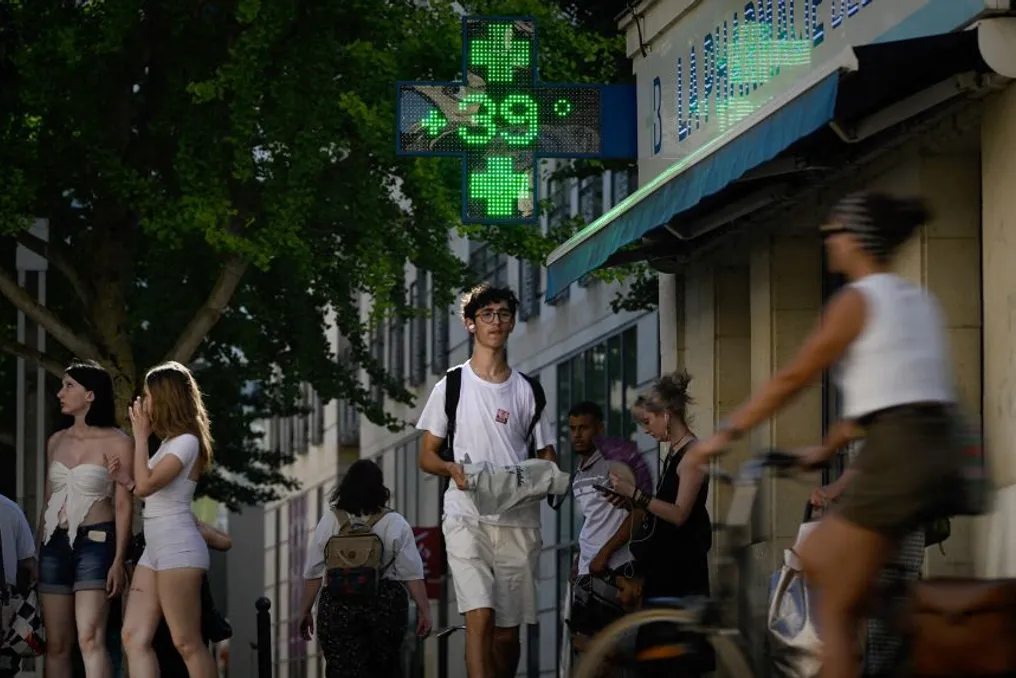
As France experiences another wave of heat, the country has not yet recovered from the previous one. This week, abnormally high temperatures have become frequent again, inevitably raising the question that was repeatedly voiced in June: why doesn't France use air conditioning systems?
Popular
Public Reaction to Heat
Some citizens have started taking action independently. On Thursday, dozens of people gathered near several Lidl stores in the Paris region, hoping to purchase an air conditioner. In the suburb of Aubervilliers, the crowd put so much pressure on the doors that fights broke out among buyers. One visitor told the newspaper Le Parisien that he saw people being trampled, while another added that he was shocked and got pushed from all sides but couldn't leave without an air conditioner.
Current State of Equipment
According to the French Energy Transition Agency, only about 24% of households in France are equipped with air conditioners. This figure has risen from 18% just two years ago, but it still lags significantly behind the approximately 50% observed in neighboring Italy. Alexia, a 26-year-old resident of the Parisian suburbs, said she gave up and bought an air conditioner upon learning about the approaching new heatwave because all available models were sold out.
Problems in Education and Healthcare
Furthermore, only 7% of French schools have air conditioning, and last week thousands of educational institutions were closed due to unbearable temperatures in classrooms. According to health authorities, over 2000 cases of excess mortality were recorded during the peak of the June heatwave over six days, indicating that cultural resistance to air conditioning in France is beginning to weaken.
Historical and Cultural Attitude
For a long time, the French perceived air conditioners as something unsightly, noisy, unnecessary, and above all, American. There is also a long-standing French belief that inhaling conditioned air can cause illness. Instead, traditional French architecture relies on thick stone walls and shutters, which provide passive cooling and coped well during milder summer periods.
Regulatory Barriers and Heritage
This is compounded by regulations. France's reputation for bureaucracy and excessive red tape applies to the installation of air conditioners. In 19th-century buildings that form the silhouette of Paris, residents are often denied permission to install external condenser units because heritage protection rules safeguard the uniformity of the city's roofs and facades, many of which were built during the massive reconstruction of the capital under Georges-Eugène Haussmann during Napoleon III's reign. In the case of jointly owned buildings, approval from the managing company is required, and installations made without such permission may be forcibly dismantled.
Politicization of the Issue Before Elections
With the presidential elections in 2027 approaching, air conditioning has become fertile political ground. The far-right party 'National Union' led by Marine Le Pen has become the loudest advocate for air conditioning, demanding a national 'climate plan' to equip every school and hospital, as well as providing state-guaranteed interest-free loans of $23 billion to help 30–40 million households install these devices.
Disagreements Among Left-Wing Parties
Opinions are divided on the left wing. The 'Greens', traditionally the most skeptical opponents of air conditioning, are changing their stance: party leader Marine Tondelier admitted that cooling is now necessary at least in some schools and hospitals. Jean-Luc Mélenchon, leader of the ultra-left party 'France Unbowed', warned against widespread use of air conditioners, stating that installing them everywhere 'means causing more harm.'
Government Position and Environmental Arguments
The government maintains a middle ground, approving emergency air conditioner installations in hospitals while trying not to appear as if it is abandoning the French approach based on thermal insulation. The intensity of the debate became clear when the 'Greens' filed a motion of no confidence against the government on Tuesday due to its response to the heatwave. Although this motion failed, it demonstrates how deeply politicized this issue is.
Resistance to air conditioners was also presented in an environmental context, based on the assumption that they directly contribute to climate change through energy consumption. However, France's energy balance consists of about 95% of electricity coming from low-carbon sources, with nuclear power providing about two-thirds. Operating an air conditioner from such a grid does not carry the same carbon footprint as in countries like Poland or Germany, where the share of fossil fuels in electricity production is much higher.
Concentrated use of air conditioners can raise urban temperatures due to waste heat. This is a localized phenomenon, different from global warming caused by pollution heating the planet, but it exacerbates inequality between those who have access to air conditioning and those who do not. Environmental activists also argue that the fight has been reduced to a binary choice: air conditioner versus no air conditioner, which focuses the discussion on treatment rather than the root cause.
Nevertheless, for an increasing number of French people, regardless of how they try to individually combat the causes of climate change, dealing with its consequences is becoming a necessity for survival.