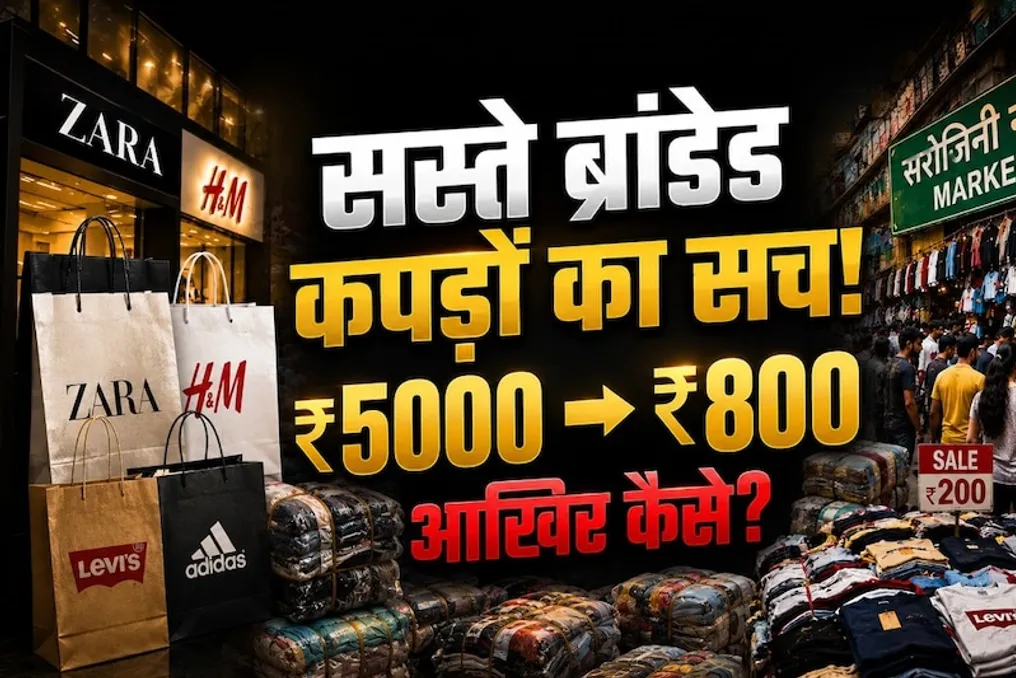
The question arises as to why in Delhi shopping centers such as Sarojini Nagar, Lajpat Nagar, or Gandhi Nagar, jeans that cost 5000 rupees in large department stores can be found for only 800 or 1000 rupees. The initial reaction of most people is to assume that such a low price means a counterfeit. However, the real situation is more complex.
Sources of cheap clothing
Although some items may indeed be counterfeit, a significant portion of the inexpensive clothing is explained by other reasons. Social media often circulates videos and posts claiming that very cheap clothing is sourced from the clothes of deceased people, but currently, there is no credible evidence or official confirmation of these claims. In many cases, cheap clothing represents export surplus, factory remnants, or goods with minor defects sold at a reduced price. Therefore, one should rely only on verified information, not on viral statements on social media.
The role of global manufacturing
It is interesting that this entire process originates not in any specific store or market, but in numerous large factories where products for well-known global fashion brands are manufactured. Every year, thousands of factories in India produce millions of units of clothing, most of which are exported to countries such as America, Europe, and other nations worldwide. This is why India has become an important center of the global apparel industry.
Production hubs
In cities like Noida, Gurugram, Tirupur, Bangalore, and Ludhiana, thousands of factories operate around the clock. Millions of items for international brands, including Zara, H&M, Levi's, Puma, Adidas, and Marks & Spencer, are produced in these factories. After inspection, most of the products are sent to America, the United Kingdom, Europe, and the Middle East. However, here begins the most curious twist of the story that few people know about.
How clothing reaches local markets
Not every item produced is sent abroad. Some items remain in India due to overproduction, export surplus, inventory clearance, or other reasons, and are then supplied to our markets through various supply channels. This is what allows people to buy branded shirts or jeans for half or even less than their actual cost. Shmim Ahmed, owner of the Kanha Collection showroom in Gandhi Nagar, explained how branded clothing becomes affordable in Delhi markets. He stated that if a foreign brand orders 100 thousand T-shirts, the factory sometimes produces 103 or 105 thousand pieces for safety purposes to guarantee order fulfillment, even if some details are rejected during quality control. These excess goods, known as export surplus, can subsequently reach local markets through different channels.
Reasons for price reduction
Another important reason is exceeding the required production volume, known as 'overrun'. Furthermore, when a brand prepares a new collection, old stock is sold off with significant discounts to quickly make room. This stock then ends up in factory outlets, discount stores, or wholesale traders. This is why you can find the same branded shirt or jeans in some places for half the price you saw in a department store several months ago.
Imports from abroad
Yusuf, who runs a shop in Kamla Nagar, notes that not all cheap branded items sold in India are manufactured domestically. Some goods arrive from countries such as Bangladesh, Vietnam, China, Cambodia, Indonesia, Turkey, and Sri Lanka. These countries are major apparel production centers where many international fashion brands conduct their manufacturing. Sometimes, goods for inventory liquidation or authorized surplus arrive from these countries to international traders, which can then reach Indian wholesale markets.
Importation of used clothing
Regarding the import of used clothing from other countries, the situation is more complicated. Many countries around the world have a long tradition of charity and second-hand sales. People in America, the UK, Japan, South Korea, and other European countries often donate or sell clothing they have worn for a short time or after changing styles. Some of this clothing is sold in local second-hand shops, and some is exported to other countries. Nevertheless, India has regulations regarding the import of used clothing, and not every piece of second-hand clothing can be directly put on sale in stores. Consequently, it is incorrect to assume that all cheap clothing in the market is imported and used.
Significance of Delhi markets
Sarojini Nagar is considered not just a market, but a real treasure trove for fashion lovers. Here, you can find trendy clothing, export surplus, clearance items, and various fashion goods in one place. If you know how to bargain, the price can be even lower. Lajpat Nagar is known for quality clothing and ethnic fashion, while Gandhi Nagar is considered Asia's largest wholesale market for ready-made clothing, from which clothing is supplied to many states in the country. The Jafarabad area in Delhi is also known for its wedding attire and lehenga business. In some shops there, you can find used or once-or-twice-worn wedding outfits at a low price, although this is not guaranteed in all stalls.
Importance of caution when shopping
It is extremely important to be vigilant because alongside export surpluses in the market, you can encounter fakes, replicas, and unlicensed products. Many people mistake a brand logo for a guarantee of authenticity, although reality may be different. For quality purchases, one should always carefully examine the seams, fabric, labels, buttons, zippers, and workmanship. One should not trust only the brand name in any store.
Conclusion on pricing
The answer to why clothing is so cheap lies not in one, but in multiple factors: export surplus, overrun, inventory clearance, factory outlets, and the network of large wholesalers. This is why the same type of clothing can have a different price in different places. Next time you see branded jeans for 800 rupees or a branded shirt for 500 rupees, do not rush to assume it is a fake. It might be export surplus, part of a clearance sale, or the result of overproduction at the factory. It is also possible that it is a first copy.