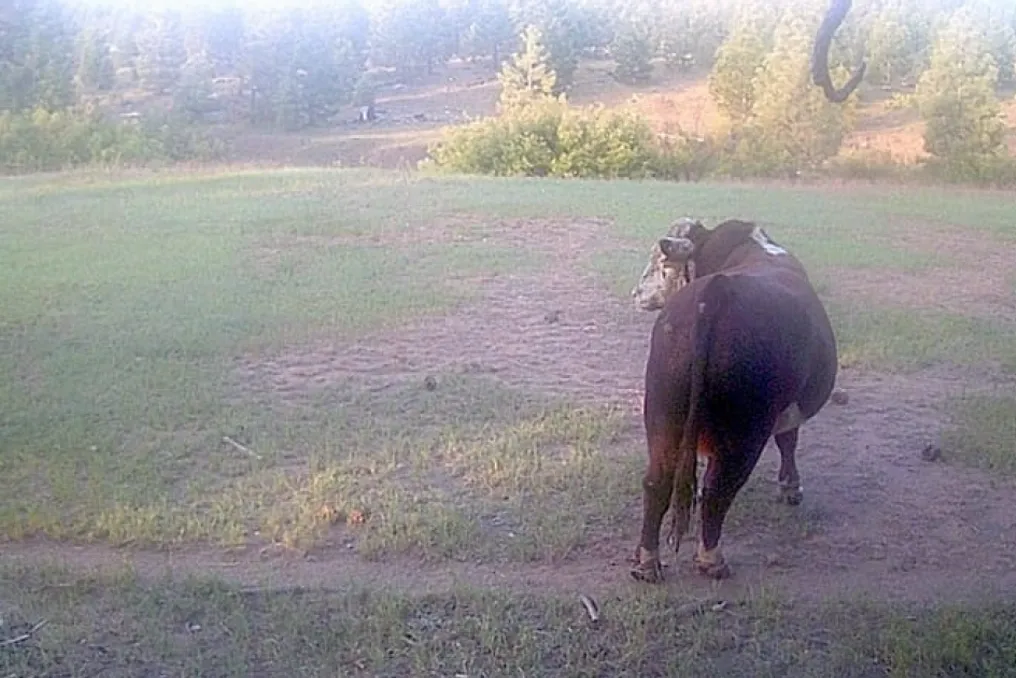
Zoologists analyzed the diet of common wolves from two packs inhabiting California. The study of 98 samples of these predators' scat revealed the presence of cow DNA in 72 percent of cases. Additionally, genetic material from small mammals and black-tailed deer was found in the wolves' feces. Based on biomass calculations, cows constitute at least half of these wolves' diet.
});
Popular
Reasons for Dietary Change
It appears that predators in California are lacking wild ungulates, forcing them to regularly hunt livestock that graze freely from spring to autumn. The results, published in the journal PLoS One, indicate that the coexistence of wolves and humans in California will be extremely difficult.
History of Wolves in the USA
By the mid-20th century, common wolves (Canis lupus) were nearly eradicated in the USA. A significant population survived only in Alaska, and about 750 individuals survived in Minnesota and Michigan. Nevertheless, in recent decades, the wolf population and range in continental states have been growing thanks to conservation and reintroduction programs. Scientific data demonstrates that the return of these predators positively affects ecosystems and even increases human safety, although not everyone welcomes this.
Work of the Research Group
A team of zoologists led by Tina Saitone from the University of California, Davis, confirmed ranchers' concerns by studying the diet of wolves settling in California. These predators returned here in 2011 after almost a century of absence, migrating from reintroduction sites in Yellowstone National Park and Idaho. In 2016, wolf reproduction began in California, and by the end of 2024, there were at least 50 individuals across at least seven packs. Researchers focused on two packs from northeastern California, known as Lassen and Harvey. These packs use territories where ranchers graze cows from May to October, including private properties and leased US Forest Service lands.
Scat Analysis Details
From June to October 2022–2023, Saitone and her staff collected 105 samples of these wolves' scat. Genetic analysis showed that the samples belonged to 20 individuals: 12 females and 8 males. Subsequently, using DNA metabarcoding, researchers identified the prey. The analysis of 98 samples concluded that the Lassen and Harvey packs primarily feed on cows. In 2022, the DNA of these ungulates was found in 86 percent of the scat, and in 2023, in 55 percent. Of the 20 identified individuals, at least 17 (85 percent) consumed cows at least once. Other dietary components included small mammals and black-tailed deer (Odocoileus hemionus). In 2022, their DNA was found in 45 and 38 percent of the samples, respectively, and in 2023, in 60 and 55 percent.
Biomass Proportion Calculation
Summing the data for both years, cow genetic material was present in 72 percent of samples, and black-tailed deer in 45 percent (p < 0.001). Researchers calculated that cows made up at least half of the total prey biomass: 60 percent in 2022 and 50 percent in 2023. The proportion of black-tailed deer was 8 percent in 2022 and 15 percent in 2023, and small mammals was 14 percent in 2022 and 17 percent in 2023. The authors used the average calf weight (181.5 kg) for the calculation, but when using the 2017–2019 estimate (including calves, yearling individuals, and adult females), the average weight of cows in this area was 272 kilograms. In that case, in 2022, cows accounted for 68 percent of the biomass, and in 2023, 65 percent.
Comparison with Expectations
Considering only ungulates, cows accounted for 88 percent of the biomass in 2022 and 78 percent in 2023. Meanwhile, the availability of ungulates to wolves was 93 percent in 2022 and 86 percent in 2023. Thus, the share of cows in the diet was slightly lower than predicted. Predators consumed black-tailed deer more often than expected: 12 percent of the biomass in 2022 versus 7 percent availability, and 22 percent in 2023 versus 14 percent availability (considering only ungulates).
Conclusions on Wolf Behavior
The data obtained show that wolves in northeastern California mainly feed on cows from spring to autumn. Although the study design does not allow for an exact determination of what portion of the eaten livestock died by wolves and what died from natural causes or accidents, researchers believe that in most cases, the predators hunted the livestock rather than consuming carrion. This is supported by recorded instances of wolf attacks on cows and low natural mortality rates of livestock on free pasture. According to scientists, these results are likely applicable to other packs in the state.
Comparison with Other Regions
Saitone and her colleagues note that such a strong dependence on livestock is not typical for North American wolves. In other parts of the continent, these predators usually prefer to hunt various species of deer, including moose (Alces alces). It is assumed that California wolves depend so heavily on cows due to the limited number of large wild ungulates they could feed on, such as black-tailed deer, whose population has been declining since the 1970s. Theoretically, farmers could deter wolves, but with thousands of head of livestock grazing freely over vast areas, this is practically impossible. As a result, it will be very difficult for wolves to coexist in California.