The Chinese humanoid robotics industry reached a critical point in July 2026 when two leading companies chose radically different commercialization strategies that could define the future development of the sector for many years.
The Chinese humanoid robotics industry reached a critical point in July 2026 when two leading companies chose radically different commercialization strategies that could define the future development of the sector for many years.
Unitree Robotics, based in Hangzhou and initially focused on quadrupeds, quickly received approval for an IPO on the STAR Market, raising over $5.9 billion. The company aims to deliver 20,000 humanoid robots annually this year. Their G1 robot, priced from $13,500, caused significant resonance in the global industry.
Thanks to over 30 degrees of freedom, autonomous navigation, and complex grasping capabilities, the G1 is significantly cheaper than competitors like Boston Dynamics Atlas (estimated in the millions per unit) and Tesla Optimus. Unitree's cost advantage stems from its experience as a global leader in quadruped robot manufacturing. By shipping tens of thousands of robotic dogs worldwide, Unitree has optimized Chinese supply chains for reducers, high-density brushless motors, micro-hydraulic systems, and sensors over several generations.
The $5.9 billion from the IPO will be directed towards expanding their superfactory in the Yangtze River Delta and developing their fundamental embodied world-vision-language-action model, WVLA 2.0.
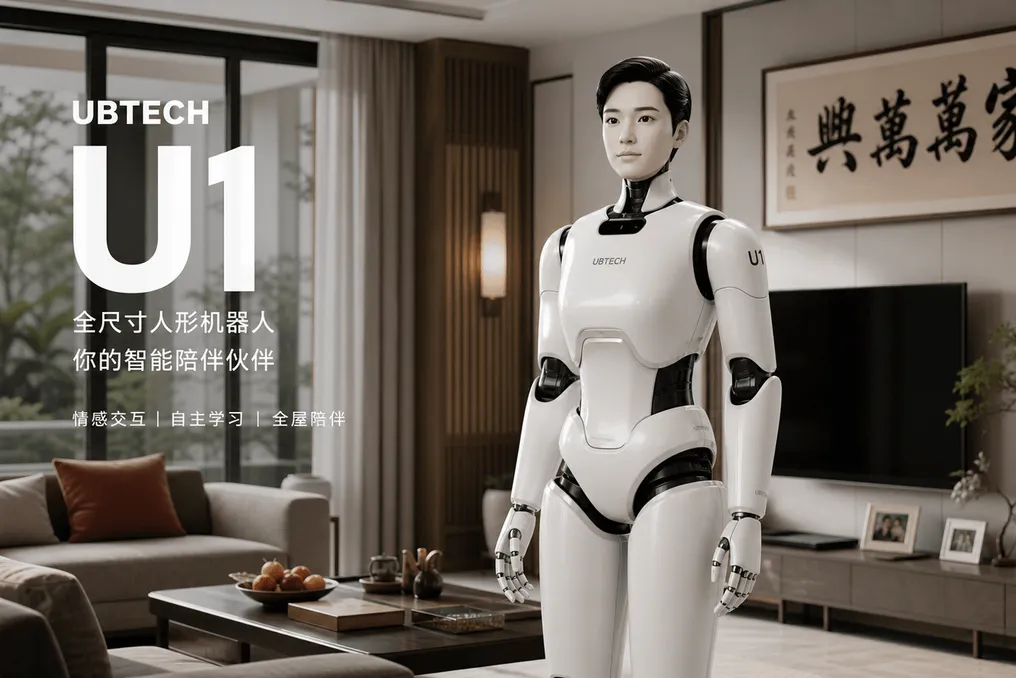
In contrast, UBTECH introduced its YouWorld U1 companion series, distinguished by hyperrealism. The U1 model overcomes the uncanny valley effect through 1:1 scale reproduction of skin pores and subcutaneous blood vessels, and is managed by emotional large language models. At a premium price approaching $140,000, the U1 has already gathered over 13,000 orders from affluent buyers in just a few days.
UBTECH represents a path toward a high-end, emotionally intelligent companion focused on consumer relationships rather than industrial performance.
These two strategies reflect a fundamental contradiction in the commercialization of embodied AI. Unitree follows a Fordist approach, relentlessly lowering costs through supply chain mastery to make humanoid robots accessible for factories, warehouses, and eventually homes. UBTECH, conversely, promotes a concept reminiscent of the Western world, offering ultra-realistic emotional companions to those who can afford them, betting that the emotional connection between human and robot justifies the high price.
Both Chinese companies benefit from the integrated national supply chain that provides motors, sensors, batteries, and computing hardware. The parallel experiments of these companies will provide crucial data on whether the scaling of robotics will depend on price reduction or on the creation of emotional value.
The robotics company UBTECH, registered in Hong Kong, has demonstrated growing consumer interest in emotional AI in China, selling over 5,000 pre-orders for its full-sized humanoid robot U1 in less than three weeks. The launch of U1 on JD.com and Tmall platforms at the beginning of June led to the accumulation of over 5,000 pre-orders by June 21, which is almost five times higher than the company's total sales of full-sized humanoid robots in 2025, amounting to 1,079 units.