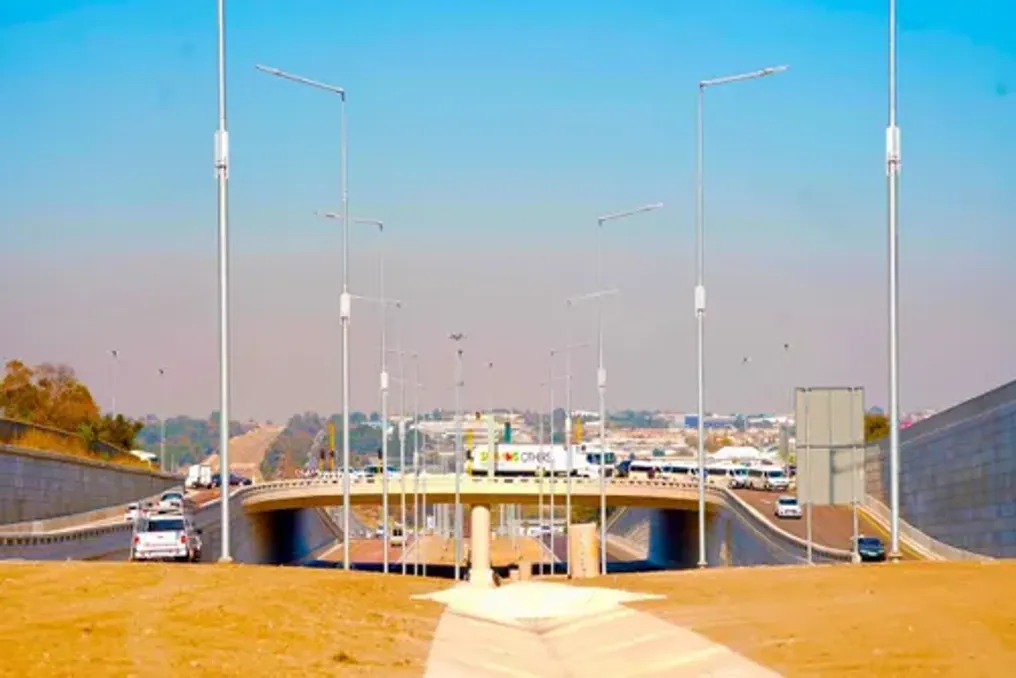
The Gauteng provincial government has officially opened the modernized K101 road, also known as the Old Johannesburg Road. This measure is intended to improve mobility, reduce traffic jams, and strengthen economic activity between Johannesburg and Tshwane.
Premier Panyisa Letsufi formally presented the completed project, calling it a significant investment in the province's transport infrastructure. The Gauteng Department of Roads and Transport reported that the updated route should enhance road safety, reduce travel time, and offer drivers an alternative to the often-congested N1 highway.
This 5.4-kilometer section runs from the D795 road in Midrand to the N1 on Brakfontein road. It serves as a key transport corridor connecting two of Gauteng's largest urban municipalities. The road is used by private motorists, freight carriers, buses, taxis, pedestrians, and cyclists.
Addressing those present at the opening ceremony, Letsufi emphasized that infrastructure development must be accompanied by strengthened measures to protect public assets. He called for expanded video surveillance, stricter law enforcement, and better coordination among government departments to combat crime, vandalism, and damage to public infrastructure. Furthermore, he noted that infrastructure investments must create tangible economic opportunities, especially for youth struggling to find employment.
Gauteng MEC for Roads and Transport, Kedibone Diala-Tlabla, stated that this project demonstrates how strategic infrastructure investments can improve residents' quality of life and support broader economic development. Diala-Tlabla noted that 'the K101 road modernization project is a practical example of how infrastructure can change lives. It is not just about roads, bridges, and traffic lights, but about connecting communities to opportunities, improving mobility, enhancing safety, and supporting economic growth.'
Diala-Tlabla added that continuous investment in transport infrastructure is necessary to support Gauteng's rapid urban growth. Construction began in October 2022 after traffic volumes along this corridor significantly increased. Daily traffic has risen from approximately 20,000 to over 30,000 units, with buses and taxis accounting for nearly a third of this traffic, highlighting the route's importance for public transport users.
According to the Department of Roads and Transport, the completed project includes:
Provincial officials reported that these improvements should ease congestion, improve traffic flow, and enhance connectivity between residential, commercial, and industrial areas. The inclusion of pedestrian walkways, cycle lanes, improved lighting, and modernized traffic signals should also make the corridor safer for all road users.
The provincial government stated that the project brought benefits beyond the modernized infrastructure itself. During construction, 127 community members received technical skills training, and 53 participants completed programs aimed at strengthening small, medium, and micro-enterprises (SMEs). The project also created jobs for local workers and new contractors.
Now that construction is complete, the Gauteng Provincial Government urges residents to help protect the new infrastructure by reporting instances of vandalism, illegal dumping, and any damage to roads or public facilities along the corridor.