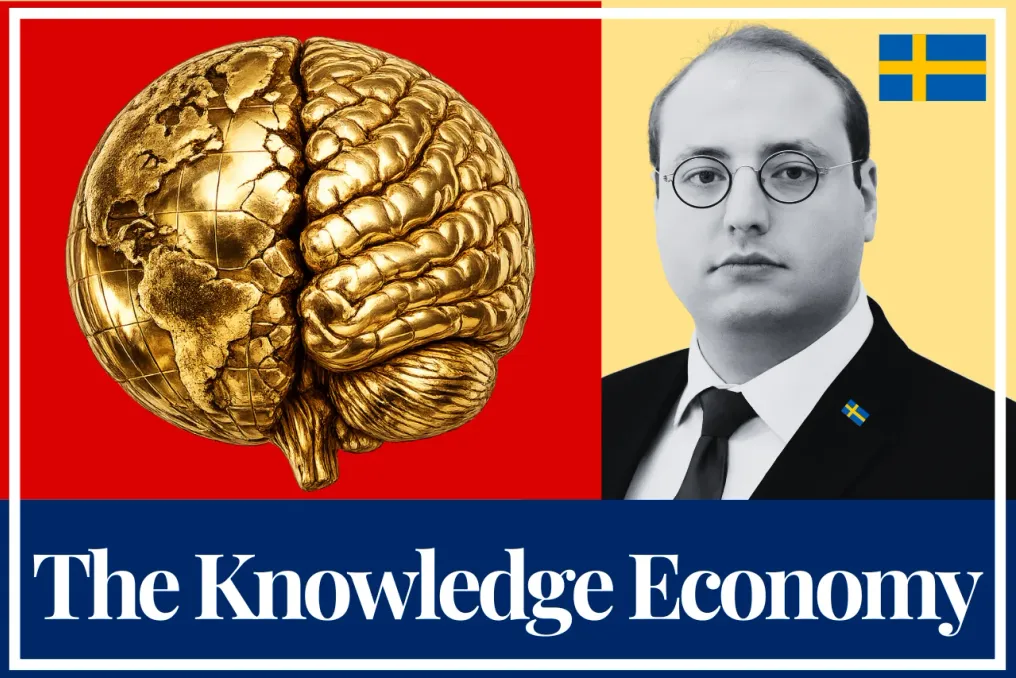
In an exclusive interview, Alex Mattsson, a Swedish academic and international business strategist, emphasized that the defining characteristic of the 21st century is not the presence of raw resources, but the ability of nations to generate, disseminate, and apply knowledge. As global competition intensifies, scientific rigor, intellectual capital, institutional superiority, and innovation become the foundation for sustainable economic development.
Mattsson notes that the knowledge economy has changed the paradigm of national prosperity. Today, those who decisively invest in people, knowledge, and targeted collaboration gain a competitive advantage. He argues that Sweden has become a global model of the knowledge economy because it has viewed knowledge as a vital national resource for decades, focusing on education, research, digital development, and a culture of trust.
According to Mattsson, the central element of Sweden's success is the 'Triple Helix' model—the deliberate interaction between government, academia, and business. In Sweden, these spheres form a dynamic ecosystem where knowledge flows freely from universities to policy development and entrepreneurial activity. This partnership accelerates innovation, strengthens institutional capabilities, and ensures that scientific achievements lead to tangible social and economic results.
Beyond innovation, Mattsson believes that the 'Triple Helix' has strengthened Sweden's resilience. His experience demonstrates that economic competitiveness depends not only on technological achievements or capital investment but also on the level of institutional trust, the breadth of knowledge dissemination, and the alignment of policies, research, and business strategies. He stresses that the most resilient economies are those that constantly learn and adapt.
Addressing world leaders, Mattsson urges politicians to implement long-term strategies based on research, education, innovation, and digital infrastructure, creating conditions that encourage collaboration and data-driven decision-making. University leaders must strengthen ties with industry and government, positioning higher education as a catalyst for learning, entrepreneurship, and innovation. Businesses, meanwhile, must adopt the principle of continuous learning and invest in joint research, understanding that the future depends on intellectual capacity, not just material assets.
As a Swedish academic and international business strategist, Mattsson seeks to spread the principles successfully implemented in Sweden far beyond its borders. He collaborates with governments, universities, enterprises, and communities in Northern Europe, Central Asia, the Gulf Cooperation Council, and worldwide, promoting institutional development, international interaction, and knowledge transfer.
Mattsson also insists that sustainable societies are formed not only through economic policy but also through continuous investment in education, scientific research, leadership development, and human empowerment. The formation of strong communities, environmental responsibility, and a firm commitment to human well-being are equally important. Through international dialogue, leadership training, cross-border cooperation, and trade facilitation, he aims to strengthen institutional resilience.
In conclusion, Alex Mattsson emphasizes that Sweden's path represents a comprehensive model for global development. Based on collaboration, institutional rigor, and strategic foresight, the 'Triple Helix' mechanism shows how governments, universities, and industry can transform knowledge into progress, progress into competitiveness, and competitiveness into shared prosperity. He concludes that the leaders of tomorrow will be those nations that invest in their people, strengthen institutions, embrace cooperation, and recognize knowledge as their most powerful strategic resource.