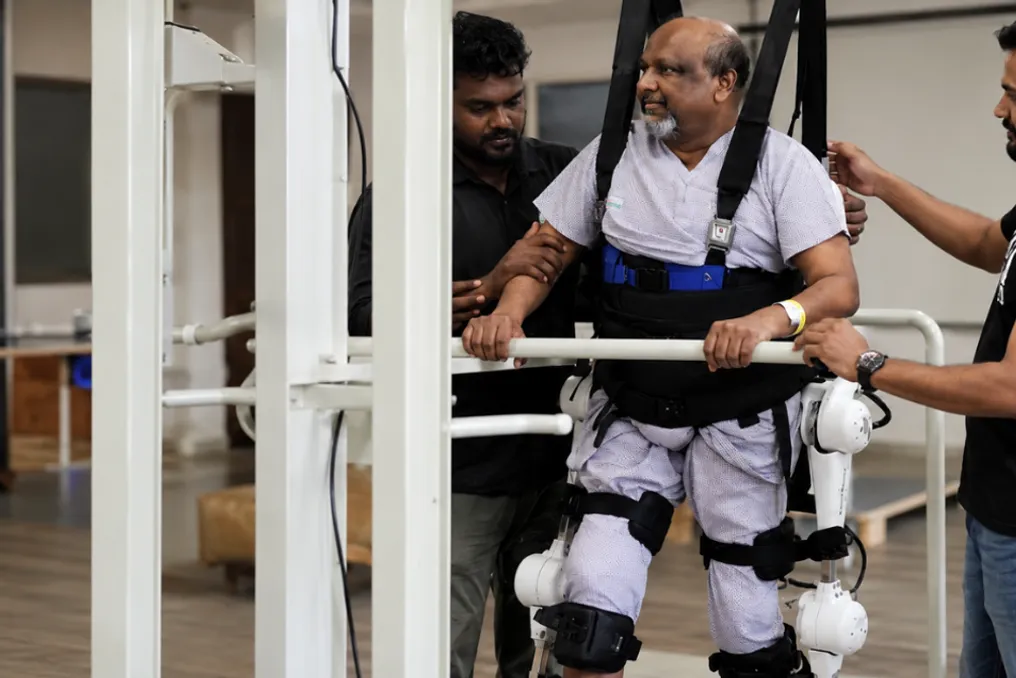
After his grandfather lost the ability to walk following surgery, a young engineer began creating a robotic suit for people in similar situations.
The Device's History
Mohan, a 69-year-old retired engineer from Ernakulam, faced serious difficulties after spinal surgery: he could not move either leg, and both limbs had lost strength. For several weeks, he had to rely entirely on a wheelchair and the help of others.
During rehabilitation at the hospital, a device enveloped his lower body, read his movements, and made his legs move—something neither exercises nor physiotherapy could achieve. Mohan recalls that the device 'initiated walking movement' and allowed him to slowly start moving his legs.
Birth of Astrek Innovations Startup
The machine that helped Mohan take his first steps was produced not in Germany or the USA, but in Kochi by the startup Astrek Innovations. The story of this invention began not in a laboratory, but in a family home in northern Kerala, where the young man watched his strong and active grandfather lose the ability to walk after an operation that was supposed to go well.
Robin Kanattu Thomas, the 30-year-old founder of Astrek Innovations, grew up in Kannur. His grandfather suffered an accident and underwent surgery, and according to all clinical indicators, he should have recovered, but this did not happen due to a lack of proper and prolonged rehabilitation. Robin noted that his grandfather was 'clinically fully healthy to walk, but couldn't due to insufficient rehabilitation.'
Seeking Solutions for India
Robin already had experience working with people with disabilities through his NGO, visiting hospitals and rehabilitation centers. However, after his grandfather's incident, his interest became more personal. He began to wonder how many people lose the chance to walk again because of the high cost or remoteness of necessary technologies.
Co-founders Robin, Alex M Sunny, Jithkin Vidya Ajith, and Vishnu Sankar started spending time in rehabilitation facilities across Kerala. They spoke with stroke patients, people recovering from spinal cord injuries, and others suffering from lower limb mobility impairments. They discovered that solutions existed, but they were inaccessible to most patients in India.
Robotic exoskeletons for rehabilitation are already used in countries such as Japan, Israel, Russia, and the USA. In India, they were almost non-existent, largely because importing a single device could cost between 1.5 to 2 crore rupees, and maintenance and repair support was complicated. Robin emphasized that it was impossible to constantly attract engineers from different countries to fix malfunctions, and there was no adequate after-sales support.
Creating the Exoskeleton in India
In 2018, he founded Astrek Innovations to change this situation. The Astrek device is a lower-body exoskeleton specifically designed for rehabilitation. It is fitted to the user's hips and legs, uses motors to provide movement, and employs machine learning to support the patient's gait pattern.
The team spent six years collecting data on how healthy people sit, stand, and walk. This information was loaded into algorithms that allow the device to anticipate and support movement more naturally, rather than mechanically. Astrek also aims to make the device cheaper and simpler to manufacture. The patented modular design works like Lego bricks, allowing various parts to be combined into a system without needing to build them separately.
While imported exoskeletons can cost around 1–1.2 crore rupees, Astrek prices vary depending on the institution and deal conditions, usually ranging from a few to tens of lakhs depending on customization and service agreements. Robin added that the cost could decrease as production and sales increase.
Most devices are manufactured locally, including batteries; almost all components are made in India. Furthermore, the team modified the mechanical design so that patients do not overly depend on upper body strength, which facilitates the use of the device by the elderly and those with limited arm strength.
The Science of Nervous System Recovery
For rehabilitation specialists, the goal of the exoskeleton goes beyond simply moving the patient's legs. The real task is retraining the nervous system. Dr. Remya Mathew, a consultant in physical medicine and rehabilitation at Rajagiri Hospital, explains that the goal is 'neuroplasticity or brain training, which we are trying to achieve with the exoskeleton.'
According to her, robotic gait training works by repeatedly stimulating the nervous system with walking patterns. 'The repetition of the gait cycle we provide returns these movement patterns to the brain,' she explains. In rehabilitative medicine, repetitive assisted movements are used to help the brain relearn movement after injury. This process is called neuroplasticity, where the brain forms new pathways for recovery.
Dr. Remya continues that gait training and repetitions form new neural connections. The process affects not only the brain but also the spinal cord through so-called central pattern generators, which help coordinate walking movements. 'When done repeatedly, we are trying to induce neuroplasticity in the brain. The gait centers reset and retrain,' she concludes.
Users' Personal Experiences
Pradesh, a 40-year-old network engineer from Thrissur, suffered a spinal cord injury in a bicycle accident in 2011, resulting in paraplegia due to a compression fracture. For years, he searched for solutions available elsewhere but unavailable in India.
He later became one of the first to test an early version of the Astrek exoskeleton. His doctor connected him with the startup's team. Although the prototype was heavier than optimal and required assistance to put on, the experience itself was unprecedented. He noted that previously his daily mobility depended on crutches, requiring upper body strength to move his legs, whereas with the exoskeleton, the situation was reversed.
The first time standing in the machine evoked a strong emotional response: 'I felt that yes, this is the support I need.' Pradesh's story reflects a broader issue in the Indian rehabilitation ecosystem.
Addressing Aging and Accessibility Issues
Astrek is not only focused on spinal cord injuries. Kerala is one of India's oldest regions, and it is expected that nearly 30% of the population will be elderly in the coming decades. This raises the question for families about what will happen when age, illness, or injury begins to affect a person's ability to walk.
Robin's device is designed for five main groups of patients: stroke survivors, patients with partial spinal cord injuries, patients with complete spinal cord injuries, elderly people experiencing reduced mobility, and those requiring age-related rehabilitation. For stroke patients, the device helps retrain motor pathways through repetitive movements.
Dr. Remya emphasizes that the quality of rehabilitation greatly influences long-term outcomes. She asserts that mobility results can differ drastically when using an ideal robotic trainer compared to traditional systems. However, she warns that technology cannot replace a therapist, as the patient's condition changes daily, and the therapist must continuously adjust the treatment.
The main obstacle remains accessibility. Dr. Remya notes that only a very small group of people receives an ideal level of comprehensive neurorehabilitation, and the financial aspect is the primary problem. Moreover, advanced rehabilitation is concentrated in large cities, while most patients remain in villages and semi-urban areas where access to quality care is extremely difficult. Many abandon therapy due to cost, transportation issues, or lack of facilities, leading to rapid deterioration of their condition.
International Development and Social Mission
Currently, Astrek operates in nine rehabilitation centers: seven in Kerala and two in Japan, where the device is used in elderly care facilities in Okinawa. The company has also partnered with the Department of Health in Abu Dhabi for a pilot stroke rehabilitation program and signed agreements with pediatric rehabilitation centers in Dubai and Israel.
In its home country, the company awaits certification from the Central Drugs Standard Control Organization (CDSCO), which will allow for commercial production and sales in India. Currently, it operates under a test license that permits placement in rehabilitation centers. Furthermore, the company's production model includes a social aspect: 15 to 20% of Astrek's work is performed by people with disabilities through manufacturing partners in Kochi, and Robin hopes to significantly increase this share as production expands.