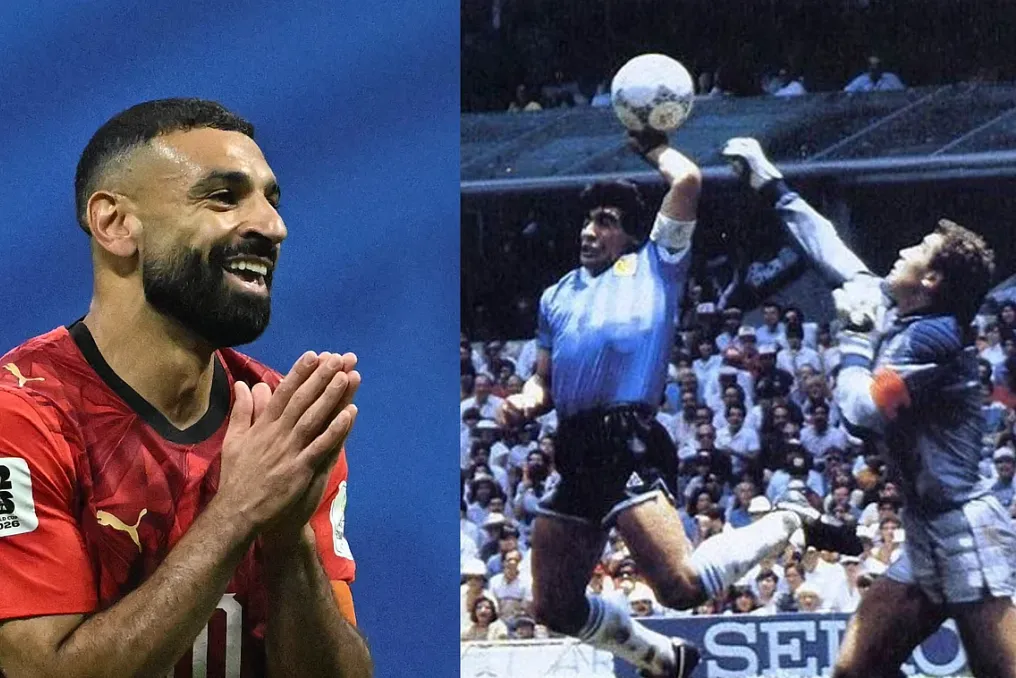
Even the most impartial fans can display fierce patriotism during the FIFA World Cup. The generation of English fans who spent their lives calling Diego Maradona a cheat because of the 'Hand of God' goal at the 1986 World Cup in Azteca rarely raises their voice when experts once again discuss this 'phantom goal' at Wembley.
History of Controversial Moments in England
In the 1966 World Cup final, held at Wembley Stadium between the hosts England and West Germany, Geoff Hurst's shot from close range hit the crossbar and bounced off the line before being cleared by German defenders. The English players celebrated this goal despite uncertainty about whether the ball had crossed the line. Swiss referee Gottfried Dienst also did not see it clearly but awarded the goal after consulting with his assistant referee.
England ultimately won the final, their only triumph in the World Cup, with a score of 4-2. However, the shadow of this 'phantom goal' remains in the history of English football. It is a chapter that no one wants to discuss in English football.
Discussions about Maradona
In England, even mentioning Maradona can spark heated debates about his place among the greatest footballers of all time. How can Maradona be praised as the greatest if he struck the ball with his hand during a header attempt? Tunisian referee Ali Bin Nasser did not see Maradona's hand in this 1986 confrontation and awarded the goal to Argentina. This goal became one of the most iconic moments in football history. Fans in Argentina still celebrate the 'Hand of God,' as Maradona called it, as if it were divine intervention.
But you rarely meet an Argentine who doesn't object to the referee awarding a penalty against West Germany versus Argentina in the final minutes of the 1990 World Cup. Argentines still believe that Mexican referee Edgardo Godosal made a mistake by awarding a penalty for what they consider a legitimate tackle by Roberto Sensi on Rudi Völler. Andreas Brehme scored from that spot, and the Germans won the final, denying Argentina the chance to become the first team to win two consecutive championships since Brazil in 1962. A generation of Argentines is still overshadowed by the sight of a distraught Maradona crying inconsolably at the award ceremony.
Argentina vs. Egypt Conflict in 2026
Let's move to 2026: this stunning return of Argentina against Egypt, ending in a 3-2 victory in the Round of 16, brought tears to millions of Egyptians. And this happened not because their team, which was leading 2-0 until the 79th minute, missed out on the greatest victory in its history. According to Egyptians, the reason for the team's exit was 'unfair' refereeing decisions and the controversial use of VAR (Video Assistant Referee).
Accusations in Favor of a Strong Team
Egypt's coach Hossam Hassan was extremely angry at the press conference after the match when asked about the disallowed goal by Mostafa Zico in the second half. When Egypt was leading 1-0, Zico scored from a devastating counterattack, but VAR disallowed the goal due to a foul by an Egyptian player during the build-up of the attack. Egyptians also claimed that the referees denied them a chance to get a penalty in the 92nd minute after Mohamed Salah fell in the Argentine penalty area. At a tied score of 2-2, the penalty at that moment could have decided the match. However, Julián Álvarez, who pursued Salah, seemed merely to be trying to get the ball while the Egyptian forward fell after light contact, having already lost possession.
South American football expert Tim Vickery from Brazil stated on his YouTube channel: 'Álvarez on Salah is not a penalty, it is not a foul.' Nevertheless, a British journalist from Brazil admitted that in a major World Cup match, the 'big team gets the advantage of doubt.'
The Egyptian Football Association also filed a complaint regarding two decisions, as Zico, whose goal was disallowed, even accused FIFA of favoritism towards Argentina. However, Alejandro Magdaleno, a veteran Argentine sports journalist present at the stadium on Tuesday, believes that all of this is part of the sport. 'Football history has always been like this. Usually, the winning teams say they did it despite the referee, while the losers claim they lost because of the referee,' Magdaleno told Khaleej Times.
He added: 'The referee made the right decisions, and VAR acted fairly. There was a clear foul on Lisandro Martínez before the disallowed goal with the score at 2-0. And Egypt's complaints up until Argentina's winning goal of 3-2 are unfounded; there was nothing there that could have served as grounds for a foul (against Salah)'.
Opinions on Controversial Moments
Sherouk Zakaria, an Egyptian media professional from Dubai, noted that the inconsistency of the referees was too obvious to ignore. 'We were leading, but in the last 10 minutes everything turned around when Argentina scored three goals. Watching it happen was heartbreaking. It wasn't because of mistakes (from our team), but because of unfair decisions (by the referees),' she stated.
She continued: 'Every time Egyptian players committed a foul, they received yellow cards, but no Argentine player received a warning. The contrast was incredible.' Zakaria said that an entire country was devastated after the defeat. 'People were crying in the Fan Zone (in Dubai) because it was unfair. It truly causes bitterness because we saw injustice in Gaza. I don't want to touch on politics, but that's what it is.' She emphasized that what was seen in the football match was far more significant than football itself, and that people couldn't sleep after the game.
Jorge Ferrari, an expatriate from Argentina living in Sharjah, was able to understand the strong emotions of the Egyptian fans immediately after the painful defeat. 'I can understand their emotions; for them, this is a major World Cup playoff match, it is a historic event for them. As a football fan, I know what it's like to lose a match when you were so close to winning,' he said.
However, he also noted that when a team loses from a strong position, it has to blame someone, and the simplest option is to blame the referee. He suggested that the coaching staff might hide their shortcomings by blaming the referee.
Tactical Errors and Outside View
Ferrari pointed to a tactical error by the Egyptian coaching staff after Lionel Messi equalized the score at 2-2 in the 83rd minute. 'I was glad when Egypt made a mistake by chasing the third goal after the 2-2 score. There were only a few minutes left, and the Argentine players were tired. The Egyptians could have played smarter football to take the game to extra time,' he observed.
He concluded: 'That would have put pressure on Argentina. But they wanted to score the third goal and ended up conceding the third. I think it was a tactical error by their coach.' Unlike Ferrari, Zakaria is not an avid football fan, but her dream of Egypt reaching the Round of 16 was the biggest event of her life. She noted that for Egyptians and Arabs, it was a victory that brought joy during a difficult time, and that this journey ended sadly.
Debates about referees and the role of video technology will continue to be a fascinating topic for neutral observers in football, unless your team finds itself at the center of such decisions. Ivan, a Serbian fan, recalled how controversial goals in Qatar in 2022 turned a football match into a fierce rivalry between countries, saying: 'It is a game involving 22 people. Things can happen like that. Football is Maradona's ball. That's what makes this game so beautiful.'
3.