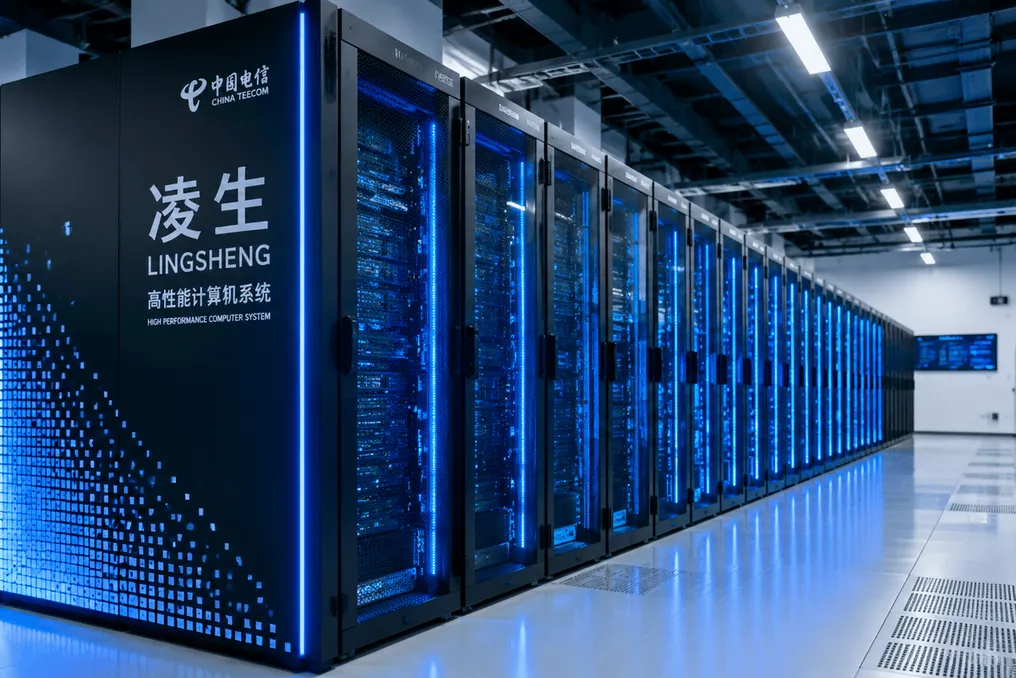
The domestic supercomputer Lingsheng, developed in China, has regained its top spot in the global TOP500 list, achieving a sustained double-precision floating-point performance of 2.19 EFLOPS. This news was announced at the ISC 2026 High-Performance Computing Conference held in Hamburg, Germany, on June 23rd. China's return to the top of the global supercomputing ranking comes after a nine-year hiatus.
China's Technological Self-Sufficiency
The Lingsheng system is built entirely using domestic Chinese processors and components. This marks a significant milestone in China's pursuit of technological self-sufficiency amid ongoing US export restrictions on advanced computing technologies. The performance breakthrough demonstrates that chips designed domestically are capable of competing at the highest level of scientific computing, handling the most demanding tasks in artificial intelligence training, climate modeling, and fundamental research.
Expert Commentary on the Ranking
In connection with this ranking, an interview was conducted with Turing Award laureate Jack J. Dongarra, a professor at the University of Tennessee, who created the LINPACK benchmark used for the TOP500 evaluation. Dongarra noted that China stopped providing data for the benchmark in recent years due to US technology export controls, which led to a gradual decline in its ranking over the past three years. He stated: 'China has already built quite powerful computers,' adding that despite the cessation of official data submissions, publicly available scientific papers detail the architectures and capabilities of Chinese supercomputers, ensuring sufficient transparency for the global HPC community.
Significance of the World Ranking
The TOP500 list, maintained for 34 years since 1993, ranks supercomputers based on their performance on the LINPACK benchmark—the standard for measuring floating-point computing capabilities. Dongarra emphasized that global competition remains fierce, as nations view high-end supercomputers as critical scientific infrastructure comparable to large telescopes or particle accelerators. Such infrastructure allows for the attraction of leading scientists and the conduct of breakthrough research.
Implications of Reaching the Top
China's return to the first place signals the effectiveness of the strategy for developing domestic chips and the continuous viability of the high-performance computing ecosystem. This has profound implications for AI training, climatology, drug discovery, materials modeling, and other computationally intensive fields that determine national competitiveness.