The Euclid space telescope, belonging to the European Space Agency (ESA), has located the two oldest quasars ever observed. These objects date back to a period when the cosmos was only 670 million years old, corresponding to approximately 5% of the current age of the Universe.
Popular
Nature of Quasars
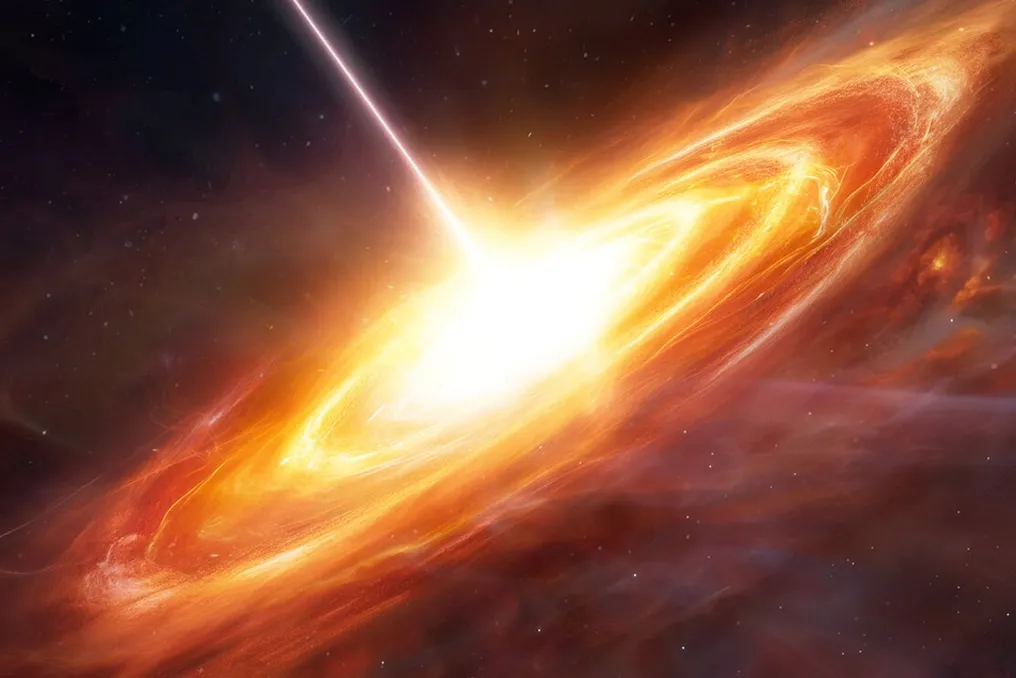
Although the term may sound unusual, a quasar is not classified as a distinct type of star or planet. It represents a galaxy in a very particular phase of its existence. At the center of this galaxy resides a supermassive black hole that is rapidly growing, absorbing vast amounts of gas and dust.
The light detected by Euclid originates from these gases, not from the black hole itself. Before being swallowed, these gases orbit the black hole at high speed, forming an extremely hot disk. The friction in this material raises its temperature to millions of degrees, resulting in the emission of a colossal amount of energy. It is this region, and not the black hole, that generates the characteristic brightness of the quasar.
Intensity and Scientific Implications
In certain situations, this luminous core exceeds the combined brightness of all stars in the host galaxy by hundreds or even thousands of times. The two recently discovered quasars were exceptionally intense, emitting energy equivalent to about one trillion suns each. This discovery, published in the journal Astronomy & Astrophysics, stands out not only for the brightness of these celestial bodies but also for its potential to help answer one of the deepest questions in contemporary astronomy: how could gigantic black holes have emerged so early in the history of the Universe?
Currently, scientists know that almost every galaxy contains a supermassive black hole at its center. The Milky Way, for example, has an estimated mass four million times that of the Sun, while in other galaxies, they can reach billions of times that mass.
The Mystery of Early Growth
The challenge lies in the fact that these giants are not formed ready-made; they grow gradually by accumulating gas, stars, and even other black holes over time. Current theories indicate that this growth process requires a considerable period. The mystery arises because the new quasars demonstrate the existence of massive black holes when the Universe was very young. Just 670 million years after the Big Bang, they had already accumulated enough mass to sustain some of the most luminous objects in the cosmos, a timeframe many astronomers consider insufficient under current models.
Observational and Technological Challenges
Detecting these quasars also presents significant difficulties, given that they are located more than 13 billion light-years from Earth, meaning their light took over 13 billion years to reach our planet. For this reason, we refer to them in the past, as we are observing their state shortly after the Universe's emergence. In addition to the vast distance, the expansion of the Universe itself causes a stretching of the light emitted by the quasars. Instead of being primarily detected in the visible range, this light shifts to the infrared, which has a longer wavelength and is invisible to the human eye.
Due to these limitations, conventional telescopes have difficulty identifying such objects, with many being invisible to instruments focused only on visible light. It was precisely to overcome this restriction that Euclid was conceived. Launched in 2023, this telescope incorporates instruments capable of observing both visible and near-infrared light, allowing for the location of much fainter and more distant objects than those captured by large ground surveys.
Results and Future Prospects
Previously, astronomers could only identify the brightest quasars of the early Universe, comparable to trying to understand a forest by observing only the tallest trees, leaving most of the population hidden. Daming Yang, an astronomer at Leiden University, Netherlands, and lead author of the study, stated that Euclid is a 'true game-changer' in a statement.
The findings confirm this: in just one year of observations, the telescope identified 31 quasars existing when the Universe was less than 770 million years old. Before this survey, scientists knew of little more than a dozen objects from that same era. Antonio La Marca, an ESA researcher part of the Euclid team, also stated in a note that this discovery more than doubles the number of known ancient quasars, representing the first real 'census' of quasars in the dawn of the Universe.
Researchers expect this to be just the beginning. The 31 quasars were located using only the first 18 months of the telescope's observation and a portion of the data Euclid will collect during its six-year mission. By the end of this period, the observatory will have mapped more than a third of the sky, with the expectation of discovering hundreds of other ancient quasars and potentially objects even closer to the Big Bang, contributing to the reconstruction of a poorly understood period of cosmic history.