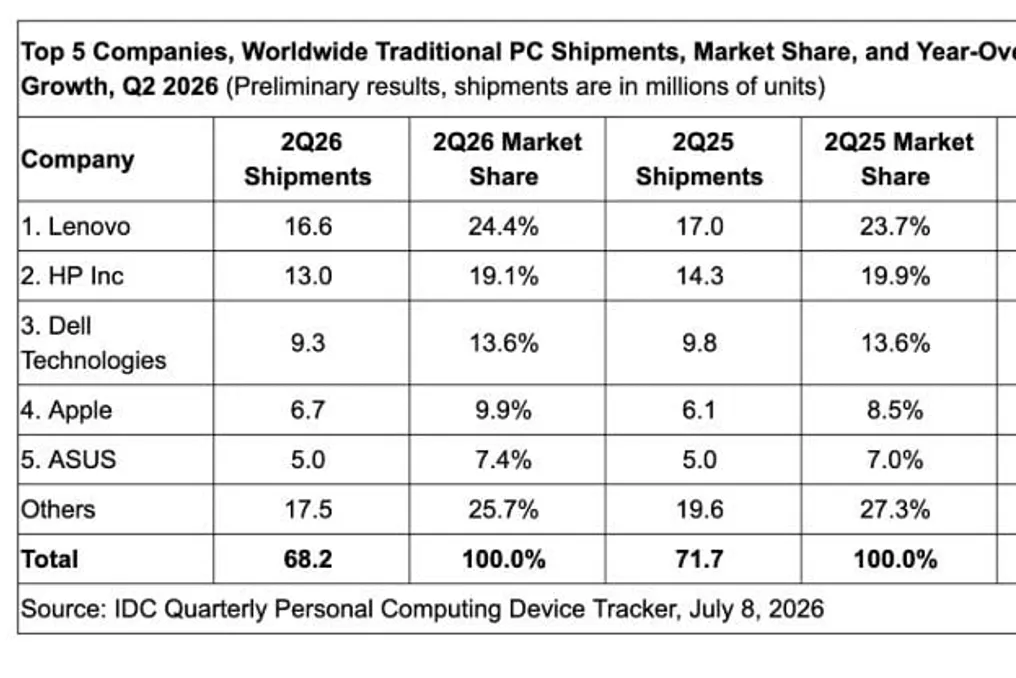
Worldwide shipments of personal computers (PCs) recorded their first decline in two years, interrupting a nine-quarter consecutive growth streak, according to the International Data Corporation (IDC). In the second quarter of 2026, global shipments fell by 4.9%, totaling 68.2 million units.
Popular
Impact of the Memory Crisis
The main cause of this market reversal was the persistent global shortage of memory chips. This scarcity has put pressure on manufacturers, resulting in price increases and decreased component supply. The consultancy expects this situation will only begin to improve in early 2028.
The memory crisis, intensified by the growing demand for artificial intelligence (AI) applications, forced manufacturers to anticipate their inventories whenever possible. Besides memory chips, the availability of other items, such as storage devices, and geopolitical factors also continue to influence the sector. Despite the drop in sales volume, manufacturers' revenue remains high because companies have managed to pass on rising costs to consumers faster than demand is decreasing.
Financial Analysis and Forecasts
Jitesh Ubrani, IDC's director of consumer device research, highlighted the imbalance between units sold and revenue: 'Shipments are falling, but revenue is increasing because manufacturers are passing on price increases faster than demand is decreasing.'
The executive emphasized that worsening macroeconomic conditions and the continuation of the memory shortage make any new inventory anticipation unlikely.
Ubrani predicted that, given the adverse economic conditions and the memory shortage expected to last until 2028, no further rounds of inventory anticipation are expected, signaling a sharp slowdown in growth rates during the second half of 2026. He added that manufacturers are preparing for new price hikes until 2027, and sales channels are already showing apprehension about high inventories under these new cost levels.
Risks to the Replacement Cycle
IDC assesses that the constant increase in costs, driven by the memory deficit, represents a significant risk to the traditional personal computer replacement cycle. Although interest in locally executed AI functionalities on devices continues to grow—driven by high cloud computing costs—higher prices may lead both consumers and corporations to postpone upgrading their equipment.
The consultancy also observed a trend of market consolidation. Large producers, such as Apple, Dell, and Lenovo, are leveraging their operational scale in segments like servers and smartphones to secure memory supply, which hinders competition from smaller companies. Jean Philippe Bouchard, IDC's vice president for consumer devices, commented that 'Market conditions continue to worsen, and the importance of supply chain management and negotiation capability is increasing more and more. Larger manufacturers, with their purchasing power and long-standing relationships with suppliers, are in a better position to gain market share from smaller competitors.'
Apple's Performance Amid Contraction
In contrast to the general market contraction, Apple was the only major manufacturer mentioned by IDC that managed to register growth in computer shipments. In the second quarter of 2026, the company shipped approximately 800,000 more PCs compared to the same period last year, raising its market share from 8.5% to almost 10%. This advance occurred coinciding with the launch of the MacBook Neo.
Bouchard stated that 'Apple's share grew alongside the launch of its latest product, the MacBook Neo, and although the company also increased its prices in line with the rest of the market, it remains well-positioned against competitors facing the same cost pressures.'
Despite the positive result, Apple also felt the impact of rising memory costs. In the United States, the entry price of the MacBook Neo rose from US$ 600 to US$ 700 (equivalent to R$ 3,099.96/R$ 3,616.62). Other models from the company saw even larger adjustments; the basic MacBook Air, for example, now costs US$ 1,300 (R$ 6,716.58).
In Brazil, the MacBook Neo is available starting at R$ 8,499, while the MacBook Air starts at at least R$ 15,999. Tim Cook, Apple's CEO, recently declared that the component shortage is reducing supply at a time of high demand. He emphasized: 'There is less supply at a time when consumers want devices, and memory suppliers are passing on huge price increases. We definitely need memory prices and supply to return to reasonable levels for consumer products.'
Finally, the latest Apple data indicates that the company closed the last quarter with US$ 68.5 billion (R$ 345 billion) in cash, representing a 41% annual increase, and has a market value exceeding US$ 4.6 trillion (R$ 23.2 trillion).