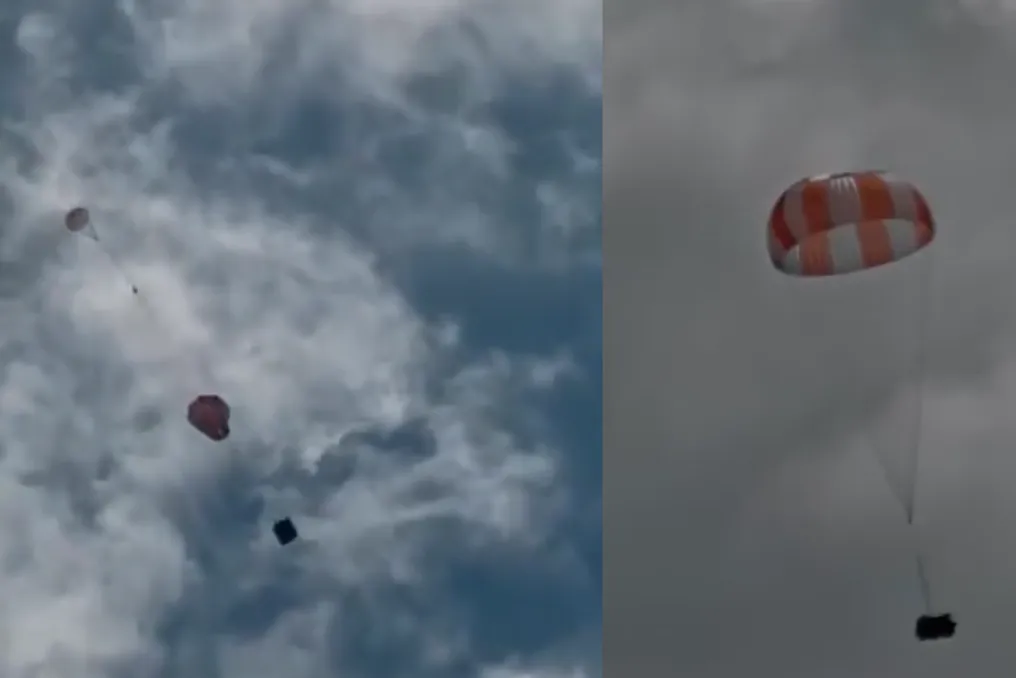
As part of preparations for India's first crewed flight mission, ISRO successfully completed a crucial test of the main parachutes intended for the Gaganyaan program's crew module.
Test Details
The test was conducted on Tuesday at the drop zone of the Aeronautical Development and Research Design Establishment (ADRDE) in Sheopur, Madhya Pradesh. According to an ISRO statement made on Wednesday, the goal of this test was to verify the structural integrity and safety margin of the main parachute under the maximum expected load during the first unmanned Gaganyaan G1 mission.
Deployment Procedure
During the testing, a simulated assembly of one main parachute along with a mass mockup was dropped from an altitude of 2.5 km using an Indian Air Force IL-76 aircraft. After release, a drogue parachute was deployed. These types of parachutes are known for their ability to stabilize the crew module and significantly reduce its speed. Subsequently, the main parachute was deployed, slowing the payload to a safe terminal velocity.
Significance of the Test
ISRO reported that this is the fifth test in a series of Integrated Main Parachute Tests (IMAT) aimed at qualifying the critical main parachute for the Gaganyaan mission. The successful completion of IMAT-05 instills necessary confidence in the performance and reliability of the main parachute system for the first unmanned Gaganyaan mission (G1).
Module Deceleration System
The Gaganyaan crew module deceleration system includes a total of 10 parachutes of four types. The descent process begins with two drogue parachutes that remove the protective cover from the parachute compartment. Next, two drogue parachutes are deployed for stabilization and deceleration of the module. After the drogue chutes are released, three pilot parachutes are deployed, which deploy three main parachutes, further slowing the crew module to ensure a safe landing in the sea.