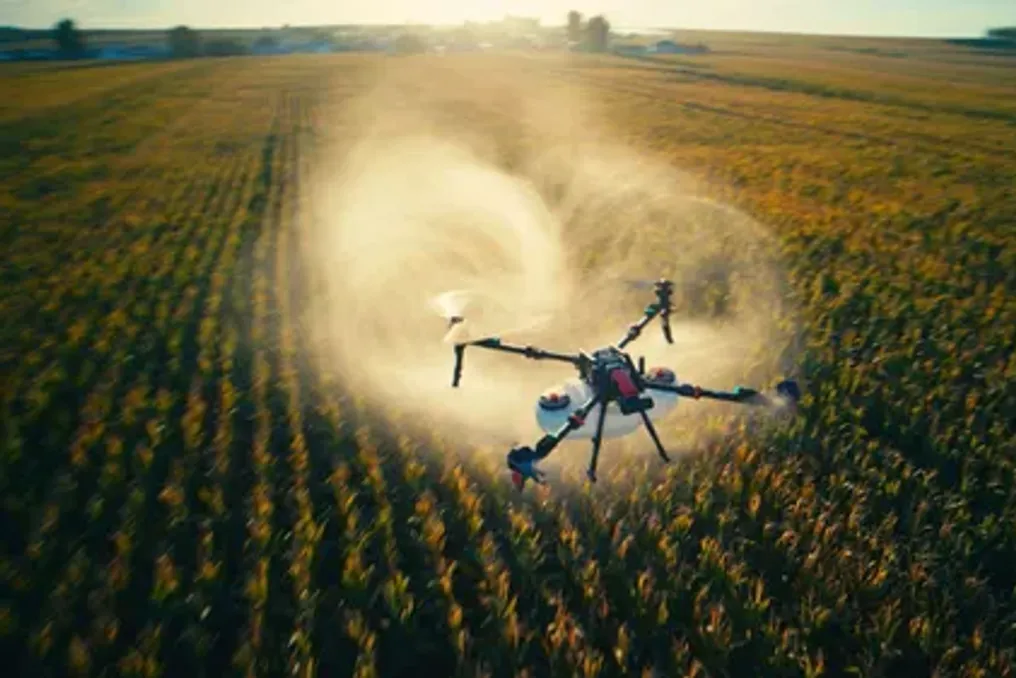
Unmanned autonomous vehicles, or drones, are actively being used across China to optimize and revolutionize agricultural production.
Unmanned autonomous vehicles, or drones, are actively being used across China to optimize and revolutionize agricultural production.
In Liantan village, Huangpu District, Guangdong Province, in southern China, a drone is capable of processing rice fields. In half an hour, it can sow 300 mu (20 hectares) of rice. The entire farm area is equipped with Internet of Things (IoT) devices, including soil sensors, weather stations, and smart cameras, which transmit data to the central 'farm brain' every 15 minutes.
According to Gong Jiacin, co-founder and Senior Vice President of XAG, a manufacturer of agricultural technology robots, one drone can manage 500 mu of land, ensuring fully autonomous cultivation.
In the Xinjiang Uyghur Autonomous Region, approximately 3,000 kilometers from the first example, there is a 3000-mu smart cotton farm from XAG in Juli County. This farm operates silently and without workers; drones patrol the sky, and unmanned aerial vehicles follow set routes, delivering precisely measured amounts of water and fertilizer directly to the roots of each cotton plant.
This project became the first fully autonomous cotton farm in China. When it was launched in 2021, local farmers doubted that two people could manage such a vast area. However, by 2024, the farm achieved an average yield of 529 kilograms of seed cotton per mu, with premium cotton accounting for over 96%.
Gong noted that agriculture has transformed from an experience-based process to a data-driven process, allowing for precise control over the entire production chain. Thanks to this technological support, many young people and graduates returning home have started creating smart farms and engaging in cultivation using drones. XAG has trained over 140,000 specialists in smart agriculture across China.
The system has enabled a 47% reduction in water and electricity costs on rice fields, a 30% decrease in pesticide use, and a 40% increase in fertilizer efficiency. Today, the company's agricultural robots are used in nearly 70 countries and regions, and it ranks second globally in sales of agricultural drones and robotics.