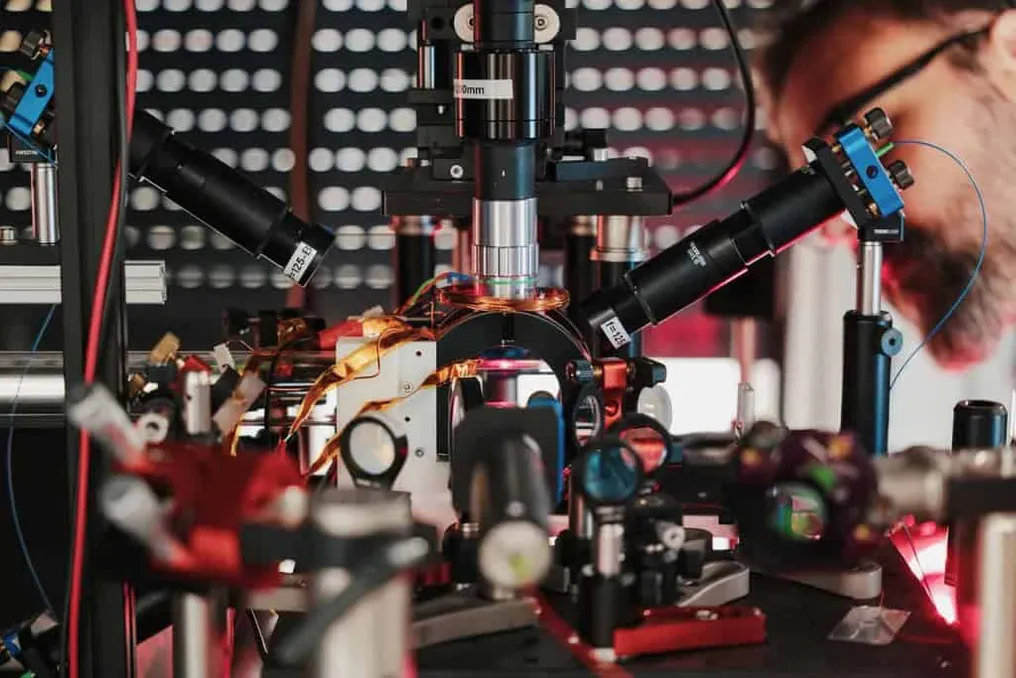
A physicist has experimentally observed the emergence of time from a completely isolated quantum system by constructing what is called a 'mini-universe'. This experiment addresses the fundamental question of how time can exist if the universe lacks external references.
Study and Experimental Methodology
Giovanni Barontini, an experimental physicist at the University of Birmingham, published a new study on June 11th in the journal Physical Review Research. To conduct this unique experiment, he used a cloud of extremely cold atoms to configure his mini-universe. The system was isolated in such a way that, like the universe, there was no external element that could serve as a temporal reference.
Barontini proceeded by dividing the system into two parts and chose to neglect one of them, designated as the 'dark sector,' in order to prove that time could originate entirely internally within the system. The results provide the first practical examination of why the universe possesses the temporal dimension.
Theoretical Context of Time
This work investigates a dilemma that has fascinated the physics community for almost six decades. The Wheeler-DeWitt equation, a cornerstone of quantum gravity—an area dedicated to reconciling Einstein's theory of gravity with quantum mechanics—models the universe as a closed set, without any external time parameter. This raises the question about the origin of our perception of time.
The relational theory of time suggests that time is not a primary property of reality, but rather something that arises from the internal interactions of the universe, where one part of the system acts as a clock for another. However, this hypothesis had never been directly verified in a laboratory environment.
Barontini's inspiration came from a personal observation: he saw his son playing with assembly kits, which made him think that the process was analogous to what occurs in his own laboratories, where they create small replicas of reality using Bose-Einstein condensates.
Construction of the Entropic Clock
To simulate a self-sufficient universe, Barontini confined the condensate in a trap and separated it in half with a thin laser beam. He carefully monitored one half, called the 'bright sector,' while intentionally ignoring the other, the 'dark sector.'
The atoms in the bright sector oscillated periodically within the trap, passing through and returning across the barrier. Barontini named the moments when the atoms invaded the bright sector as 'Big Bang' and the moments of emptying as 'Big Crunch,' a term associated with a theory of the universe's final collapse.
Subsequently, he tracked the transfer of entropy—a metric of disorder or energy dispersion in the system—between the two halves during the passage of the atoms. Instead of relying on laboratory time to sequence the events, he established an 'entropic time,' a clock defined exclusively by the flow of entropy between the two halves of the system: time progressed when there was an exchange of entropy and stopped in its absence.
Surprising Results of the Experiment
The most notable aspect for Barontini was the coherence with which all elements aligned. The internal entropic time organized the events in the bright sector in a predictable manner, mirroring the order observed in the experiment. This work constitutes a practical validation of concepts discussed in quantum cosmology and thermodynamics for decades. Although it is not a categorical statement that time is an illusion, it represents the first time such ideas have been subjected to a quantitative and direct test in a laboratory.