
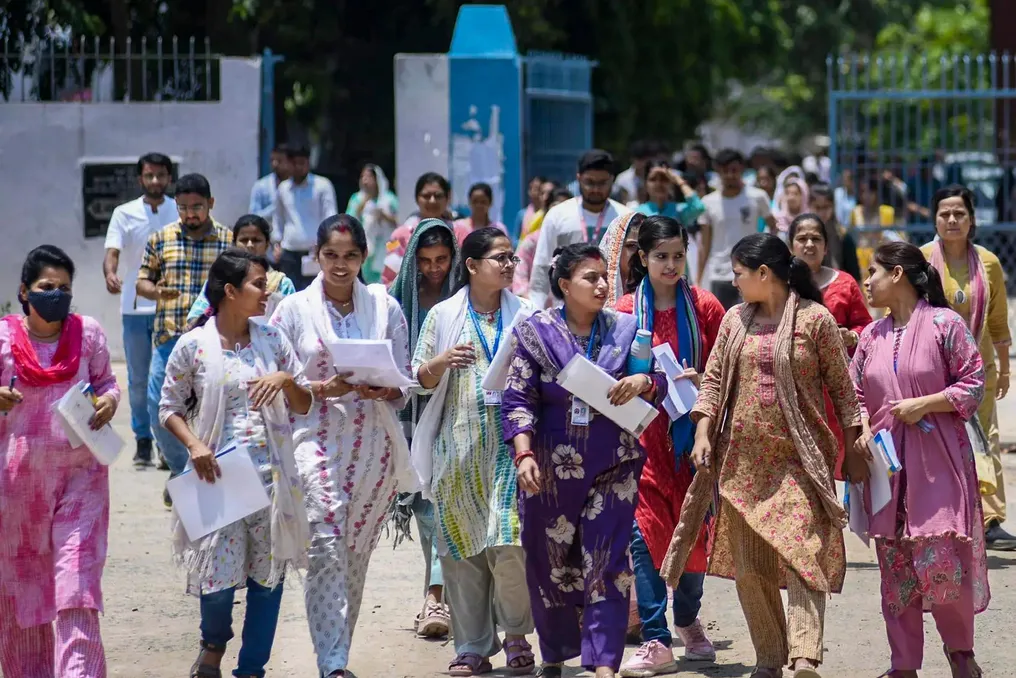
According to the All India Survey on Higher Education (AISHE) report for the period 2023–24, the most significant trend in India's higher education system is not merely the increase in enrollments, but the change in the gender composition of this growth. Women are strengthening their lead over men in terms of educational access.
Gender Ratio Dynamics
Data from the Ministry of Education shows that the Gross Enrollment Ratio (GER) among women reached 31.2%, while it was 28.9% among men. The GER measures the percentage of enrollment in higher education relative to the population aged 18 to 23 years who are eligible to study.
Over the last three years, a noticeable shift has occurred: the GER among women increased from 28.5% in 2021–22 to 30.2% in 2022–23, and then to 31.2% in 2023–24. The GER among men rose from 28.3% to 28.9%, remaining at this level in 2023–24. Thus, the advantage for women expanded from 0.2 percentage points in 2021–22 to 1.3 percentage points in 2022–23 and to 2.3 percentage points in 2023–24.
Enrollment Volume and Structure
AISHE 2023–24 records that 'the GER among women continues to exceed the GER among men for the seventh consecutive year.' Furthermore, the All India Gender Parity Index increased from 1.01 in 2021–22 to 1.04 in 2022–23 and to 1.08 in 2023–24, confirming the sustainability of this trend.
Currently, women constitute 2.24 crore out of a total of 4.50 crore students in higher education, corresponding to 49.7% of the entire system. In absolute numbers, female enrollment increased from 2.07 crore in 2021–22 to 2.18 crore in 2022–23 and to 2.24 crore in 2023–24, meaning an addition of almost 17 lakh women over two years. Meanwhile, the total number of enrolled students grew by approximately 17 lakh over the same period, indicating that women contributed to almost the entire net increase.
Higher Level and Social Groups
The presence of women is more pronounced at higher levels of education. They account for 56.2% of postgraduate students, indicating that they not only enter universities but also continue their studies after the bachelor's degree. Women also make up 50.3% among students from the SC category, 52.3% among ST, and 49.9% among OBC.
Significant progress is observed across social groups: female enrollment from SC increased from about 31.7 lakh in 2021–22 to 33.9 lakh in 2022–23 and to 35.1 lakh in 2023–24. Female enrollment from ST increased from 13.46 lakh to 14.67 lakh, and then to 15.08 lakh, while female enrollment from OBC rose from 78.19 lakh to 85.32 lakh and 90.05 lakh. In percentage terms, this corresponds to an increase of approximately 10.7% for women from SC, 12.0% for women from ST, and 15.2% for women from OBC over two years.
Regional Distribution and Limitations
The regional distribution is also an important aspect: in 2023–24, the number of enrolled women exceeded the number of men in the states of Bihar, West Bengal, Telangana, Kerala, Haryana, Punjab, Jharkhand, Chhattisgarh, and Assam, as well as in Uttarakhand. For instance, in Bihar, 14.0 lakh women were enrolled compared to 13.6 lakh men, and in West Bengal, 12.5 lakh versus 12.0 lakh.
However, this success has caveats. Women demonstrate better results in access, postgraduate education, science, pedagogy, and medical sciences, but they still lag behind in core technical fields. In undergraduate engineering and technology in 2023–24, women accounted for only 31.1% of the total enrolled, a slight increase compared to 30.1% in 2022–23. Thus, although the access gap has shifted in favor of women, the technical gap persists.