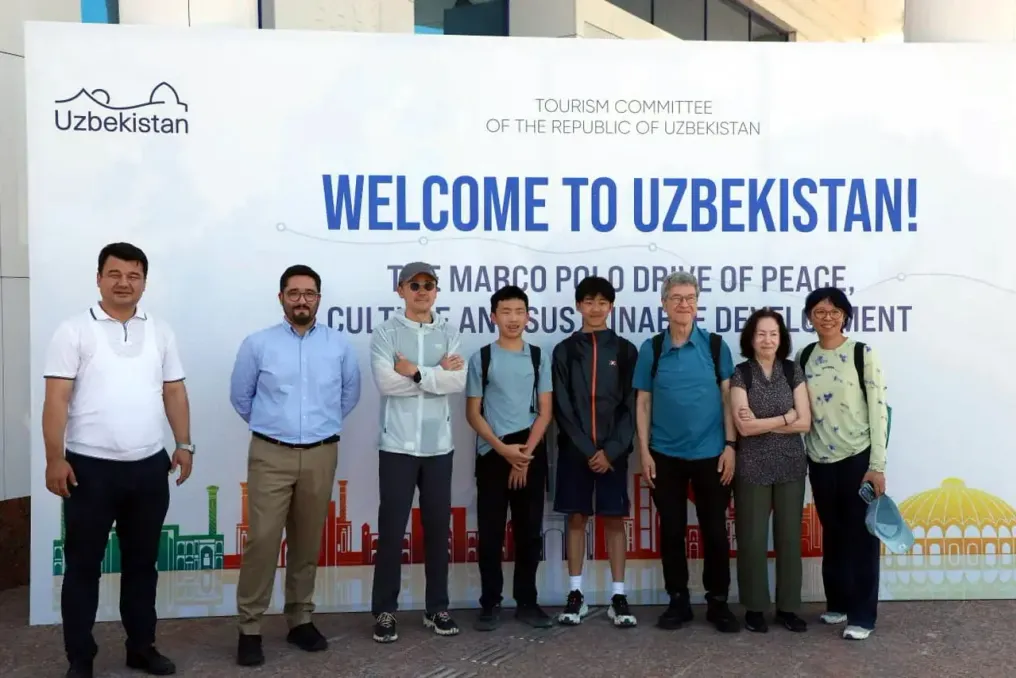
The international expedition titled 'The Marco Polo Drive of Peace,' which exclusively uses modern electric and hybrid vehicles, has officially entered the territory of Uzbekistan.
The international expedition titled 'The Marco Polo Drive of Peace,' which exclusively uses modern electric and hybrid vehicles, has officially entered the territory of Uzbekistan.
This large-scale project combines ideas of sustainable mobility and intercultural exchange while promoting the historical heritage of the ancient Silk Road. The total length of the journey is 15,000 kilometers, and the 43-day trans-Eurasian route started in Rome, Italy, with completion planned in Hong Kong. The inclusion of Uzbekistan as a key segment emphasizes the country's historical significance as a vital crossroads of ancient civilizations and a central hub of the Silk Road network.
During the stage in Uzbekistan, participants plan to visit cities such as Tashkent, Bukhara, Samarkand, Khiva, and Nukus. They will also pass through the Aral Sea region, the city of Muynak, and the Kyzylkum Desert. The detailed travel plan is designed to introduce travelers to the country's outstanding architectural monuments, deep national traditions, unique natural landscapes, and rapidly developing tourism infrastructure.
The international composition of participants adds further global resonance to the project. The team of drivers includes renowned scientists and experts on sustainable development, including the world-famous economist Professor Jeffrey Sachs, as well as foreign media representatives who are documenting the trip to highlight Uzbekistan's vast tourism potential to a global audience.
It is expected that materials related to the trip, including reports and travelogues, will significantly improve the republic's international image, attracting the attention of new consumer markets and increasing the flow of foreign tourists. Furthermore, the expedition serves as a living practical demonstration of the feasibility of green ecotourism and long-distance travel on electric vehicles across multinational corridors. Organizers assert that the project proves Uzbekistan's significant readiness not only for traditional cultural and educational tourism but also for high-potential areas such as road trips, adventure tourism, and ecological expeditions. The implementation of such large international initiatives contributes to the global promotion of Uzbekistan's tourism brand, expands practical cooperation with foreign partners, and accelerates the development of new tourism products that meet the growing global demand for eco-friendly and thematic routes.
Uzbekistan is aiming to occupy a significant position in the growing market of pilgrimage tourism in Central Asia. The republic possesses a unique advantage in the form of rich spiritual heritage, as prominent Islamic scholars and thinkers lived on its territory. The cities of Samarkand, Bukhara, Tashkent, and Termez have long been pilgrimage destinations for religious travelers. Furthermore, Uzbekistan's geographical location in the center of Central Asia and developed air connections make it a convenient transit hub for pilgrims from neighboring countries such as Kazakhstan and Kyrgyzstan. Islamiddin Sirojiddinov, a specialist in diversification management at the Tourism Committee, noted that the combination of spiritual heritage and developed infrastructure opens up good opportunities for the development of this sector. The Umrah Plus concept is being implemented, which allows pilgrims traveling for Umrah to include visits to Uzbek cities before or after their trip to Saudi Arabia.